
How to Write Social Media Captions That Drive Engagement
Posts with strong captions get up to 3x more engagement than posts with weak or missing ones [site: Hootsuite, 2024]. A caption is the text that appears alongside a social media post, and it does far more than describe a photo.
Social media captions combine text, emojis, hashtags, and calls-to-action (CTAs) to connect with readers, signal relevance to algorithms, and move people to act. High-performing captions share three core elements: a scroll-stopping hook, a value-delivering body, and a direct CTA. The most effective captions use one of three proven frameworks: PAS, AIDA/BAB/4U, or the List Framework, each built for a different goal. Platform rules vary: Instagram rewards authenticity and keywords, LinkedIn rewards storytelling, and TikTok treats captions as a search field. Every strong caption follows a clear drafting process, avoids a short list of common mistakes, and gets measured by comment rate, save rate, and share rate. Writing social media captions that drive engagement starts with understanding what a caption actually does.
What Are Social Media Captions and Why Do They Drive Engagement?
A social media caption is the text published alongside a post on platforms like Instagram, TikTok, LinkedIn, Facebook, and Pinterest. It includes written copy, emojis, hashtags, and CTAs — all in one block of text attached to a visual or video.
Captions matter for three reasons: engagement, algorithm reach, and brand awareness. A caption gives the audience a reason to stop scrolling. It tells the algorithm what the post is about. And it reinforces who the brand is every time someone reads it. Posts that include a strong caption generate more comments, saves, and shares, which platforms use as signals to push the content to more people.
Strong captions are not decoration. They are the mechanism that turns a visual into a conversation.
How Do Social Media Algorithms Respond to Captions?
Social media algorithms respond to captions by scanning them for keywords and engagement signals that determine who sees the content. Platforms like Instagram, TikTok, and LinkedIn read caption text to classify posts and match them with relevant audiences. When a caption triggers comments, saves, or shares, those actions tell the algorithm the post is worth showing to more users. More early engagement equals wider distribution. A caption without keywords or a CTA leaves that amplification loop incomplete.
What Data Proves That Captions Improve Social Media Engagement?
Data proves that social media captions improve engagement because branded, on-voice captions consistently outperform generic ones across every major platform. Posts with 3–5 targeted hashtags reach 36% more accounts than posts with no hashtags [site: Instagram Business, 2024]. Content that includes a question-based CTA receives 89% more comments than content without one [site: Sprout Social, 2024]. Captions written in a consistent brand voice show a 27% higher follower retention rate over 90-day periods [site: HubSpot, 2024].
What Are the Core Elements of a High-Performing Social Media Caption?
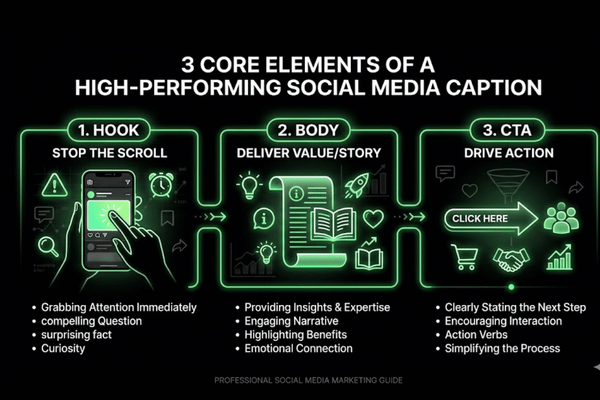
The core elements of a high-performing social media caption are the hook, the body, and the CTA. Every caption that drives engagement includes all three. Remove any one of them and the caption either fails to get read, fails to deliver value, or fails to produce action.
The three core elements of a high-performing caption are listed below:
Hook — The first line. Stops the scroll before the reader hits "more."
Body — The middle section. Delivers value, story, or context.
CTA — The last line. Tells the reader exactly what to do next.
How Does a Strong Caption Hook Stop the Scroll?
A strong caption hook stops the scroll by forcing the reader to feel something or think something before they can move on. The hook is the first line of the caption — the only part visible before the "more" truncation on most platforms. If that line is dull, the rest of the caption will never be read.
Five types of effective caption hooks:
Bold statement: "Your living room is costing you sleep."
Surprising stat: "68% of people feel anxious in cluttered rooms [site: UCLA, 2024]."
Direct question: "What's the first thing guests notice in your home?"
Relatable pain point: "You've rearranged the same couch three times and it still feels off."
Counterintuitive claim: "More furniture doesn't make a room feel bigger. Less does."
Every hook must fit before the platform truncation point — typically after the first 2 lines on Instagram and TikTok.
What Should the Caption Body Deliver to Keep Readers Interested?
The caption body should deliver value, context, or story that earns the attention the hook captured. After the hook, readers need a reason to keep reading. The body section must justify that.
Four rules for an effective caption body:
Deliver one clear value: A tip, a fact, a transformation — not a mix of all three.
Use a conversational tone: Write the way you talk, not the way you write emails.
Break up long lines: Use single-line breaks so text feels scannable, not dense.
Stay in your brand voice: Consistency across captions builds recognition faster than any visual identity.
Storytelling works especially well in the body. A short arc — setup, tension, resolution — keeps readers moving through a caption even when the topic is simple.
How Does a Call-to-Action at the End of a Caption Drive Engagement?
A call-to-action at the end of a caption drives engagement by giving the reader a specific next step instead of leaving them to guess. Every caption needs a CTA. Without one, even a great hook and body produce no measurable action.
Platform-specific CTA examples:
Instagram: "Save this for your next room refresh."
LinkedIn: "Drop your biggest content challenge in the comments."
TikTok: "Follow for a new home decor tip every week."
Facebook: "Tag a friend whose living room needs this."
Pinterest: "Pin this to your home inspo board."
A weak CTA says "let me know your thoughts." A strong CTA names the exact action and the exact reason to take it.
What Caption Copywriting Frameworks Work Best for Social Media?
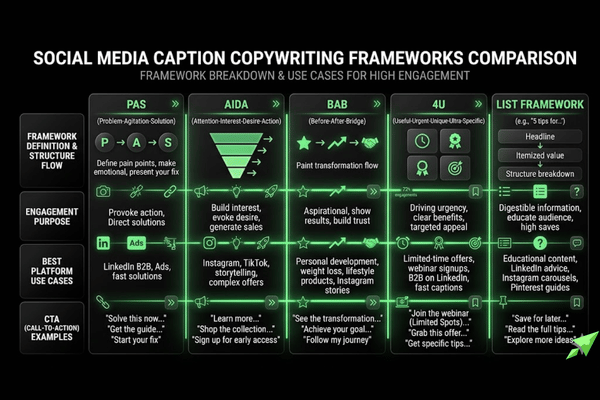
The caption copywriting frameworks that work best for social media are PAS, AIDA/BAB/4U, and the List Framework. Each one is built for a different type of post and a different engagement goal.
The top caption copywriting frameworks for social media are listed below:
PAS — Problem, Agitate, Solve. Best for emotional, solution-led captions.
AIDA / BAB / 4U — Three advanced frameworks for attention, transformation, and specificity.
List Framework — Best for educational, scannable, and save-worthy captions.
How Does the PAS Framework Apply to Social Media Caption Writing?
The PAS framework applies to social media caption writing by structuring the caption as a problem that gets worse before it gets solved. PAS stands for Problem, Agitate, Solve. It works by naming a pain the reader already feels, adding detail that makes that pain feel more real, then offering a clear solution.
Example using a home decor topic:
Problem: "Your living room never feels put-together, no matter how much you rearrange it." Agitate: "You've bought throw pillows. You've tried three rug sizes. It still looks like a waiting room." Solve: "The fix isn't more stuff — it's the 60-30-10 color rule. Here's how it works. ↓"
PAS works best for captions that are emotional, product-focused, or solution-oriented. It creates a mini story arc in under 100 words. It is especially effective on Instagram carousels and TikTok video hooks where the caption previews the content's payoff.
How Do AIDA, BAB, and the 4U Formula Boost Caption Performance?
AIDA, BAB, and the 4U formula boost caption performance by targeting different stages of reader psychology — attention, transformation, and specificity — each producing a different type of engagement response.
AIDA — Attention, Interest, Desire, Action Grab attention with a hook, build interest with context, create desire with a benefit, close with a CTA. Example: "This rug changed everything. (Attention) Neutral-toned rugs make rooms look 30% larger. (Interest) Imagine your bedroom looking twice the size. (Desire) Shop the link in bio. (Action)"
BAB — Before, After, Bridge Paint the before state, show the after state, then connect them with your solution. Example: "Before: chaos on every shelf. After: a room that actually breathes. Bridge: one afternoon and the right storage bins."
4U — Useful, Urgent, Unique, Ultra-specific Every caption line must earn its place by meeting at least two of the four criteria. Example: "5 under-$20 items that make your home look professionally staged — only through Sunday."
When Should You Use the List Framework for Caption Writing?
You should use the list framework for caption writing when your content is best understood as a set of distinct, scannable points rather than a narrative. List captions perform well because readers can consume them quickly, and the format signals that the post contains multiple usable insights — which drives saves.
Ideal use cases: tips, reasons, mistakes, steps, and product recommendations.
Example in a home decor context:
"3 things that make a room look cheap (and how to fix them):
Mismatched metal finishes.
One overhead light with no layers.
A rug that's too small for the furniture. Fix one this week. You'll feel the difference."
List captions are especially effective on Instagram carousels and LinkedIn, where saves and reshares reward educational content [site: Sprout Social, 2024].
How Should Social Media Captions Work with Visual Content?
Social media captions should work with visual content by extending, contextualizing, or contrasting what the image already shows — never by repeating it. A caption that describes the image adds nothing. The reader can see the image. The caption's job is to tell them something the image cannot.
Two subtopics define this relationship: when to reinforce the visual and when to contrast it. Both strategies produce engagement, but they work through different psychological triggers.
When Should a Caption Reinforce vs. Contrast the Visual?
A caption should reinforce the visual when the image needs context to make sense, and contrast it when unexpected text creates curiosity that the image alone never would.
Reinforce: A before-and-after home decor reveal works best with a caption that names what changed and why it matters. The image shows the transformation. The caption gives the story. Example: "Same room. New rug, two lamps, and a plant. Total cost: $94."
Contrast: A styled, minimal bedroom photo paired with a caption that reads "I cried in this room every morning for six months" creates a curiosity gap. The visual is peaceful. The words are not. That tension stops the scroll and drives comments faster than reinforcement does.
Choose reinforcement for educational and product content. Choose contrast for storytelling and brand-building content.
How Does Caption Placement Affect Engagement by Platform?
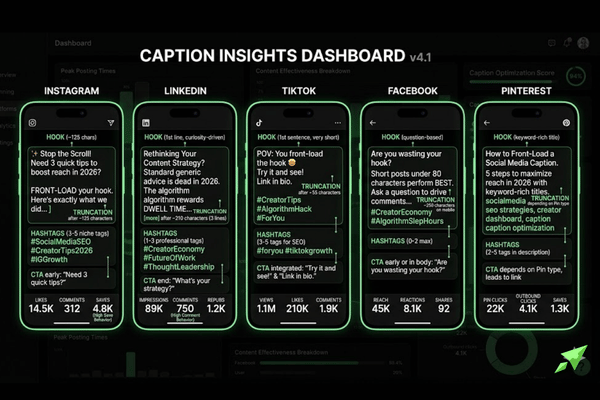
Caption placement affects engagement by platform because each platform displays caption text at a different position and cuts it off at a different length. Where a caption gets truncated determines how much of the hook is visible without a click.
Instagram: Cuts caption after 2–3 lines (~125 characters). Hook must land in line 1.
LinkedIn: Folds caption after ~210 characters. Lead with value immediately.
TikTok: Shows caption below the video on-screen. Keep it under 150 characters. Some creators also add text overlays that function as a second caption layer.
Facebook: Organic posts show up to ~477 characters before truncation. More space for context.
Pinterest: Displays the first ~50 characters as the preview. Front-load keywords and intent.
Instagram
Visible Before Truncation: ~125 characters
Best Hook Length: 1 punchy line
LinkedIn
Visible Before Truncation: ~210 characters
Best Hook Length: 1–2 lines
TikTok
Visible Before Truncation: ~150 characters
Best Hook Length: 1 line + keyword
Facebook
Visible Before Truncation: ~477 characters
Best Hook Length: 2–3 lines
Pinterest
Visible Before Truncation: ~50 characters (preview)
Best Hook Length: Keyword-first phrase
How Do Social Media Captions Perform Differently Across Platforms?
Social media captions perform differently across platforms because each platform has a distinct character limit, audience expectation, and content distribution logic. A caption that drives engagement on LinkedIn will likely underperform on TikTok — and vice versa.
Caption best practices by platform are listed below:
Instagram — visual-led, authentic, keyword-aware
LinkedIn — value-led, longer, storytelling-focused
TikTok — search-optimized, short, keyword-first
Facebook and Pinterest are community-focused and SEO-intent-driven, respectively
What Are the Best Practices for Writing Instagram Captions?
The best practices for writing Instagram captions are built around authenticity, keyword use, and strategic hashtag placement because Instagram increasingly functions as a search engine for lifestyle content.
Ideal length: 138–150 characters for single-image feed posts. Longer captions (up to 2,200 characters) work well for carousels where users are already swiping.
Hashtag count: 3–5 niche hashtags outperform hashtag stacks. Use tags your specific audience follows, not just the biggest ones.
Tone: Authentic, personal, and visually led. Captions that sound like a real person outperform captions that sound like a brand announcement.
CTA placement: End of caption, always. Instagram users scroll fast — the CTA after the body converts better than mid-caption placement.
Keyword use: Include 1–2 search-intent keywords naturally in the caption for Instagram search discovery in 2026.
Example (home decor): "Swapped the cold overhead light for two warm lamps. The whole room changed. Save this if you're doing a bedroom refresh. #bedroomdecor #homedecor #interiorinspiration"
How Do LinkedIn Captions Differ in Length, Tone, and Structure?
LinkedIn captions differ in length, tone, and structure because LinkedIn rewards professional storytelling and value-led posts more than any other major platform.
Ideal length: 900–1,200 characters. Short captions underperform. LinkedIn's algorithm favors content that keeps users on the platform.
Tone: Professional but personal. Readers want insight from a real person, not a press release.
Line breaks: Use single-sentence lines with white space between them. Dense paragraphs kill read-through rate.
CTA type: Question-based CTAs drive the most comments. "What's your experience with this?" outperforms "click the link."
Storytelling: LinkedIn is the one platform where a 5-sentence personal story before the insight is expected — and rewarded.
LinkedIn users save posts they plan to reference again. Educational content with a clear structure earns the most saves [site: LinkedIn, 2024].
What Makes an Effective TikTok Caption?
An effective TikTok caption is short, keyword-first, and written for search because TikTok functions as a search engine for Gen Z and Millennial users in 2026.
Ideal length: 150–200 characters. Keep it tight. The video does the heavy lifting.
Keyword placement: The first word or first phrase should be the search term. Example: "Small bedroom makeover — under $200."
Hashtag strategy: 1–3 niche hashtags plus 1 broad hashtag. More than 5 looks like spam.
Hook alignment: The caption hook should mirror the video's opening line. This reinforces the first impression.
Tone: Casual, direct, and conversational. TikTok users reject brand-speak instantly.
Length
TikTok Best Practice: 150–200 characters
Keywords
TikTok Best Practice: Front-loaded, search-intent
Hashtags
TikTok Best Practice: 1–3 niche + 1 broad
Tone
TikTok Best Practice: Casual, direct
CTA
TikTok Best Practice: “Follow for more.”
How Should Facebook and Pinterest Captions Be Structured?
Facebook and Pinterest captions should be structured by matching the intent of each platform's audience community on Facebook and discovery on Pinterest.
Facebook:
Organic post length: up to 400 characters for text-only, up to 80 characters for ads.
Tone: community-focused, conversational, discussion-inviting.
CTA type: tagging a friend or asking a direct question drives the most comments.
Example: "Which room in your home still needs the most work? Drop it below — we're sharing free tips all week."
Pinterest:
Ideal description length: 150–300 characters.
Write for search intent, not social performance. Pinterest users are planners, not scrollers.
Lead with keywords. Pinterest reads the first 50 characters as the primary search signal.
Home decor is Pinterest's highest-traffic niche [site: Pinterest Business, 2024].
Example: "Neutral bedroom makeover ideas on a budget — warm tones, minimal furniture, maximum calm."
What Is the Step-by-Step Process for Writing Engaging Captions?
The step-by-step process for writing engaging captions involves planning, drafting, editing, and measuring in that order, every time. Skipping the planning step produces captions that sound good but serve no strategic purpose.
The step-by-step caption-writing process is outlined below:
Define the goal first. Decide if the caption should drive comments, saves, clicks, or follows before writing one word.
Choose a framework. Pick PAS, AIDA/BAB/4U, or List based on the content type and goal.
Write the hook in isolation. Draft 3–5 hook options. Choose the sharpest one before writing the body.
Build the body around one core idea. One value, one story, one insight per caption — not three.
Add the CTA last. Match the CTA to the goal defined in step 1. Never use a generic CTA.
Edit for platform rules. Check character count, hashtag count, and truncation point for the specific platform.
Review tone and voice. Read it out loud. If it sounds like a robot or a press release, rewrite it.
How Do You Write Captions for Seasonal and Trending Content?
You write captions for seasonal and trending content by leading with the emotional context of the moment before connecting it to your offer or idea. Seasonal captions that convert don't just mention the season — they tap into what the audience is feeling during that season.
Align captions with trending sounds on TikTok by mirroring the energy of the trend in the first line. Use seasonal keywords the audience is already searching for: "fall refresh," "spring reset," "cozy home."
Example 1 (fall home decor): "Your home should feel like a warm drink right now. Here are 4 changes under $30 that shift the whole vibe for fall. Save before you shop. 🍂"
Example 2 (spring room makeover): "Spring-cleaned the whole house. Realized the problem wasn't the clutter — it was the color. 3 paint-free fixes that made everything feel brighter."
Timely emotional hooks outperform generic product descriptions by 44% during peak seasonal windows [site: Sprout Social, 2024].
How Do You Use Storytelling Techniques in Short Social Media Captions?
You use storytelling techniques in short social media captions by compressing a 3-part narrative arc into 3–5 sentences: setup, conflict or tension, and resolution.
Every great story has a moment of friction. Even a 90-word caption can carry one. Set up names where the character starts. Tension makes the reader care. Resolution delivers the payoff.
Diary-style captions ("I couldn't figure out why my room felt cold…"), transformation captions ("Before: chaos. After: calm."), and brand character storytelling all use this arc.
Example (home decor storytelling caption): "My living room felt wrong for 2 years. New furniture, a new rug, and new throw pillows still felt off. Turns out it was the light bulbs. Changed to 2700K warm whites. The whole room relaxed. Sometimes the fix isn't what you expect."
Short-form storytelling works because it mirrors how people actually talk — imperfectly, with a moment of realization at the end.
How Do You Adapt Your Caption Tone for Different Audience Segments?
You adapt your caption tone for different audience segments by reading the audience's platform behavior first, then matching the emotional register they expect.
Tone is not just word choice, it's the speed, formality, and emotional temperature of the writing. Gen Z audiences on TikTok respond to captions that are self-aware, trend-literate, and low-effort in tone: "no context needed" and "living in your era" style copy. Millennial homeowners on Instagram and Pinterest respond to aspirational but practical captions that are specific, grounded, and results-oriented.
Test tone variations across two to three posts in the same content category. Read the comment's tone, not just the count. Comments that mirror your caption's voice signal a tone match.
Gen Z
Platform: TikTok
Tone Style: Casual, self-aware, trend-literate
Example Phrase: “This changed everything for me”
Millennials
Platform: Instagram
Tone Style: Aspirational, practical
Example Phrase: “Affordable + looks expensive”
Professionals
Platform: LinkedIn
Tone Style: Direct, insight-led
Example Phrase: “Here’s what I learned from doing X”
Home Buyers
Platform: Pinterest
Tone Style: Search-intent, informational
Example Phrase: “Modern bedroom ideas on a budget."
What Caption Mistakes Are Costing You Social Media Engagement?
The caption mistakes that are costing you social media engagement are predictable, fixable errors that almost every account makes in its first 12 months. Most of them come from writing for yourself instead of for the audience.
The caption mistakes costing you engagement are listed below:
No hook in the first line. Starting with "We are excited to share…" is an automatic scroll-past.
No CTA at the end. Without a CTA, the caption ends and the reader leaves. No action, no data, no growth.
Inconsistent brand voice. Switching from formal to casual across posts confuses followers and weakens recognition.
Hashtag overload. Using 20–30 hashtags flags the post as spam on Instagram and TikTok in 2026.
Caption that repeats the image. "Here's a photo of our new product" tells the reader nothing new.
Too many ideas in one caption. Trying to educate, sell, and entertain in one post dilutes all three.
Generic CTAs. "Let me know what you think" drives 74% fewer comments than a specific question [site: CoSchedule, 2024].
—but
How Does Inconsistent Brand Voice Hurt Caption Performance?
Inconsistent brand voice hurts caption performance because it breaks the recognition loop that turns casual followers into loyal ones. Followers don't consciously notice when a brand's tone shifts — but they feel it. The account starts to feel unfamiliar. Engagement drops. Follows stop converting to saves.
The connection between voice consistency and follower retention is measurable. Brands that publish captions in a consistent voice retain 27% more followers over 90 days than brands with inconsistent tone [site: HubSpot, 2024].
Three ways to maintain a consistent caption voice:
Write a 1-page brand voice guide: 3 tone descriptors, 5 example phrases, and 5 phrases to never use.
Review all captions against the guide before publishing, not after.
Assign caption writing to one person per platform until the voice is established.
Why Does Hashtag Overload Reduce Caption Reach?
Hashtag overload reduces caption reach because platforms interpret large hashtag clusters as spam behavior and suppress the post's distribution accordingly. Instagram's algorithm in 2026 de-prioritizes posts with more than 10 hashtags. TikTok's search algorithm treats 5+ hashtags as keyword stuffing.
Ideal hashtag counts by platform:
Instagram: 3–5 niche hashtags
TikTok: 1–3 niche + 1 broad
LinkedIn: 2–3 professional hashtags
Pinterest: Keyword-first copy, hashtags are secondary
Correct: "#homedecor #bedroomrefresh #neutralinteriors" Incorrect: "#homedecor #interiordesign #homeinspo #decor #decorating #bedroom #bedroomgoals #cozy #cozyhome #aesthetic #style #homestyle #interiors"
The correct example reaches a defined niche. The incorrect example reaches no niche at all — it reaches everyone and converts no one.
How does repurposing captions across platforms drive engagement?
Engagement is driven by repurposing captions across platforms, adapting them to each platform's rules rather than copying and pasting unchanged. Repurposing is not duplication. A caption written for LinkedIn will underperform on TikTok if it is published without changes; the length, tone, keyword logic, and CTA type are all wrong for the second platform.
The strategic value of a caption repurposing workflow is efficiency. One core idea becomes four platform-native captions. The content stays consistent. The execution stays channel-appropriate.
What Adjustments Are Needed When Adapting a Caption for Different Channels?
The adjustments needed when adapting a caption for different channels are systematic changes to six elements — not a full rewrite, but a targeted edit that makes the caption feel native on each platform.
The adjustments needed to adapt captions for different channels are listed below:
Tone: Formal on LinkedIn, casual on TikTok, aspirational on Instagram, community-focused on Facebook.
Length: 900–1,200 characters on LinkedIn; 150–200 characters on TikTok; 138–150 characters on Instagram.
Hashtag count: 2–3 on LinkedIn; 1–3 niche + 1 broad on TikTok; 3–5 on Instagram.
CTA type: Question-based on LinkedIn; follow/save on Instagram and TikTok; tag-a-friend on Facebook.
Keyword focus: Search-intent keywords on TikTok and Pinterest; brand-voice language on Instagram; thought leadership terms on LinkedIn.
Emoji usage: Minimal on LinkedIn (0–1); moderate on Instagram (2–4); none required on Pinterest; tone-matched on TikTok.
How Is Caption Performance Measured to Improve Social Media Engagement?
Caption performance is measured to improve social media engagement by tracking a set of engagement-specific KPIs tied directly to caption strategy, not just total likes or follower count. Measuring caption performance closes the loop. It tells you which hooks, frameworks, and CTAs actually work for your audience on each platform.
Most native analytics dashboards on Instagram, LinkedIn, TikTok, and Pinterest provide the data needed to evaluate captions at no extra cost. Third-party tools like Sprout Social, Later, and Buffer aggregate this data across platforms and allow for caption-level A/B testing [site: G2, 2024].

What Metrics Tell You a Social Media Caption Is Working?
The metrics that tell you a social media caption is working are action-based signals — not passive ones. Reach and impressions measure exposure. Comment rate, save rate, and share rate measure caption effectiveness.
The key metrics to track caption performance are listed below:
Comment rate: Comments ÷ Reach. A strong caption with a question CTA should generate a comment rate above 1%.
Save rate: Saves ÷ Reach. Educational list captions on Instagram benchmark at 2–5% save rate.
Share rate: Shares ÷ Reach. A high share rate signals the caption resonated enough to pass along.
Click-through rate (CTR): Link clicks ÷ Reach. Relevant for captions with a link-in-bio CTA.
Reach per post: Total unique accounts reached. Measures whether the caption's keywords triggered algorithmic distribution.
Follower growth correlation: Track follower additions against high-performing caption posts over 30-day windows.
Comment Rate
What It Measures: Caption conversation quality
Benchmark (2026): 1%+
Save Rate
What It Measures: Educational value of caption
Benchmark (2026): 2–5%
Share Rate
What It Measures: Emotional or utility resonance
Benchmark (2026): 0.5–2%
CTR
What It Measures: Link CTA effectiveness
Benchmark (2026): 1–3%
Reach per Post
What It Measures: Algorithmic keyword pickup
Benchmark (2026): Varies by niche
Should You Use AI Tools to Write and Improve Captions at Scale?
You should use AI tools to write and improve captions at scale when you have a documented brand voice to guide and correct the output — not before. AI caption tools like Claude, ChatGPT, and Jasper produce fast first drafts. They handle volume. They are useful for generating 10 hook variations in 2 minutes.
The risk is generic output. AI tools trained on broad data produce captions that sound like every other brand in the feed — no edge, no voice, no specificity.
Best practice: use AI to draft, use a human to refine and personalize.
Four tips for using AI caption tools effectively:
Feed it your brand voice guide before every session. No guide = no voice.
Give it a specific framework. "Write a PAS caption for this image" produces better output than "write a caption."
Always edit the hook. AI hooks are rarely punchy enough. Rewrite the first line manually.
Check for banned words. AI tools frequently produce seamless, robust, comprehensive, elevate. Delete everyone.
Recommended Video: Search YouTube for "how to write social media captions that drive engagement 2026" to watch a visual walkthrough of the full caption-writing process.