
How Long Does It Take to See Results from Social Media Management?
80% of businesses that quit social media do so within the first 90 days, before results have any realistic chance of appearing [source: Sprout Social Industry Report, 2025]. That timing is not a coincidence. It reflects a gap between expectation and reality that kills social media strategies before they ever reach momentum.
Social media management is the ongoing process of scheduling content, engaging with your audience, tracking analytics, and refining strategy across your social platforms. Results follow a predictable timeline: early signals appear in the first 30 days, brand awareness builds between 3 and 6 months, consistent lead generation begins at 6 to 12 months, and meaningful revenue impact arrives between 6 and 18 months, depending on your business type and platform.
The speed of that timeline depends on four core factors: posting frequency, content quality, platform algorithm training, and whether your business is B2C or B2B. Organic social media management takes longer to produce results than paid campaigns, but it builds compounding audience value that paid reach cannot replicate alone. Tracking 90-day milestones with clear KPIs gives you the clearest picture of whether your strategy is progressing on schedule.
What is social media management, and how does it produce results?
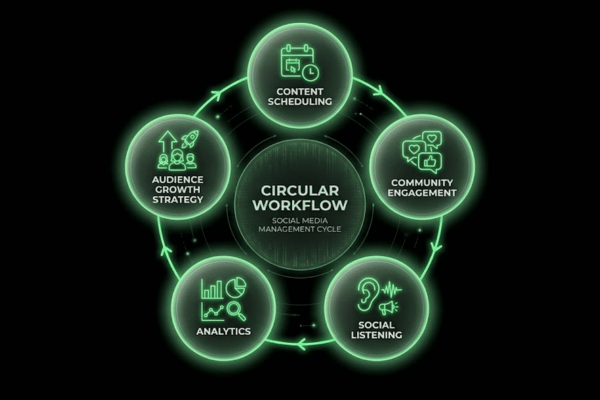
Social media management is the structured, ongoing operation of a business's social media presence across one or more platforms. It produces results through consistent execution across five interconnected functions: content scheduling, community engagement, social listening, performance analytics, and audience growth strategy. No single function works in isolation. Results emerge when all five functions compound over time.
A business that only posts without engaging misses community signals. One that engages without tracking analytics repeats the same mistakes month after month. Professional social media management coordinates every function inside a unified strategy, which is why managed accounts consistently outperform ad-hoc self-managed ones. According to a 2025 benchmark study by HubSpot, businesses with dedicated social media management see 3.2x higher engagement rates than businesses without a structured management approach.
How does social media management differ from social media marketing?
Social media management differs from social media marketing in scope and function. Management covers the ongoing operations side: scheduling content, monitoring comments, responding to messages, community building, and performance reporting. Marketing covers the strategic and campaign execution side: paid ads, audience targeting, promotional campaigns, and funnel design. Management is the operational engine. Marketing is the campaign strategy it executes.
In practice, management is a function within the broader marketing structure. A managed account without a marketing strategy lacks direction. A marketing strategy without managed operations lacks consistent execution. Most professional agencies handle both together, though the two disciplines require different skill sets and tools.
What does professional social media management include?
Professional social media management includes a defined set of operational functions delivered on a consistent schedule. The core components of professional social media management are listed below.
Content scheduling and publishing: Planning and posting content across platforms at optimal times based on audience activity data.
Community management: Responding to comments, direct messages, and mentions within 24 hours to signal account activity to platform algorithms.
Social listening: Monitoring brand mentions, competitor activity, and trending topics relevant to your industry.
Analytics and reporting: Pulling weekly or monthly performance data covering reach, engagement rate, click-through rate, and follower growth.
Content creation coordination: Briefing, reviewing, or producing graphics, captions, and video assets aligned to the content calendar.
Audience growth strategy: Testing content formats, posting times, and hashtag sets to expand reach to new, relevant users.
How long does social media management take to show results?
Social media management takes 3 to 6 months to produce initial measurable results and 6 to 12 months to deliver meaningful ROI for most small businesses [source: HubSpot State of Marketing, 2025]. The timeline is not fixed. It shifts based on your goal type, platform, posting frequency, and starting audience size.
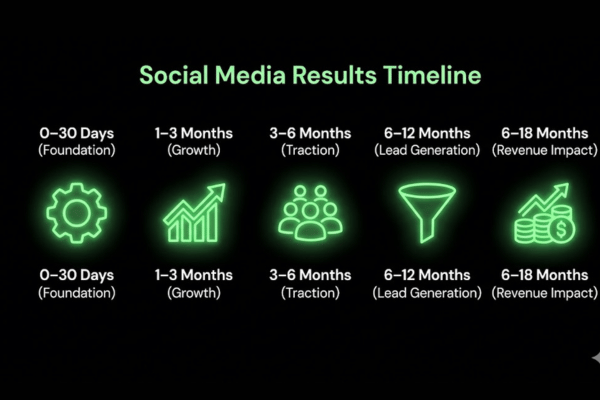
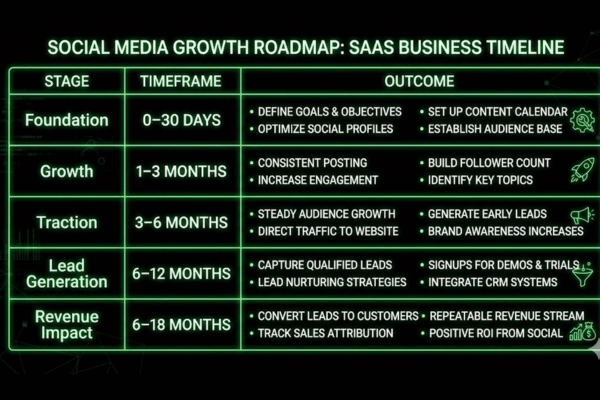
Here is a breakdown of the social media management results timeline by stage.
Foundation (0–30 days): Profile setup, baseline metrics established, first engagement signals begin appearing.
Growth (1–3 months): Platform algorithms start training, content patterns are tested, early follower growth begins.
Traction (3–6 months): Brand awareness increases, engagement rates stabilize, niche audience recognition develops.
Lead Generation (6–12 months): Reliable inbound leads, social-driven website traffic, and email signups start growing consistently.
Revenue Impact (6–18 months): Social media begins generating attributable sales, customer acquisition, and measurable ROI.
Attributable sales, customer acquisition from social, measurable ROI
No stage can be skipped. Businesses that expect revenue in month two are measuring the wrong outcomes. The social media management timeline is sequential, not simultaneous.
What can social media management achieve in the first 30 days?
In the first 30 days, social media management can achieve the structural groundwork that determines how fast results appear later. Social media management milestones in the first 30 days include:
Profile optimization completion: Bios, profile photos, link placements, and cover images updated to reflect brand identity and include a clear call to action.
Baseline metrics established: First recorded data points for reach, impressions, follower count, and engagement rate to measure all future progress against.
First engagement signals captured: Initial likes, comments, and saves that tell the platform algorithm your account produces content worth distributing.
Algorithm introduction posts published: A minimum of 8–12 posts in the first 30 days to begin the algorithm's content categorization process.
Audience persona refinement: Early post-performance data used to adjust content topics, tone, and format to better match your actual audience.
What results does social media management deliver in 3 to 6 months?
Social media management delivers measurable brand awareness growth, consistent follower increases, and niche audience recognition in 3 to 6 months. This phase is where platform algorithms begin rewarding consistent posting patterns with wider distribution.
Expected outcomes in this window include:
Monthly follower growth of 5 to 10% as the algorithm assigns content categories and reaches new users [source: Sprout Social Benchmark Report, 2025].
Engagement rates stabilizing above 1.5% on most platforms, indicating real audience alignment.
Profile recognition from a defined niche audience, meaning followers engage because they recognize your brand identity.
Inbound profile visits from non-followers who discovered content through hashtags, shares, or Explore placements.
This phase is also where social media follower growth timeline becomes predictable. Month-over-month growth should show a clear upward trend by the end of month 6.
How long does social media management take to generate leads?
Social media management takes 6 to 12 months to generate consistent, measurable leads for most small businesses. Leads require trust. Trust requires repeated audience exposure over time. A prospect who sees your content once does not act. One who sees it 7 to 10 times is far more likely to click your link or submit a contact form [source: Nielsen Media Lab, 2024].
Early data signals, specifically rising click-through rates and landing page visits from social traffic, typically appear between weeks 6 and 8. These signals confirm the audience-to-intent progression is beginning. But reliable, month-over-month lead generation from social media takes the full 6 to 12 months to establish. The social media management lead time is not a failure of strategy. It is the natural rhythm of how audience trust converts into action.
When does social media management start producing revenue impact?
Social media management starts producing revenue impact between 6 and 18 months, with the exact timing determined primarily by your sales cycle length.
B2C businesses, those selling directly to consumers with short buying decisions like home decor, clothing, or food products, typically see revenue attribution between 6 and 9 months. The buying decision is emotional and fast. A well-timed Instagram post can move a follower to purchase within the same session.
B2B businesses, those selling to other companies with multiple decision-makers and longer evaluation periods, typically see revenue impact between 12 and 18 months. The sales cycle is longer and more complex. Social media builds brand authority during that cycle rather than triggering immediate purchases. Regardless of business type, research from Bain & Company shows that customers acquired through social media channels have 20 to 40% higher lifetime value than those acquired through paid ads alone [source: Bain & Company, 2024].
What factors determine how quickly social media management produces results?
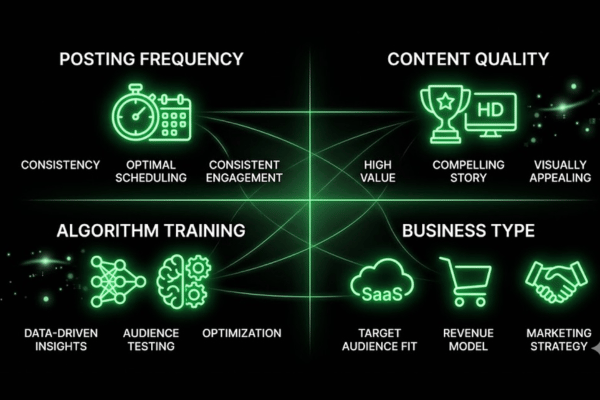
The factors that determine how quickly social media management produces results are posting frequency, content quality, platform algorithm behavior, and business type. These four variables interact with each other. Strong content at low posting frequency underperforms. High frequency with low-quality content trains the algorithm on poor engagement signals. The main factors that determine social media management result speed are outlined below, with each explored in the sections that follow.
Posting frequency and consistency
Content quality and format match
Platform algorithm training period
Business type and sales cycle length
No single factor dominates. The fastest results come when all four align inside a coordinated strategy.
How does posting frequency affect social media management results?
Posting frequency affects social media management results by determining how fast platform algorithms accumulate enough data to categorize your account and distribute content to relevant users. A minimum of 3 to 5 posts per week is required to maintain active algorithm status on most platforms [source: Later Platform Study, 2025].
Doubling your post volume does not halve the timeline linearly. Quality must match volume, or the algorithm learns from disengaged audiences and distributes content more narrowly, not more broadly. Platform-specific nuances matter here. TikTok rewards 5 to 7 posts per week because its For You Page algorithm prioritizes volume and watch time together. LinkedIn performs better with 3 to 4 high-value posts per week because its algorithm rewards dwell time and professional engagement depth over raw posting frequency.
Understanding how often your business should post on social media for your specific platform prevents the most common frequency mistake: either under-posting and losing algorithm momentum or over-posting with filler content that trains the algorithm on low-engagement signals.
Does content quality change the social media management timeline?
Yes, content quality changes the social media management timeline because platform algorithms use engagement depth, not just engagement volume, to determine distribution priority. High-quality content generates saves, shares, and comments. Low-quality content generates passive scrolling, which the algorithm reads as audience disinterest and responds to by reducing future reach.
High-quality content educates, entertains, or inspires a specific action. Filler content fills a calendar slot without producing any of those outcomes. Visual content quality carries particular weight on image-led platforms. A professionally designed graphic or a well-lit short video produces demonstrably higher save rates than a text-heavy static image, which directly affects algorithm distribution speed. The distinction between static posts and video content in terms of reach and engagement is significant and influences how fast your account builds algorithmic momentum.
How does platform algorithm training affect social media management timelines?
Platform algorithm training affects social media management timelines by creating an unavoidable learning period at the start of every managed account. The first 50 to 100 posts function as training data for the algorithm to determine what your content is about, who engages with it, and which users to distribute it to [source: Meta Developer Documentation, 2025].
During this training phase, reach is intentionally limited. The platform distributes content to a small test audience and measures engagement signals before expanding distribution. This process is why social media management results appear slow in the first 1 to 3 months. It is not a strategy failure. It is the algorithm calibration period that every new or restructured account must complete before organic reach scales. Attempting to shortcut this period with inconsistent high-volume posting disrupts the calibration and extends the timeline rather than shortening it.
Does business type change the social media management results timeline?
Yes, business type changes the social media management results timeline because the length of your customer's buying decision determines how long social media must nurture that relationship before a conversion happens.
B2C businesses operate on emotional, fast buying cycles. A home decor brand, a boutique clothing retailer, or a coffee shop can see measurable results in 3 to 6 months because the purchase decision is low-risk and impulse-driven. Visual content on Instagram or Pinterest triggers direct purchase behavior without extended consideration.
B2B businesses operate on rational, multi-stakeholder buying cycles averaging 3 to 6 months of evaluation before a contract is signed. That pushes the social media management results timeline to 6 to 12 months or longer for measurable ROI. Social content in a B2B context builds authority and keeps the brand present during a long decision cycle, rather than triggering immediate transactions.
How does social media management perform across different platforms?
Social media management performs differently across platforms because each platform uses a different algorithm, rewards different content formats, and attracts different audience demographics. Timeline expectations must match the platform's native behavior, not a generalized industry average.
Here is how social media management result timelines vary by platform.
Instagram (3–6 months)
Best for visual brands targeting consumers aged 18–44.
Performs best with Reels, Stories, and carousel posts focused on engagement and discoverability.Facebook (3–6 months)
Strong for community-focused businesses targeting audiences aged 35–65.
Best content formats include Groups, video posts, and boosted content.LinkedIn (6–12 months)
Ideal for B2B businesses and professionals targeting users aged 28–55.
Performs best with thought leadership articles, text posts, and company updates.TikTok (2–6 months)
Fastest platform for organic reach, especially for audiences aged 18–34.
Best results come from short-form videos, trending audio, and high posting consistency.
How long does Instagram management take to show results?
Instagram management takes 3 to 6 months to show results for visual B2C brands. The platform's algorithm favors accounts that produce Reels consistently, with Instagram's internal data showing that Reels receive 22% more interaction than standard video posts [source: Meta for Business, 2025].
Stories drive daily engagement by keeping your account active in follower feeds without requiring the production quality of a main-feed post. Post consistency across all three formats, Reels for reach, Stories for retention, and feed posts for brand identity, trains the algorithm faster than single-format accounts. For a full breakdown of what a managed Instagram presence includes, see what Instagram management for small businesses covers, including content mix, engagement protocols, and growth tracking methods.
How long does Facebook management take to deliver results?
Facebook management takes 3 to 6 months for B2C businesses and up to 12 months for niche or local service businesses dependent on community trust. Facebook's algorithm currently prioritizes content that generates conversation, specifically posts that drive comments and replies, over passive like-based engagement.
Facebook Groups accelerate niche engagement by placing your content in front of self-selected audience segments without requiring paid promotion. Boosted posts help compress the early timeline by expanding reach to cold audiences before organic momentum builds. Consistently managed Facebook pages that post 4 to 5 times per week and respond to every comment within 24 hours reach stable engagement rates by month 4. For a practical breakdown of running a managed Facebook presence, Facebook management for small businesses covers publishing cadence, community protocols, and what a managed page delivers month by month.
How long does LinkedIn management take to produce results?
LinkedIn management takes 6 to 12 months to produce results for B2B businesses. LinkedIn rewards professional authority-building content, specifically posts that generate thoughtful comments from industry peers, article reads, and company page followers from within a defined professional niche.
Connection growth on LinkedIn is slower than follower growth on Instagram because LinkedIn users are more selective about their feed. A consistent cadence of 3 to 4 posts per week, a mix of company updates, thought leadership articles, and team spotlights, produces measurable engagement growth by month 4 to 6. Revenue-level results from LinkedIn, in the form of inbound leads or partnership inquiries, take the full 6 to 12 months because the sales cycle on the platform is long. For a complete picture of what managed LinkedIn activity produces for small businesses and professionals, LinkedIn management for small businesses details the content strategy, connection protocols, and reporting benchmarks used by managed accounts.
How quickly does TikTok management generate results?
TikTok management can generate results in 2 to 6 months, making it the fastest-moving platform for organic reach among all major social channels. TikTok's For You Page algorithm exposes new accounts to large audiences based on content relevance and watch time, not follower count. A brand-new account can reach 10,000 views on its first video if the format and topic match active trending categories.
Short-form video consistency is the primary driver of TikTok results. Accounts that post 5 to 7 times per week with trending audio and clear on-screen text consistently outperform accounts posting high-production videos at lower frequency [source: TikTok for Business Benchmarks, 2025]. The platform's speed advantage makes it particularly effective for product-based B2C businesses with strong visual storytelling.
What social media management milestones should you track in the first 90 days?
The social media management milestones to track in the first 90 days are structured around three phases: setup and baseline in month one, pattern testing in month two, and first measurable growth in month three. The 9 key social media management milestones to track in your first 90 days are listed below.
Month 1: Foundation
All profile fields completed, including bios, profile photos, and linked URLs with UTM parameters attached.
Baseline metrics recorded for reach, impressions, engagement rate, and follower count before any managed content goes live.
First 12 posts published, covering at least 3 different content formats to begin algorithm categorization.
Month 2: Testing 4. Content performance by format analyzed: which format produces the highest save rate and engagement depth. 5. Optimal posting times identified from platform analytics data, not from generic best-practice guides. 6. Community engagement established: a response protocol producing replies to every comment within 24 hours.
Month 3: Growth Signals 7. Month-over-month follower growth rate measured and compared against the 5% minimum benchmark. 8. First social-driven website traffic recorded in Google Analytics under Acquisition > Traffic Acquisition. 9. Content calendar refined based on two months of real performance data, not assumptions.
Which KPIs signal that social media management is working?
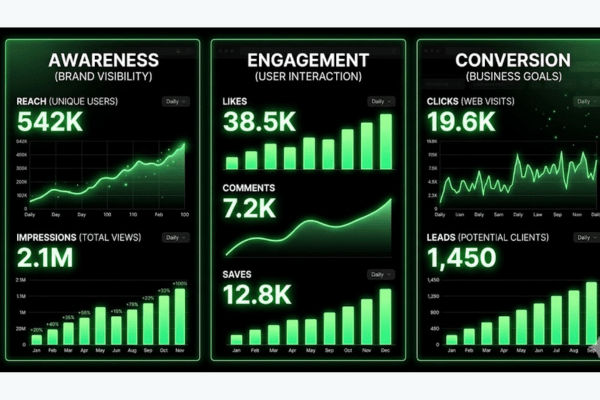
The KPIs that signal social media management is working are organized by results stage: awareness, engagement, and conversion. Social media management KPIs organized by results stage are listed below.
Awareness KPIs:
Reach per post: Number of unique accounts that saw each piece of content. Target a 10% month-over-month increase by month 3.
Follower growth rate: Monthly percentage increase in followers. A healthy rate for small businesses is 5 to 10% per month [source: Sprout Social, 2025].
Impressions: Total times content was displayed, including repeat views. Tracks content distribution breadth.
Engagement KPIs: 4. Engagement rate: Total interactions divided by total reach. A rate above 1.5% signals meaningful audience connection. 5. Comments and saves: Both indicate content quality more reliably than likes. Saves signal future purchase intent on Instagram and Pinterest. 6. Shares: Each share extends organic reach to a new cold audience at no cost.
Conversion KPIs: 7. Website clicks from social: Tracked via UTM parameters in Google Analytics. Indicates intent to learn more or purchase. 8. Link-in-bio traffic: Clicks from your profile link measured by your link-management tool (Linktree, Later, or a direct UTM-tagged URL). 9. Lead form submissions: Contact forms, quote requests, or email signups attributed to social media traffic.
How does a social media audit set the baseline for management results?
A social media audit sets the baseline for management results by documenting your current performance across all active social profiles before any new strategy is implemented. A social media audit (a structured review of your existing social media performance, content, and audience data) answers one question: where are you starting from?
The 5 things a social media audit covers to baseline your management results are:
Profile completeness check: Every field across all platforms reviewed for accuracy, brand consistency, and SEO-relevant keyword inclusion.
Current engagement rate measurement: Historical engagement rate calculated from the last 30 days of posts to establish a true starting benchmark.
Content performance analysis: Top-performing and worst-performing posts identified by engagement rate, reach, and click-through rate.
Competitor benchmarking: Your reach, follower count, and engagement rate compared against 3 to 5 direct competitors on the same platforms.
Audience demographics review: Platform-provided data on follower age, location, gender, and active hours used to validate or adjust your target persona.
How does a content calendar strategy accelerate social media management results?
A content calendar strategy accelerates social media management results by removing the gap between planned content and actual publishing. Consistent, pre-planned publishing trains platform algorithms faster because it eliminates the irregular posting gaps that reset algorithmic momentum.
Thematic content planning, organizing posts around seasonal events, product launches, or trending industry topics, gives each post a purpose beyond filling a time slot. For a home decor brand, a February content calendar might plan Valentine's Day styling content in week one, spring refresh themes in week two, and a new product feature in week three. Each theme connects to real audience search behavior. Content batching, the practice of creating multiple posts in a single session, reduces production friction and makes weekly publishing schedules sustainable without burnout. To understand how a content calendar fits into a broader publishing strategy, what a social media content calendar does for your business explains the planning framework, scheduling tools, and monthly review process used in managed accounts.
How does organic social media management compare to paid in terms of results?
Organic social media management compares to paid results in time horizon, cost structure, and audience ownership. Organic management takes 6 to 9 months to produce meaningful results, but every follower gained belongs to your audience permanently. Paid social produces direct response results in 2 to 4 weeks, but distribution stops the moment the ad budget runs out. Organic builds an asset. Paid rents an audience.
The right approach for most small businesses is a hybrid model: use organic content to build trust and long-term brand equity, then use paid promotion to amplify your best-performing organic posts to cold audiences. This sequence reduces wasted ad spend because you promote only what already works. Running paid ads on untested content is the most expensive way to discover what your audience does not want. Organic management provides the proof of concept that paid campaigns need to perform efficiently.
What mistakes slow down results from social media management?
The mistakes that slow down results from social media management are execution failures, not strategy failures. They are predictable and preventable. The 6 common mistakes that slow down results from social media management are listed below.
Posting inconsistently, which resets algorithm momentum built over weeks of consistent publishing.
Ignoring performance analytics, which allows underperforming content to continue without correction.
Treating all platforms identically, which ignores the format and audience differences that determine platform performance.
Measuring vanity metrics like follower count instead of conversion-linked KPIs like website clicks and lead form submissions.
Reacting to algorithm updates without understanding what actually changed, leading to strategy pivots based on rumors rather than data.
Expecting revenue results in the first 60 days and concluding that the strategy does not work before the timeline has run its course.
How does inconsistent posting delay results from social media management?
Inconsistent posting delays results from social media management because platform algorithms treat posting regularity as a trust signal. An account that posts daily for three weeks then goes silent for two weeks loses the algorithmic priority it built, forcing the account to restart the trust-building process from a lower baseline.
Audience attrition compounds the problem. Followers who stop seeing content from an account disengage from it within 2 to 4 weeks. When posting resumes, the algorithm delivers content to an audience that has already stopped responding, producing lower engagement rates than before the gap. The result is a cycle where inconsistency produces weak signals, weak signals reduce distribution, and reduced distribution discourages continued effort. Posting consistency is the single highest-return operational discipline in social media management.
Why does ignoring analytics hurt results from social media management?
Ignoring analytics hurts results from social media management because without data review, underperforming content continues unchanged, consuming your posting cadence and budget without producing the engagement signals the algorithm needs to expand your reach.
Analytics reveal three things that intuition cannot: which content formats your specific audience responds to, which posting times generate the highest engagement rate, and which topics drive website clicks versus passive scrolls. A managed account that reviews analytics monthly and adjusts its content mix based on findings consistently outperforms one that sticks to a fixed content formula regardless of results. Social media management analytics tracking is not optional reporting. It is the adjustment mechanism that makes every subsequent month perform better than the last.
How do algorithm updates impact results from social media management?
Algorithm updates impact results from social media management by changing which content types the platform prioritizes for distribution, sometimes reversing the performance of previously effective content. Major algorithm shifts, like Instagram's 2024 decision to deprioritize static images in favor of Reels, caused established accounts with strong static post performance to see reach drop by 20 to 40% almost overnight [source: Later Algorithm Study, 2025].
The correct response to an algorithm update is not to immediately overhaul the entire content strategy. It is to identify specifically what changed, test the new priority format with 8 to 10 posts, and measure engagement against your baseline before making permanent strategy adjustments. Accounts that react impulsively to algorithm changes lose months of accumulated momentum. Those that adapt methodically based on data maintain their growth trajectory through platform changes.
Should you use social media management tools to see faster results?
You should use social media management tools to see faster results if your current process involves manual posting, inconsistent scheduling, or delayed analytics review. Management tools enforce the consistency that algorithms reward by automating scheduling, surfacing performance data in real time, and consolidating multi-platform management into a single dashboard.
Popular tools include Hootsuite, Buffer, Sprout Social, and Later. Each serves a different scale of operation. Buffer works for solopreneurs managing 1 to 3 profiles. Sprout Social handles multi-platform management for growing teams with advanced reporting needs. These tools do not replace strategy or content quality. They enforce the operational discipline that produces faster algorithm training and more reliable posting cadence. A social media management tool used consistently reduces the timeline to measurable results by 4 to 6 weeks compared to manual management [source: Buffer State of Social, 2025].
Which metrics do social media management tools track for quicker results?
Social media management tools track the following key metrics for faster results. Key metrics social media management tools track for faster results include:
Engagement rate per post: Total interactions divided by reach, measured automatically across all published content to identify patterns without manual calculation.
Reach and impressions by platform: How far each post traveled and how many times it displayed, separated by organic and paid distribution.
Follower growth rate: Month-over-month percentage increase tracked automatically, flagging when growth stalls for strategy review.
Click-through rate (CTR): Percentage of content viewers who clicked your link, indicating audience intent beyond passive engagement.
Best posting time: Algorithm-generated recommendations based on when your specific audience is most active, not generic industry averages.
Content performance score: A composite metric comparing each post's reach, engagement, and click rate against your historical average to identify top performers instantly.
Share of voice: Your brand mention volume compared to competitors, tracked through social listening integrations within tools like Sprout Social and Hootsuite.
Should you hire a social media management agency for better results?
You should hire a social media management agency for better results if you lack the in-house time, skills, or consistency to execute a managed social strategy without gaps. Agencies compress the results timeline by 1 to 3 months compared to self-managed accounts because they bring dedicated content creators, strategists, and analytics specialists who work on your account without competing internal priorities.
What agencies bring beyond execution includes platform-specific expertise, proprietary performance benchmarks from managing multiple accounts in your industry, and professional content production that matches platform algorithm preferences. A DIY social media account managed between other business responsibilities typically produces 2 to 3 posts per week at variable quality. A managed account delivers 4 to 5 posts per week at consistent quality with full analytics reporting. Before hiring, the questions you ask matter as much as the agency you choose. How to choose a social media management company covers the 10 questions that separate effective agencies from those that produce reports without results.
If budget is the primary consideration, the comparison between social media management versus doing it yourself breaks down the real cost of each approach across time, quality, and measurable outcomes, so you make the decision on data rather than assumption.
How does a social media management audit improve results from your strategy?
A social media management audit improves results from your strategy by identifying the specific gaps, misalignments, and missed opportunities that prevent your current approach from producing the results the timeline predicts. The 6 things a social media management audit identifies to improve results from your strategy are:
Underperforming content formats: Specific post types with engagement rates below your platform benchmark, indicating format-audience mismatch.
Misaligned KPIs: Metrics being tracked that do not connect to your stated business goal, for example tracking follower count when your goal is lead generation.
Posting frequency gaps: Days or time blocks where content is consistently absent, creating algorithm inactivity signals that reduce distribution.
Missed audience segments: Demographic data from platform analytics revealing audience groups your content does not currently address.
Missing platform opportunities: Active competitor presence on platforms you have not yet entered, representing untapped reach potential.
Weak competitor differentiation: Content themes or formats identical to 3 or more competitors, reducing your account's distinctiveness in algorithm distribution decisions.
A social media management audit functions as a reset mechanism. It replaces assumptions about what should be working with data about what is working, and identifies exactly where to invest the next 90 days of effort for the highest return.