
How to Measure Social Media ROI for Your Small Business
Only 34% of small businesses say they can prove their social media marketing generates a positive return [source: Sprout Social, 2024]. The rest are guessing. If you post, run ads, and hope for results, you are spending time and money without knowing what it buys you. Measuring social media ROI gives you a clear picture of what works, what does not, and where your next dollar should go.
Social media ROI for small businesses is the financial and non-financial return you get from every hour and dollar spent on social media. The standard formula is ROI = (Value Generated – Cost of Investment) / Cost × 100. Measuring this return tells you which platforms drive real business results and which ones drain your budget without payback.
This guide covers the definition, formula, key metrics, tracking tools, step-by-step measurement process, platform benchmarks, common mistakes, and when to hire outside help. Every section connects directly to the core question: Are your social media efforts worth it?
What is social media ROI for a small business?
Social media ROI is the net return a small business gets from its social media activity compared to what it spends. It measures everything from direct revenue and leads to brand awareness and customer loyalty. The formula is simple: ROI = ((Value Generated – Cost of Investment) / Cost of Investment) × 100. A 300% ROI means you get $3 back for every $1 spent.
Most small businesses think of ROI as pure profit. That is incomplete. Social media return on investment includes monetary results like sales, signups, and leads. It also includes non-monetary results like brand recognition, repeat customers, and referrals. Both types count. Both affect your bottom line, even if one takes longer to show up in your bank account.
A small business with $500 in monthly ad spend and $2,000 in social-driven sales has a basic ROI of 300%. But if that same business also gained 50 new followers who each refer one friend, the true return is higher. Measuring social media ROI accurately means counting both the fast returns and the slow ones.
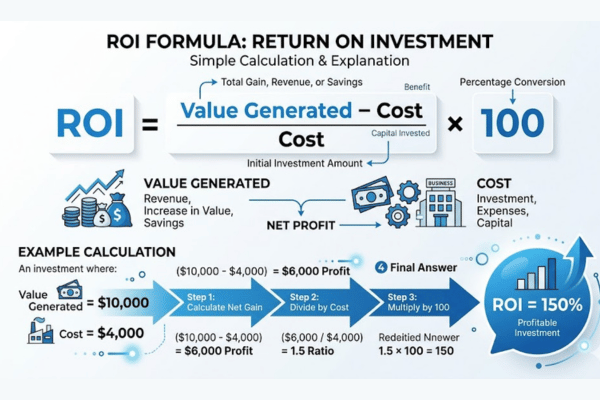
What does social media ROI include beyond direct revenue?
Social media ROI for a small business includes more than direct revenue. It also covers brand awareness, customer loyalty, word-of-mouth referrals, and community growth. These non-monetary returns are real business assets, even though they do not show up instantly as sales.
You assign proxy dollar values to make them measurable. If your average customer is worth $300 over their lifetime [source: Harvard Business Review, 2023], each social media follower who becomes a repeat buyer is worth $300 in customer lifetime value. Each referral click from a social post equals the value of your average order. Non-monetary social media ROI becomes measurable when you attach dollar estimates to each outcome. Community growth, brand impressions, and word-of-mouth all have equivalent costs if you were to buy them through paid advertising.
How does social media ROI differ for small businesses vs. large companies?
Social media ROI differs for small businesses compared to large companies because small businesses operate on tighter budgets, rely more on organic content, and have fewer analytics resources. A large company might run 10 paid campaigns across 6 platforms simultaneously. A small business typically manages 1 or 2 platforms and depends heavily on free tools and organic reach.
Small business ROI benchmarks are also different. Large companies target a 5:1 ROAS as a baseline. A small business with no dedicated analytics team might be satisfied with a 2:1 return initially. Measurement complexity scales with business size. For small businesses, a simple spreadsheet and one tracking tool often deliver enough data to make better decisions.
Why should small businesses measure social media ROI?
Small businesses should measure social media ROI because every dollar and hour spent on social media carries a real opportunity cost. You have less budget than large competitors. A wrong platform choice or ineffective content strategy does not just waste money. It takes time you could spend on better-performing channels.
ROI data tells you three things fast. First, which platforms actually drive results for your specific audience. Second, which content types produce the highest return. Third, whether your social media spend is justified compared to other marketing channels like email or SEO. If you are unsure what social media management actually involves before measuring it, what is social media management breaks down the full scope of the work.
Measuring social media return on investment turns guesswork into decisions. Without it, you post based on habit or intuition. With it, you reallocate budget toward what works and cut what does not. Small business marketing accountability comes down to one question: can you prove this channel earns more than it costs? ROI measurement answers that question every single month.
How does measuring social media ROI help a small business allocate its budget?
Measuring social media ROI helps a small business allocate its budget by showing you which platforms and content formats produce the highest returns for the lowest cost. If your Instagram posts generate 3x more leads than your Facebook ads at half the spend, that data justifies a budget shift.
ROI-driven budget decisions work in three steps. First, you track performance by platform. Second, you compare cost per result across each channel. Third, you redirect spend from low-ROI channels to high-performing ones. A small business that reallocates even 20% of its budget from a low-performing channel to a high-ROI one improves total return without spending more [source: HubSpot State of Marketing, 2024]. Social media budget allocation stops being a gut feeling and becomes a data-backed process. Content performance data also shows you which post formats, like video versus static images, generate the most clicks, saves, and conversions. If you want a direct comparison on that, static posts vs. video posts shows which format performs better by platform and goal. That shapes your content strategy, not just your ad spend.
What happens when small businesses do not track social media ROI?
When small businesses do not track social media ROI, they risk continuing to spend money and time on channels that produce nothing. 56% of small businesses cannot confidently measure their social media ROI [source: Clutch Small Business Survey, 2023]. That means more than half are spending without proof of return.
The consequences stack up fast. You continue investing in low-performing content. You have no data to justify stopping or scaling any campaign. You cannot identify your best platform. And when the budget gets tight, you do not argue for keeping social media spend at all. Untracked social media investment is the most common source of wasted small business marketing budgets.
How do you calculate social media ROI for a small business?
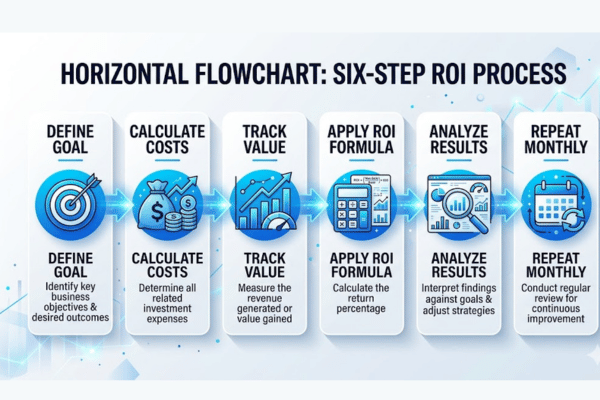
Calculating social media ROI for a small business involves tracking your total costs, measuring the value your social media activity generates, and applying the standard ROI formula. Use these steps to calculate social media ROI for your small business.
Define your goal. Choose one measurable outcome per campaign: sales, leads, email signups, or website traffic.
Add up your total costs. Include ad spend, content creation costs, tool subscriptions, and time (converted to an hourly dollar rate).
Track the value generated. Sum all revenue, lead values, and proxy values from non-monetary outcomes tied to social media.
Apply the ROI formula. ROI = ((Value Generated – Total Cost) / Total Cost) × 100.
Interpret the result. Positive ROI means you earned more than you spent. Negative ROI means you need to cut costs or change strategy.
Repeat monthly. One month of data is not enough. Track at least 90 days before making major budget decisions.
What is the social media ROI formula for small businesses?
The social media ROI formula for small businesses is: ROI = ((Value Generated – Cost of Investment) / Cost of Investment) × 100.
Here is a real-world example. A small bakery spends $1,000 per month total: $400 on Facebook ads, $300 on a part-time social media contractor, and $300 on Canva and scheduling tools. Their social media drives $5,000 in monthly sales. The formula looks like this: ((5,000 – 1,000) / 1,000) × 100 = 400% ROI.
That 400% means they earn $4 for every $1 spent. Any ROI above 100% means you doubled your investment. The formula works for both paid and organic social media ROI calculation as long as you count every cost, including your own time. Most small businesses undercount costs by forgetting to include labor.
How Can a Small Business Use a Social Media ROI Calculator?
A small business can use a social media ROI calculator by entering total costs, tracked revenue, lead value, and time investment. The calculator then shows whether social media produced a positive or negative return.
Use these inputs:
- Add monthly ad spend.
- Add content creation costs.
- Add tool costs.
- Add labor hours as a dollar value.
- Add revenue from social media.
- Add estimated lead value.
Example: If your total monthly cost is $800 and social media creates $2,400 in value, your ROI is 200%. That means your business earns $2 back after every $1 spent.
How do you assign a dollar value to non-monetary social media results?
Assigning a dollar value to non-monetary social media results involves using proxy valuation methods tied to known business metrics. Three methods work for most small businesses.
First, use cost-per-equivalent-reach. Find what it would cost to reach the same number of people through paid ads. If your organic post reached 2,000 people and paid reach costs $0.02 per person, that post had $40 in earned media value.
Second, use average lead value. If your average lead converts at 10% and your average sale is $200, each lead is worth $20. A social post that generated 30 leads produced $600 in proxy value.
Third, use customer lifetime value (CLV). If a new social follower becomes a repeat buyer worth $400 over two years, each follower acquired has a $400 ceiling value [source: Bain & Company, 2022]. These proxy valuations are not perfect. They are directional. But they are far better than treating non-monetary returns as worthless.
How do you calculate time investment as part of social media ROI?
Calculating time investment as part of social media ROI involves tracking all hours spent on social media tasks and converting them into a dollar cost using your hourly rate or your employee's salary equivalent.
Track time across four categories: content creation, scheduling and publishing, engagement and community management, and reporting. If you spend 8 hours per week on social media and your time is worth $40 per hour, your monthly time cost is $1,280. Time cost is the most overlooked part of small business social media ROI because it never shows up on a bank statement.
Add this to your paid costs before running the ROI formula. A campaign that looks profitable at $500 in ad spend may actually lose money when you factor in 20 hours of labor at $40 per hour, which adds another $800 in real cost. Social media labor cost calculation changes how many campaigns appear worthwhile.
What metrics should small businesses track to measure social media ROI?
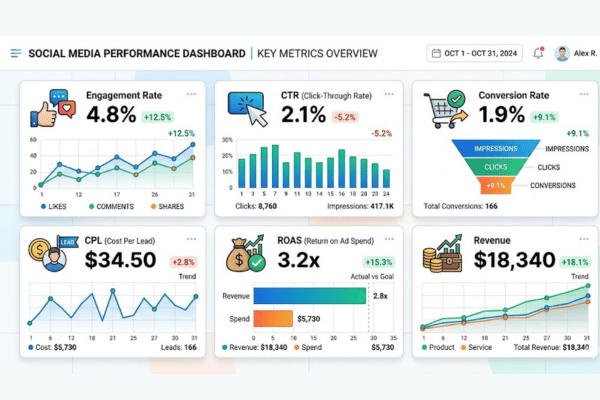
The metrics small businesses should track to measure social media ROI include four categories: engagement, conversion, reach, and revenue attribution. Track these social media ROI metrics first.
Engagement rate: Likes, comments, shares, and saves as a percentage of reach. Indicates content quality.
Click-through rate (CTR): Percentage of viewers who click your link. Signals audience intent.
Conversion rate: Percentage of social visitors who complete your goal action: purchase, signup, or form fill.
Cost per lead (CPL): Total social spend divided by number of leads generated.
Revenue attributed to social: Total sales traceable to a social media source through UTM tracking or last-click attribution.
Customer acquisition cost (CAC): Total social spend divided by new customers acquired.
Return on ad spend (ROAS): Revenue generated per dollar of paid ad spend.
Engagement Rate
What It Measures: Content resonance
Best For: Organic content evaluation
CTR (Click-Through Rate)
What It Measures: Audience intent
Best For: Link-based campaigns
Conversion Rate
What It Measures: Goal completion
Best For: Lead generation and e-commerce
Cost Per Lead (CPL)
What It Measures: Lead efficiency
Best For: Paid social campaigns
ROAS (Return on Ad Spend)
What It Measures: Ad profitability
Best For: Paid ad ROI tracking
Revenue Attribution
What It Measures: Direct sales impact
Best For: Full-funnel ROI reporting
Which engagement metrics connect to social media ROI for small businesses?
Engagement metrics that connect to social media ROI for small businesses include the following.
Engagement rate (target: 1–5% on most platforms): Total interactions (likes, comments, shares, saves) divided by reach. A higher rate signals your audience finds the content worth responding to.
Click-through rate (CTR): Clicks on your link divided by impressions. Average CTR across social platforms is 0.9–2.5% [source: WordStream, 2024]. Anything above 3% is strong.
Saves and shares: Saves indicate high-value content users want to return to. Shares expand organic reach at no extra cost. Both outperform likes as ROI signals.
Comments: Direct comments indicate deeper engagement. A post with 20 comments but 100 likes is often more algorithmically valuable than a post with 200 likes and no comments.
Replies to Stories/DMs: On Instagram and Facebook, direct message responses from Stories indicate strong intent and are often precursors to purchases.
What conversion metrics matter most for small business social media ROI?
Conversion metrics that matter most for small business social media ROI are listed below.
Social-to-website conversion rate: Percentage of social traffic that completes a goal on your site. Track this in Google Analytics under Acquisition > Traffic Acquisition.
Cost per lead (CPL): Total social ad spend divided by the number of leads generated. A CPL below your average profit per customer is a healthy threshold.
Lead-to-customer rate: Percentage of social-generated leads that become paying customers. This connects top-of-funnel social activity to actual revenue.
Form completion rate: For local service businesses, contact forms filled out from social traffic indicate direct intent. Track using UTM parameters plus Google Analytics Goals.
Social-attributed revenue: Revenue traced back to a specific social channel using UTM codes and your analytics platform. This is the most direct conversion metric available.
How do reach and awareness metrics factor into small business ROI?
Reach and awareness metrics factor into small business social media ROI by capturing the top-of-funnel return that does not convert immediately but builds long-term purchase intent. Reach means the number of unique accounts that saw your content. Impressions mean the total times your content was displayed, including repeat views.
Follower growth rate indicates whether your audience is expanding or stagnating. A 5–10% monthly follower growth rate for a small business is healthy [source: Sprout Social Benchmarks, 2024]. You assign a proxy value to awareness by comparing your organic reach to what paid advertising would cost to achieve the same exposure. If Facebook CPM (cost per 1,000 impressions) averages $7 and your organic post reached 5,000 people, it delivered $35 in equivalent paid value. Social media awareness tracking for small businesses does not require complex tools. Your native platform insights provide this data for free.
What tools do small businesses use to track social media ROI?
The tools small businesses use to track social media ROI include free native analytics built into each platform, Google Analytics for website tracking, UTM link builders, and low-cost social media management tools. Small businesses can use these tools to measure social media ROI.
Native platform analytics: Facebook Business Suite, Instagram Insights, LinkedIn Analytics, TikTok Analytics, Pinterest Analytics
Google Analytics 4 (GA4): Free website traffic and conversion tracking linked to social sources
Google Campaign URL Builder: Free UTM parameter generator
Metricool: Low-cost multi-platform analytics and scheduling (starts at $0/month for 1 profile)
Buffer Analyze: Social media performance reporting for small teams (from $6/month)
Sprout Social: Advanced analytics and ROI reporting for growing businesses (from $249/month)
Later: Visual scheduling with link-in-bio tracking (free plan available)
Facebook Business Suite
Cost: Free
Best For: Facebook and Instagram
ROI Features: Track reach, engagement, and ad results
If you’re focused only on Meta platforms, this is a no-brainer. Free and straight from the source.
Google Analytics 4
Cost: Free
Best For: All platforms (website tracking)
ROI Features: Conversion tracking, revenue attribution
This is your backbone. Without GA4, you cannot clearly connect social traffic to website actions.
Metricool
Cost: Free to $22/month
Best For: Multi-platform small teams
ROI Features: Post-performance, paid + organic overview
Solid middle-ground tool. Good for managing multiple channels without going broke.
Buffer Analysis
Cost: From $6/month
Best For: Solopreneurs
ROI Features: Engagement and growth tracking
Simple, lightweight, gets the job done without overwhelming you.
Sprout Social
Cost: From $249/month
Best For: Growing businesses
ROI Features: Full ROI dashboards, competitor data
This tool fits growing businesses that need deeper reporting and competitor data. Full data, deep insights.
Which free tools help small businesses measure social media ROI?
Free tools that help small businesses measure social media ROI include the following.
Facebook Business Suite: Tracks reach, engagement, follower growth, and ad results for Facebook and Instagram. Access it at business.facebook.com at no cost.
Instagram Insights: Shows post reach, profile visits, website clicks, and audience demographics directly inside the Instagram app.
LinkedIn Analytics: Tracks post impressions, follower growth, visitor demographics, and content engagement for business pages.
TikTok Analytics for Business: Provides video views, follower trends, profile reach, and traffic to your website link.
Google Analytics 4 (free tier): Tracks which social platforms send traffic to your site and whether those visitors complete goals like purchases, signups, or form fills. No cost for most small business traffic volumes.
How do UTM parameters work for tracking small business social media ROI?
UTM parameters work for tracking small business social media ROI by adding a short code to the end of your links so Google Analytics knows exactly where each visitor came from. UTM stands for Urchin Tracking Module. They are tags attached to a URL that identify the traffic source, marketing medium, and campaign name.
Here is a plain example. A regular link looks like: yoursite.com/contact. A UTM-tagged link looks like: yoursite.com/contact?utm_source=instagram&utm_medium=social&utm_campaign=spring_sale. When someone clicks that link, Google Analytics records that the visit came from Instagram as part of your spring sale campaign.
You build UTM links for free using Google's Campaign URL Builder at ga-dev-tools.google.com/campaign-url-builder. Add a unique UTM link to every bio, post, and ad. Then check Google Analytics > Acquisition > Traffic Acquisition to see which social links drove conversions. Campaign URL tracking with social media requires no paid tools. It takes 2 minutes per link to set up.
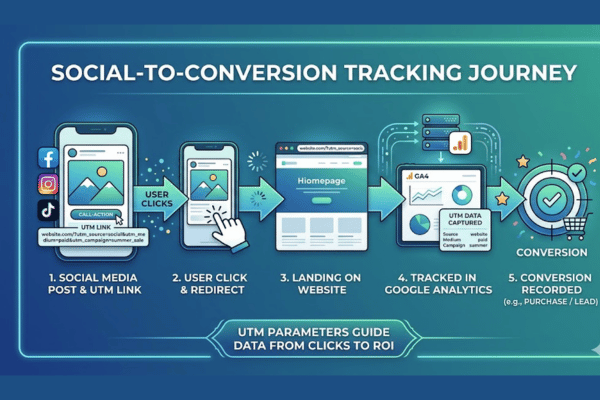
How does Google Analytics connect to social media ROI measurement?
Google Analytics connects to social media ROI measurement by tracking exactly which social channels send visitors to your website and whether those visitors take actions that matter to your business. It links social activity directly to business outcomes.
In GA4, go to Reports > Acquisition > Traffic Acquisition. Filter by "Session source / medium" to see traffic from each social platform. Then set up Conversions (formerly Goals) to track specific actions: purchases, form submissions, phone call clicks, or email signups. When a conversion fires, GA4 attributes it to the social channel that brought the visitor, giving you a direct revenue connection. Social referral tracking in Google Analytics is the closest thing to proof that your social media drives business results. For e-commerce, GA4 tracks actual purchase revenue per social channel automatically when connected to your store.
How Do You Calculate Social Media ROI in GA4?
You calculate social media ROI in GA4 by tracking social traffic, setting conversion events, and comparing conversion value against total social media cost. GA4 means Google Analytics. 4. It shows which platforms send visitors, leads, and sales to your website.
Follow this process:
- Open GA4 and go to Reports.
- Click Acquisition.
- Open Traffic Acquisition.
- Filter by session source/medium.
- Find traffic from Instagram, Facebook, LinkedIn, TikTok, or Pinterest.
- Compare conversions and revenue from each social source.
- Apply the ROI formula using your total social media cost.
Example: If LinkedIn sends 40 visitors and 5 form submissions, assign a lead value to each form. If each lead is worth $100, LinkedIn created $500 in tracked value.
How do you measure social media ROI step by step for your small business?
Measuring social media ROI step by step for your small business involves setting a goal, tracking costs, measuring results, and reporting monthly. Follow these 6 steps to measure social media ROI for your small business.
Set a SMART goal tied to a business outcome (e.g., generate 50 leads from Instagram in 30 days).
Choose your primary platform based on where your audience spends time and your content format strengths.
Install tracking tools, including GA4, UTM links, and your chosen platform analytics.
Define your cost baseline by logging all spend: ads, tools, contractor fees, and time converted to dollars.
Track value generated by pulling conversion data from GA4 and platform analytics weekly.
Create a monthly ROI report that shows the set goals, achieved metrics, formula results, and next-step decisions.
How do you set SMART goals for small business social media ROI?
Setting SMART goals for small business social media ROI involves defining goals that are specific, measurable, achievable, relevant, and time-bound. SMART is a framework used by marketers and business planners to create goals that can actually be tracked and evaluated.
Here is how each component works for social media:
Specific: "Generate leads from Facebook" is vague. " Generate 30 contact form submissions from Facebook ads" is specific.
Measurable: Attach a number. "Increase engagement" is not measurable. "Reach a 3% engagement rate on Instagram posts" is.
Achievable: If your current lead volume is 10 per month, a goal of 12 next month is achievable. 100 is not.
Relevant: The goal must connect to a real business outcome. Follower count alone is not relevant unless followers become buyers.
Time-bound: Set a 30 or 90-day deadline. "By June 30, 2026" beats "this quarter."
SMART goals turn social media activity into measurable social media objectives. Without them, ROI has nothing to measure against. A clear social media strategy gives those goals a framework to sit inside, so your measurement connects to a broader plan rather than individual campaigns in isolation.
How do you identify the right platform to measure ROI for your small business?
Steps to identify the right social media platform for ROI measurement are listed below.
Match the platform to your audience demographics. Facebook skews 35–64. TikTok skews 18–34. LinkedIn skews B2B professionals. Go where your buyers already are [source: Pew Research Center, 2024].
Align with your content format strengths. Strong at video? TikTok and Instagram Reels deliver higher organic reach. Good at writing or thought leadership? LinkedIn performs better.
Check platform analytics depth. Facebook Business Suite and LinkedIn Analytics offer detailed ROI data. Some platforms provide less conversion-specific data, making ROI tracking harder.
Evaluate your business goal fit. E-commerce benefits most from Instagram and Pinterest. Local service businesses often see stronger ROI from Facebook and Nextdoor. B2B companies consistently get better ROI from LinkedIn [source: Content Marketing Institute, 2024].
Start with one platform. Master its metrics before adding a second. Spreading thin across 4 platforms with no data is worse than going deep on 1 with clear ROI signals. When you are ready to add more channels, managing multiple social media platforms covers what that system looks like in practice and what it costs to run it properly.
How do you create a social media ROI report for your small business?
Creating a social media ROI report for your small business involves summarizing your goals, results, formula output, and next steps in one clear document reviewed monthly.
A complete small business social media ROI report includes five components. First, a goals recap: what you set out to achieve. Second, a metrics summary: engagement rate, CTR, leads, and revenue attributed. Third, the ROI formula result as a percentage. Fourth, key insights: what worked, what did not, and why. Fifth, next steps: budget adjustments, content changes, or platform switches based on the data.
Monthly social media ROI reporting creates a decision trail. It shows you month-over-month performance trends and stops reactive budget decisions driven by single bad weeks. Monthly cadence is recommended over weekly because social media results often lag 2–4 weeks behind the activity that caused them.
Recommended Video
Recommended Video: Search YouTube for "how to measure social media ROI for small business Google Analytics UTM" to watch a step-by-step visual walkthrough.
What makes measuring social media ROI challenging for small businesses?
What makes measuring social media ROI challenging for small businesses is attribution complexity. Customers rarely see one post and immediately buy. They might see your Instagram Reel on Monday, visit your website on Thursday via a Google search, and convert on Saturday after clicking a Facebook retargeting ad. Which channel gets credit for that sale?
Most small businesses rely on last-click attribution, which gives 100% credit to the final touchpoint before conversion. This model undervalues early social media touchpoints that built awareness and trust. Multi-touch attribution models distribute credit across all channels involved, but they require more advanced analytics setups than most small businesses operate.
Time delays add another layer of difficulty. Social media builds purchase intent slowly. A customer who follows you in February might buy in May. Connecting that May purchase back to your February content requires consistent UTM tracking and a CRM that captures the original lead source. Without these systems in place, long-term social media ROI goes unmeasured and undervalued.
How does organic social media ROI differ from paid social media ROI?
Organic social media ROI differs from paid social media ROI in the cost structure, measurement method, and time horizon. Organic ROI is measured through engagement, reach, referral traffic, and leads generated without any ad spend. Paid ROI is measured through ROAS (Return on Ad Spend), cost per click, and cost per conversion tied directly to campaign dollars.
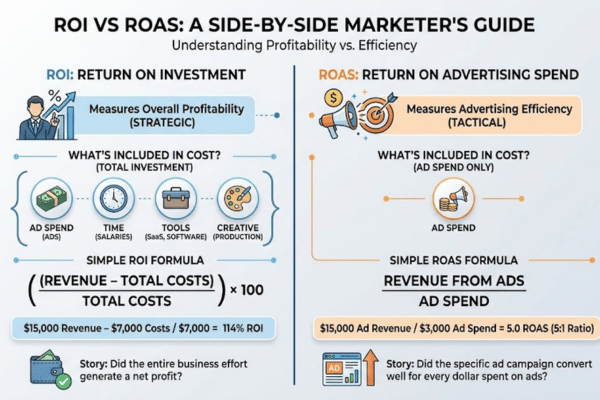
Organic social media return builds slowly. A strong organic post might generate 500 website visits over 2 weeks. A paid campaign can generate 500 visits in 2 days. But organic content has no direct dollar cost beyond your time. ROAS, not standard ROI, is the primary metric for paid social performance. ROAS = Revenue / Ad Spend. A 4x ROAS means you earned $4 for every $1 in ad spend. Most small businesses start with organic content to test what resonates, then layer in paid promotion on their top-performing posts. That sequence reduces wasted ad spend significantly.
How do you measure ROI from organic social media posts?
Measuring ROI from organic social media posts involves tracking reach, referral traffic, engagement rate, and social-driven leads without any ad spend attached. Organic post performance tracking relies on three data sources working together.
First, use your platform's native analytics to track reach, impressions, and engagement per post. Second, add UTM parameters to every link in your bio and posts. This shows how much website traffic and how many conversions each organic post drives. Third, check Google Analytics to see which organic social sources produce goal completions. Organic social ROI is real, but it requires UTM tracking to connect posts to conversions. Without UTMs, your GA4 reports show "direct" traffic instead of crediting the Instagram or Facebook post that actually sent the visitor. Measuring organic social media returns accurately requires this setup before you publish, not after.
How do you calculate return on ad spend (ROAS) for small business paid social?
Calculating return on ad spend (ROAS) for small business paid social involves dividing total revenue generated by total ad spend. The formula is: ROAS = Revenue Generated / Ad Spend.
Example: A small clothing boutique spends $400 on Facebook ads in one month. Those ads drive $2,000 in tracked online sales. ROAS = $2,000 / $400 = 5x ROAS. That means every $1 in ad spend produced $5 in revenue.
ROAS differs from ROI because it only counts ad spend, not total costs. ROI factors in all costs: tools, time, and contractor fees. ROAS is more useful for evaluating individual campaigns or ad sets. ROI is more useful for evaluating your overall social media program. A 3x ROAS is often the minimum break-even point for most small businesses after accounting for product cost and overhead [source: Meta Business Benchmarks, 2024]. Below 3x, most campaigns lose money when full costs are factored in.
What is a good social media ROI benchmark for a small business?
A good social media ROI benchmark for a small business is a 5:1 ratio, or 500% ROI, meaning $5 returned for every $1 spent. This is the general industry benchmark used across digital marketing [source: Nielsen, 2023]. A 2:1 ratio (200% ROI) is considered break-even for many businesses once all costs are included.
Benchmarks vary significantly by industry, platform, and goal type. A retail business running Instagram Shopping ads targets higher ROAS than a local plumber building brand awareness through organic Facebook posts. Small businesses should first establish their own historical baseline. Run 90 days of tracked campaigns. Calculate your actual ROI. Then set your next benchmark 20–30% above that baseline. Chasing industry averages without your own data leads to misdirected goals. Your current performance is your most honest starting benchmark.
How does social media ROI vary by platform for small businesses?
Social media ROI varies by platform based on audience type, content format, and buyer intent.
Facebook: Strong ROI for local businesses, event promotion, and retargeting campaigns. Average ROAS for Facebook ads across industries is 3.5x [source: WordStream, 2024]. Best for 35+ demographics. For a deeper look at running Facebook effectively, Facebook management for small businesses covers what a consistent presence on the platform actually requires.
Instagram: High ROI for visual products, fashion, food, and lifestyle brands. Instagram Shopping and Reels drive strong e-commerce conversion. CTR averages 0.7–1.5% on feed ads. Instagram management for small businesses breaks down what active management on the platform includes and what it costs.
TikTok: Fast-growing ROI for businesses targeting 18–34 year olds. Organic reach is still high compared to Facebook. TikTok Shop conversion rates for product-based small businesses range from 1–4% [source: TikTok for Business, 2024].
LinkedIn: Best ROI for B2B small businesses, consultants, and professional services. Cost per lead is higher ($50–$100+) but lead quality is also higher.
Pinterest: Strong ROI for home decor, fashion, food, and DIY businesses. Pinterest users have 85% higher average order values than users from other platforms [source: Pinterest Business, 2023].
What are the common mistakes small businesses make when measuring social media ROI?
The common mistakes small businesses make when measuring social media ROI are tied to tracking gaps, wrong metrics, and incomplete cost accounting. Avoid these 6 common social media ROI mistakes.
Tracking vanity metrics only. Likes and followers feel like progress. They rarely connect to revenue.
Not counting time as a cost. Every hour you spend on social media has a dollar value. Leaving it out inflates your ROI.
No UTM parameters on links. Without UTMs, you cannot trace website conversions back to social posts.
Measuring too soon. One week of data does not reveal ROI. Social media often takes 60–90 days to show measurable revenue impact.
Wrong attribution model. Last-click attribution misses the full customer journey and undervalues top-of-funnel social content.
No clear goal before the campaign starts. Without a defined goal, you cannot calculate what "value generated" actually means.
How do vanity metrics mislead small business social media ROI analysis?
Vanity metrics mislead small business social media ROI analysis by creating the illusion of success without any connection to revenue, leads, or business growth. Vanity metrics are numbers that look impressive but do not indicate business impact. Common examples include total followers, post likes, and raw impressions.
A post with 10,000 impressions and zero clicks generates no business value. A post with 200 impressions and 40 clicks to your booking page generates leads. The second post has far superior ROI, even though the first looks better on the surface.
Here are actionable alternatives to vanity metrics:
Replace follower count with follower growth rate (month-over-month percentage).
Replace total likes with engagement rate (interactions divided by reach).
Replace impressions with referral traffic (social visits to your website from UTM-tracked links).
Replace post reach with conversion rate (percentage of social visitors who complete your goal).
Social media vanity metrics are not useless as context. They become a trap when they replace real performance data in your decision-making process.
Should you outsource social media ROI tracking for your small business?
Outsourcing social media ROI tracking for your small business makes sense when your campaigns have grown too complex to manage with free tools, your ad spend exceeds $1,500 per month, or you have no internal person with analytics experience. When those conditions do not apply, keeping tracking in-house costs less and keeps you closer to your own data.
The decision comes down to two factors: budget and complexity. A solo business owner running one platform with organic-only content does not need an outside analyst. A small business running paid campaigns across three platforms with multiple conversion goals probably does. Outsourcing social media analytics to an agency or freelance specialist costs $500–$3,000 per month depending on scope [source: Clutch Agency Rate Guide, 2024]. That cost is only justified if the improvement in tracking accuracy leads to better ROI decisions that save or earn more than the fee.
In-house tracking with free tools like GA4, native analytics, and UTM links handles 80% of what most small businesses actually need to measure. The remaining 20% is where specialist help earns its cost. Before deciding, it helps to understand how much social media management costs across different service tiers so you know what you are actually comparing against.
When does hiring a social media analyst make sense for a small business?
Hiring a social media analyst makes sense for a small business when the following conditions apply.
Your monthly ad spend exceeds $2,000 and you cannot tell which campaigns are profitable and which are not.
You run paid campaigns on 3 or more platforms simultaneously and lack the time or skill to interpret cross-platform data. At that point, the operational side of running multiple platforms at once becomes as much of a challenge as the measurement itself.
Your customer journey is long and complex, involving multiple touchpoints before conversion, requiring multi-touch attribution modeling.
You have tried tracking yourself for 90+ days and still cannot produce a reliable ROI number that informs budget decisions.
Your business is scaling rapidly, with new products, markets, or audiences that require faster data interpretation than you can manage alone.
Your revenue attributed to social media exceeds $10,000 per month, making the improvement in ROI tracking worth more than the analyst's fee.
Measuring social media return on investment accurately is not optional when real budget is on the line. An analyst's job is to make your data actionable. If you can do that yourself, keep it in-house. If you cannot, the cost of not hiring becomes higher than the cost of hiring.