
LinkedIn Management for Small Businesses and Professionals
What is LinkedIn management for small businesses and professionals?
LinkedIn management is the strategic process of optimizing, maintaining, and growing a LinkedIn presence for business and career outcomes. It combines profile optimization, content publishing, and engagement systems to strengthen professional branding, expand networking reach, and support measurable business growth on the platform.
For small businesses, it builds a consistent professional presence that attracts leads and positions services clearly. A well-structured LinkedIn profile improves visibility in search results and increases inbound inquiries. According to a HubSpot B2B marketing report, LinkedIn generates over 80% of B2B leads [site: HubSpot report].
For professionals, it enhances online presence and credibility within targeted industries. Optimized profiles with keyword-rich headlines, featured sections, and verified experience increase recruiter discovery. Professional branding on LinkedIn directly influences hiring decisions, especially in competitive roles.
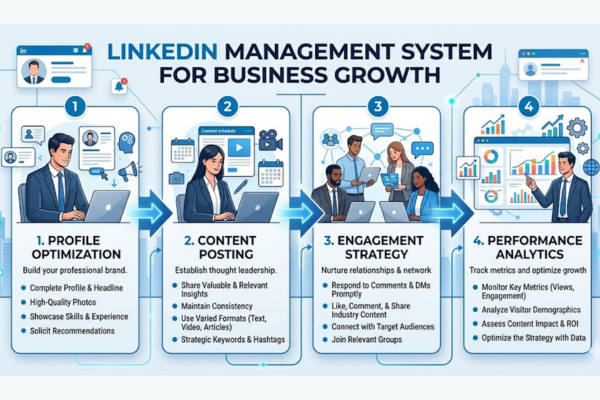
Effective LinkedIn management includes several tightly connected components:
Profile optimization: Refines headline, banner, about section, and experience using search-aligned keywords and value propositions
Content posting: Publishes consistent professional content, including insights, case studies, and short-form updates
Engagement strategy: Builds relationships through comments, direct messages, and industry conversations
Performance tracking: Measures reach, engagement rate, and profile views using LinkedIn Analytics
A data-led strategy, combined with human expertise, ensures every task supports one goal, drive real results. In practice, this includes analyzing engagement patterns, testing content formats, and aligning messaging with audience intent.
How does LinkedIn management help businesses and professionals manage profiles and pages?
LinkedIn management improves profiles and pages through structured optimization, consistent content sharing, and targeted engagement. It applies profile optimization, content sharing, and engagement systems to increase visibility, strengthen authority, and maintain active connections that support measurable growth on LinkedIn.
It refines every section of a LinkedIn profile, including headline, banner, and featured content, to align with search intent. Optimized pages increase profile views by 30–70% based on LinkedIn internal insights [site: LinkedIn Business data]. Regular updates signal activity to the platform algorithm.
Content sharing builds a consistent professional presence across feeds and search results. Posting 3–5 times weekly improves engagement rate and audience recall. High-value posts, including insights and case-based updates, position users as trusted voices.
Engagement and connection building drive long-term relationship growth. Strategic commenting, direct messaging, and network expansion improve reach beyond first-degree connections. This approach ensures business social media activity translates into real interactions and qualified visibility.
What tasks are included in LinkedIn management for daily activities?
Tasks for daily LinkedIn management include content creation, engagement, connection building, and profile monitoring. Tasks for daily LinkedIn management are listed below. These actions maintain visibility, improve audience engagement, and ensure profiles stay active within LinkedIn’s ranking and discovery systems.
Creating content creation assets such as posts, carousels, and short-form updates
Sending targeted connection requests aligned with industry or buyer personas
Responding to messages, comments, and notifications to maintain daily engagement
Updating profile sections including experience, featured posts, and skills
Monitoring LinkedIn activity insights such as impressions, clicks, and engagement rate
Engaging with industry posts to expand reach beyond direct network connections
Consistent execution of these tasks supports one goal—drive real results through sustained activity. Field-tested workflows from social media management teams show daily engagement increases profile visibility within 7–14 days.
How is LinkedIn management different from basic posting and networking?
LinkedIn management differs from basic posting and networking by using structured strategy, audience targeting, and performance tracking. It applies a data-led strategy with audience analysis and consistent engagement to achieve specific business outcomes instead of random activity.
Basic posting focuses on occasional updates without alignment to goals or audience intent. In contrast, professional LinkedIn strategy maps content to funnel stages, from awareness to conversion. This ensures every post supports visibility or lead generation, helping you decide between Social Media Management vs DIY setups.
Audience targeting separates high-value prospects from general connections. Advanced systems analyze job roles, industries, and behavior patterns using LinkedIn Analytics. This creates precise engagement loops instead of broad, ineffective networking.
Professional services also track performance metrics like reach, engagement rate, and profile clicks. According to LinkedIn Marketing Solutions documentation, data-backed campaigns improve conversion efficiency significantly [site: LinkedIn Marketing Solutions guide]. This transforms activity into measurable business growth.
How does LinkedIn management improve branding, visibility, and networking for business growth?
LinkedIn management improves branding, visibility, and networking through strategic content distribution and targeted relationship building. It strengthens brand visibility and professional networking simultaneously by aligning content, engagement, and audience targeting with business growth objectives.
Brand visibility increases through consistent professional content that reflects expertise and authority. Posting 3–5 times weekly keeps profiles active in feeds and search results. A strong professional branding framework ensures recognition across touchpoints.
Visibility expands further through engagement-driven algorithms. Active commenting and content interaction increase reach beyond first-degree networks. LinkedIn reports that engagement-driven posts receive significantly higher impressions [site: LinkedIn Engineering blog].
Networking improves through intentional connection building with decision-makers, clients, and industry leaders. Strategic outreach creates lead generation pathways while building trust over time. This turns connections into long-term business relationships.
How does LinkedIn management generate leads and business opportunities?
LinkedIn management generates leads through targeted content, strategic engagement, and conversion-focused actions. It combines connection building, content, and calls to action to attract qualified prospects and convert them into business opportunities within LinkedIn’s ecosystem.
Content attracts the right audience by addressing industry pain points and offering clear solutions. Educational posts, case studies, and insights position profiles as authority sources. This increases inbound inquiries and profile visits.
Engagement builds trust before conversion. Responding to comments, initiating conversations, and nurturing connections create familiarity. According to HubSpot’s B2B benchmark reports, relationship-driven platforms generate higher-quality leads [site: HubSpot report].
Calls to action, including direct messages and profile links, guide users toward next steps. LinkedIn Ads and organic outreach both support lead generation pipelines. This integrated approach turns visibility into measurable revenue opportunities.
Why is consistent LinkedIn activity critical for long-term growth?
Consistent LinkedIn activity is critical because it maintains visibility, strengthens credibility, and supports sustained audience engagement. Consistency ensures long-term growth by keeping profiles active and discoverable within LinkedIn’s algorithm and professional networks.
Regular posting signals relevance to LinkedIn’s ranking system. Profiles posting at least 3 times weekly maintain higher reach and engagement rates. This keeps content visible in followers’ feeds every single day.
Ongoing engagement builds trust and authority over time. Replying to comments, sharing insights, and interacting with networks reinforce professional credibility. This continuous interaction improves network retention and strengthens relationships.
Long-term growth depends on cumulative visibility and authority signals. A consistent professional presence increases profile views, connection requests, and inbound opportunities. Field observations from social media experts show stable growth within 60–90 days of disciplined activity.
How does LinkedIn management work step by step for businesses and professionals?
LinkedIn management works in a clear sequence that starts with setup and ends with lead nurturing. Each stage builds visibility, authority, and conversion pressure across the profile, content, and outreach system.
Optimize the profile or page. Update the headline, banner, summary, services, and contact details with relevant keywords.
Define audience targets. Map job titles, industries, buyer roles, and professional goals before publishing anything.
Create content. Build posts, articles, carousels, and video around expertise, proof, and audience pain points.
Schedule consistently. Use a content calendar and LinkedIn tools to publish at fixed intervals.
Engage daily. Reply to comments, send connection requests, and join relevant conversations.
Nurture leads. Move warm contacts into direct messages, follow-ups, and business conversations.
Track performance. Review impressions, engagement, follower growth, and conversions, then refine the next cycle.
How does LinkedIn management begin with profile and page optimization?
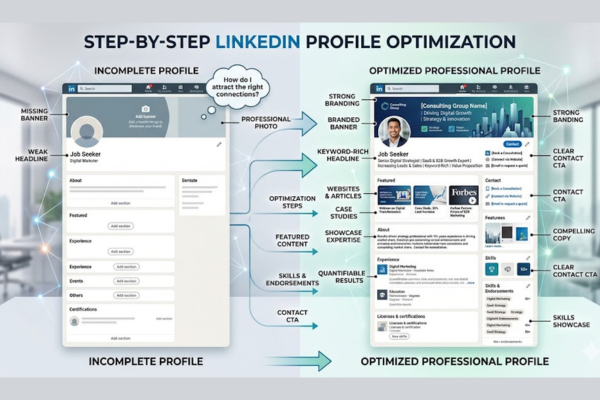
LinkedIn management begins by optimizing the profile or page for search, clarity, and trust. Strong profile optimization improves LinkedIn visibility by aligning the headline, summary, services, and featured section with audience targeting and professional branding.
The process starts with updating every core field. That includes the profile photo, banner, headline, about section, work history, and contact links. Relevant keywords help LinkedIn understand the profile and surface it to the right audience.
Customizing the page comes next. Businesses add service descriptions, branded visuals, and clear calls to action. Professionals add proof points, niche positioning, and role-specific messaging.
How are content strategies and calendars used in LinkedIn management?
Content strategies and calendars keep LinkedIn posts consistent, relevant, and goal driven. A Social Media Content Calendar turns LinkedIn activity into a repeatable system that supports professional goals, audience engagement, and steady visibility.
The strategy begins with content pillars. These usually include expertise, proof, industry insight, and relationship building. Each post serves a specific purpose.
The calendar then assigns topics, formats, and publish dates. This prevents random posting and keeps messaging aligned with campaigns, launches, and audience needs.
How is content created, scheduled, and published in LinkedIn management?
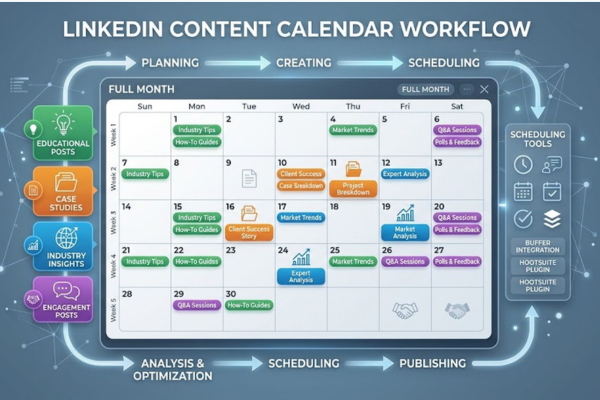
Content creation in LinkedIn management starts with a business goal and ends with scheduled publishing. Each piece of content is built to match audience interest and brand voice before it enters the posting queue.
Drafting begins with hooks, proof, and a clear takeaway. The message must stay professional, direct, and easy to scan. Strong content also supports consistency across posts and profile updates.
Scheduling tools handle publishing frequency. LinkedIn automation platforms help teams post on time, maintain rhythm, and avoid gaps in activity. That keeps the profile active without manual posting every day.
How is engagement and networking handled in LinkedIn management?
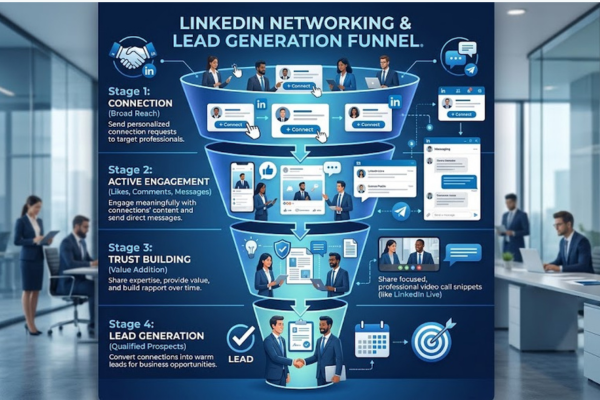
Engagement and networking work through targeted interaction, not random connection requests. Meaningful engagement builds trust before the sales conversation begins and helps professionals connect with clients, partners, and peers.
The process starts with personalized outreach. Connection requests are tailored to the person, role, or shared interest. Generic messages get less response.
Replies matter just as much. Comment responses, message follow-ups, and content interactions keep the relationship warm. That is where professional networking becomes lead nurturing.
How is performance tracked and optimized in LinkedIn management?
Performance tracking uses LinkedIn analytics to measure what content and actions produce results. Analytics turn activity into decisions by showing engagement, views, clicks, follower growth, and conversion patterns.
The review process checks post-performance, profile visits, and audience response. High-performing topics are repeated. Weak formats are replaced.
Optimization happens after the data review. That means changing headlines, post timing, content types, and outreach patterns based on actual results. The next cycle becomes sharper than the last.
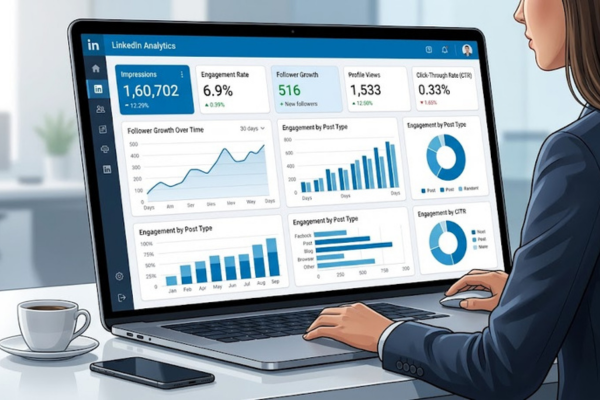
What content types are used in LinkedIn management, and how do they perform?
LinkedIn management uses posts, articles, and video to reach different audience stages. Each content type serves a different visibility and engagement function depending on the goal.
Posts perform best for reach and quick interaction. They are fast to consume and easy to share. Articles support deeper thought leadership and long-form credibility.
Video often drives strong attention because it feels personal and direct. It works well for education, brand voice, and trust building. The best mix depends on the audience and business objective, especially when comparing the performance of Static Posts vs. Video Posts.
How are headlines, summaries, and messaging handled in LinkedIn management?
Headlines, summaries, and messaging are written to capture attention and guide action. Strong messaging makes the profile easier to trust and easier to remember.
The headline should say who the person helps and how. The summary should explain expertise, outcomes, and positioning in plain language. That keeps the profile clear.
Professional tone matters throughout. Messaging must stay persuasive without sounding forced. Consistency between the profile, posts, and outreach strengthens brand voice through professional Social Media Content Creation for Businesses.
What scheduling and posting frequency are included in LinkedIn management?
Scheduling and posting frequency are based on audience behavior and content goals. A content calendar keeps posting consistently and reduces gaps in visibility.
Most teams test different posting windows before locking in a schedule. The goal is to match the times when the audience is active and responsive. To optimize this, one must ask How Many Times Per Week Should a Business Post on Social Media? to maintain maximum momentum.
Scheduling tools support this process by organizing posts in advance. They also help maintain a steady rhythm across busy weeks and campaign periods.
What analytics and reporting are included in LinkedIn management?
Analytics and reporting measure whether LinkedIn activity supports business growth. Reports show which actions improve engagement, reach, and lead flow.
Common metrics include impressions, engagement rate, follower growth, profile visits, and click-throughs. These figures reveal what the audience values most.
Reporting then feeds strategy adjustments. Weak content gets revised, strong content gets repeated, and outreach methods get refined. That creates a tighter growth loop.
How do personal branding and thought leadership perform in LinkedIn management?
Personal branding and thought leadership turn LinkedIn into a credibility engine. Consistent content and engagement build professional authority over time.
Regular sharing of industry insight keeps the profile visible and relevant. It also positions the person or business as informed and active in the field.
Thought leadership grows when the content has a clear point of view. That means useful ideas, practical examples, and direct expertise. The result is stronger trust and better recall.
How do educational and storytelling posts drive engagement in LinkedIn management?
Educational and storytelling posts drive engagement by giving LinkedIn users useful ideas and a human reason to respond. They turn expertise into trust, which increases comments, saves, shares, and profile visits across a professional audience.
Educational posts work because they solve a problem fast. Case studies, success stories, and how-to posts show proof, not noise. That makes the content easier to trust and easier to discuss.
Strong formats include:
Educational posts that explain one concept clearly.
Case studies that show a result with context.
Success stories that prove a process works.
Behind-the-scenes posts that reveal how work gets done.
Storytelling adds memory. A short narrative about a client outcome, a lesson learned, or a project win gives the audience an emotional anchor. That often produces deeper audience connection than a plain announcement.
How does content align with the buyer journey in LinkedIn management?
Content aligns with the buyer journey by matching the reader’s stage, question, and decision level. Awareness content educates, consideration content compares, and decision content converts. That structure supports lead nurturing and cleaner sales funnel movement, which is a core part of a Social Media Strategy and How It Works for Small Businesses.
At the awareness stage, posts answer broad questions and introduce the problem. At the consideration stage, they compare methods, frameworks, or services. At the decision stage, they present proof, offers, and direct calls to action.
This alignment works best when audience targeting is precise. A founder, recruiter, and operations leader need different messages. The right content speaks to the right need at the right time. [site: LinkedIn Marketing Solutions, content strategy guide]
How does LinkedIn management support lead generation through profiles and content?
LinkedIn management supports lead generation by turning the profile and content into a visible path to contact. An optimized profile plus relevant content creates conversion points that move visitors from interest to inquiry.
The profile does the first job. A strong headline, summary, and Contact Info section make it easy for prospects to identify the offer and reach out. Clear CTAs move attention toward action.
Content does the second job. Posts build credibility, answer objections, and show expertise before the first message. When the content matches the audience’s pain points, business opportunities appear more naturally. [site: LinkedIn Help Center]
How does LinkedIn management support audience and network growth?
LinkedIn management supports audience and network growth by connecting with the right people and keeping them engaged. It builds a larger network with stronger relevance, not just a bigger connection count.
Growth starts with audience selection. The strategy targets clients, partners, peers, and industry voices that match the brand’s goals. That makes the network more useful over time.
Meaningful relationships matter more than volume. Consistent comments, thoughtful messages, and useful posts keep the brand visible and credible. That improves brand visibility while expanding the professional circle. [site: LinkedIn official resources]
How does LinkedIn management grow followers organically?
LinkedIn management grows followers organically through consistent posting, useful content, and targeted outreach. Organic growth comes from relevance and engagement, not forced promotion.
LinkedIn algorithms reward posts that keep users active on the platform. Relevant content, useful comments, and steady participation raise visibility inside the feed. That improves follower acquisition without relying on paid spend. [site: LinkedIn Engineering blog]
The best organic growth patterns are simple. Publish regularly. Respond quickly. Share content that solves a real problem. That keeps attention moving toward the profile and page.
How do LinkedIn ads support LinkedIn management strategies?
LinkedIn ads support management strategies by extending reach and amplifying high-value content. Paid distribution helps the right message reach the right audience faster.
Sponsored Content is useful for promoting posts that already perform well organically. Text Ads support simple awareness campaigns. Both formats help drive traffic, retarget visitors, and support audience targeting.
Paid and organic work best together. Organic content builds trust. Ads accelerate visibility. That combination supports business goals without replacing the brand voice. [site: LinkedIn Ads documentation]
How does LinkedIn management measure and improve performance using analytics?
LinkedIn management measures performance with metrics such as impressions, engagement rates, click-through rates, and follower growth. Analytics show what content creates action and what content stalls.
The process starts with tracking. Each post, page update, and outreach action gets reviewed against a target. That makes performance visible instead of assumed.
Improvement follows the data. Strong formats are repeated. Weak hooks are rewritten. Underperforming topics are replaced with better ones. That is how content optimization becomes systematic. [site: LinkedIn analytics reference]
How often should LinkedIn management strategies be reviewed?
LinkedIn management strategies should be reviewed on a quarterly basis, with lighter checks each month. Quarterly strategy review keeps the plan aligned with business goals and market changes.
Monthly reviews catch immediate shifts in engagement and content performance. Quarterly reviews are better for bigger decisions, such as content pillars, audience focus, and lead generation priorities.
Data-driven insights make the review useful. Without numbers, the strategy becomes opinion. With analytics, it becomes a measurable system. [site: LinkedIn strategy best practices]
How does LinkedIn management support long-term strategy and authority building?
LinkedIn management supports long-term strategy by creating steady visibility, trust, and subject matter authority. Regular contribution builds professional credibility over time.
Authority grows when the profile keeps showing up with useful insight. That includes posts, comments, articles, and networking activity. Each touchpoint reinforces the same expertise.
Long-term growth comes from consistency. A quiet profile fades. An active one stays relevant. That difference matters for thought leadership, referrals, and future opportunities. [site: LinkedIn professional branding guidance]
How does LinkedIn management build consistent professional branding?
LinkedIn management builds consistent professional branding by keeping the profile, content, and messaging aligned. A cohesive brand message makes the profile easier to trust and remember.
The same voice should appear in the headline, summary, posts, and outreach. That creates a clear personal brand and a stronger professional image.
Consistency also improves opportunity quality. The right people notice the right message faster. That attracts better connections and more relevant conversations.
Why does LinkedIn management strengthen overall marketing and sales strategy?
LinkedIn management strengthens marketing and sales strategy by connecting profile visibility, content, and outreach into one system. It supports lead generation, improves qualification, and keeps the sales funnel moving from first view to direct conversation.
It also aligns LinkedIn with email, website, and broader social media marketing. That creates message consistency across channels and makes each touchpoint reinforce the next.
When the content, profile, and outreach all point to the same offer, sales teams waste less time. Prospects see one clear value proposition, not scattered messaging.
How does LinkedIn management scale to support business, career, and network growth?
LinkedIn management scales by adjusting content, outreach, and engagement as goals change. Scalability keeps the platform useful for a solo professional, a growing business, or a large network.
At an early stage, the focus is profile clarity, founder visibility, and connection building. At a later stage, the focus shifts to content systems, team involvement, and lead nurturing. The process changes with demand.
That flexibility matters. A static LinkedIn approach stalls, while a scalable one supports hiring, partnerships, referrals, and broader professional development.
How are costs, tools, pricing models, and ROI evaluated in LinkedIn management?
Costs are evaluated by comparing Social Media Management Cost, service fees, software, and the time saved by outsourcing. ROI is measured against leads, engagement, and brand lift, not vanity activity.
Pricing models usually include monthly retainers, project-based work, or hourly support. Tools can include scheduling software, analytics dashboards, CRM integrations, and ad platforms such as Campaign Manager.
The best ROI review looks at conversions, qualified conversions, and pipeline influence. If LinkedIn drives fewer clicks but better prospects, the strategy is working.
When should businesses and professionals rely on services related to LinkedIn management?
Businesses and professionals should rely on LinkedIn management services when time, expertise, or consistency is limited. Outsourcing becomes valuable when LinkedIn must produce results without daily internal attention.
It makes sense during growth phases, hiring cycles, product launches, and brand repositioning. It also helps when leaders need a stronger online presence but cannot manage it well themselves.
Services are useful when the platform must support prospecting, authority building, or partnership growth. In those cases, delayed action costs more than the service fee.
Why outsource LinkedIn management instead of handling it in-house?
Outsourcing LinkedIn management brings specialist expertise—answering the fundamental question: What Is Social Media Management?—faster execution, and steadier results. A professional service reduces internal drag and keeps the strategy active even when the team is busy.
In-house management works best when the team already has time, writing skill, and platform knowledge. Outside support is stronger when those resources are split across other priorities.
That separation lets the business focus on core operations while the LinkedIn system keeps working. It also reduces gaps in posting, outreach, and follow-up.
Should you invest in services that support LinkedIn management early?
Yes, early investment creates a stronger base for visibility and trust. Starting early compounds professional credibility and makes later growth easier.
A young profile benefits from consistent posting, clearer positioning, and better networking habits. Those assets take time to build, and early action shortens that runway.
It also improves future opportunity flow. A profile with history, engagement, and useful content converts better than one built under pressure.
How do in-house efforts complement LinkedIn management services?
In-house teams complement LinkedIn management by supplying brand knowledge, approvals, and real business context. That collaboration keeps messaging accurate and aligned with company goals.
Internal teams know product details, customer language, and strategic priorities. The service team turns that input into posts, outreach, and optimization.
This partnership improves consistency. It also reduces the gap between marketing intent and LinkedIn execution.
Why do content calendars and planning systems support LinkedIn management?
Content calendars and planning systems keep LinkedIn activity timely, relevant, and organized. They turn posting into a repeatable workflow instead of a reactive task.
Planning also makes it easier to match content with launches, campaigns, and seasonal priorities. That keeps messaging aligned with business goals.
A calendar improves content consistency and audience expectation. People respond better when the profile shows up with a clear rhythm.
How do automation tools enhance workflows related to LinkedIn management?
Automation tools enhance workflows by speeding up scheduling, tracking, and repetitive tasks. They improve efficiency without removing strategy.
Scheduling tools let teams plan posts in advance and maintain posting frequency. Analytics tools make performance review faster and more accurate.
Automation also helps with reminders, workflow handoffs, and reporting. That frees time for higher-value work like messaging, relationships, and lead nurturing.