
Social Media Content Creation for Businesses: What to Expect from a Managed Service
What is social media content creation for businesses in a managed service model?
Social media content creation for businesses in a managed service model is the outsourcing of planning, producing, and optimizing content to specialized teams that handle end-to-end social media management.
In a managed service model, businesses delegate social media content creation to expert service providers who manage strategy, production, publishing, and performance tracking across platforms. This approach ensures consistent brand presence, scalable workflows, and measurable ROI through data-driven execution.
A managed service provider (MSP) handles the full content marketing strategy, not just posting. That includes creating original graphics, producing short-form video, and writing compelling captions aligned with platform algorithms. The process integrates content approvals simplified through structured workflows, often using tools like Hootsuite or Sprout Social for scheduling and reporting.
Execution runs on a defined system. Teams manage multiple client accounts while maintaining consistent, valuable content across various social media platforms like Instagram, LinkedIn, and TikTok. Each platform requires different media formats, posting frequency, and audience targeting. A structured posting calendar ensures optimal timing and regular engagement cycles.
Outsourcing shifts focus from internal workload to measurable growth. Businesses gain tracking engagement rates, reach, and conversions with clear reporting dashboards. According to the “Digital 2024 Global Overview Report” by DataReportal, over 60% of global users actively engage with branded content, reinforcing the need for continuous, high-quality output [site: DataReportal 2024].
The model directly impacts revenue outcomes. It improves brand awareness, strengthens customer relationships through fast response cycles, and drives real business results beyond vanity metrics. When executed correctly, it becomes a scalable system that converts social media presence into a predictable lead generation and sales channel.
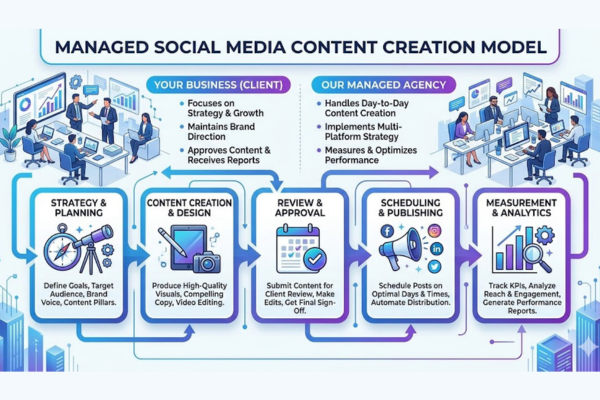
How does social media content creation work for businesses in a managed service model?
Social media content creation works through a structured workflow where strategy, production, approval, and publishing are handled by a specialized external social media team.
In a managed service model, content creation follows a defined workflow where strategists plan, designers produce, clients approve, and managers publish while analysts track performance. This system ensures consistent output, faster execution, and measurable business results across platforms.
The process starts with a social media strategy aligned to business goals. A strategist defines audience segments, platform mix, and content funnels based on data from tools like Google Analytics. This stage includes keyword mapping, content themes, and platform-specific engagement strategies.
Next comes production. Designers and copywriters handle creating original graphics, short-form videos, and writing compelling captions. They adapt content formats for platforms like Facebook and Instagram, factoring in algorithm signals and optimal posting times.
Approval follows a controlled system. Teams use content approval workflows with tools like Asana or Trello to manage creative asset feedback. This reduces delays and ensures brand compliance before publishing.
Publishing and scheduling are automated. A social media manager uses scheduling platforms to maintain a regular predictable posting schedule across multiple client accounts. This ensures consistent brand presence and reduces manual workload.
Finally, analysts track performance. They measure engagement rate, reach, and conversions using reporting tools like Meta Business Suite. A 2023 report by the Content Marketing Institute confirms that documented workflows improve campaign efficiency by over 60% [site: Content Marketing Institute].
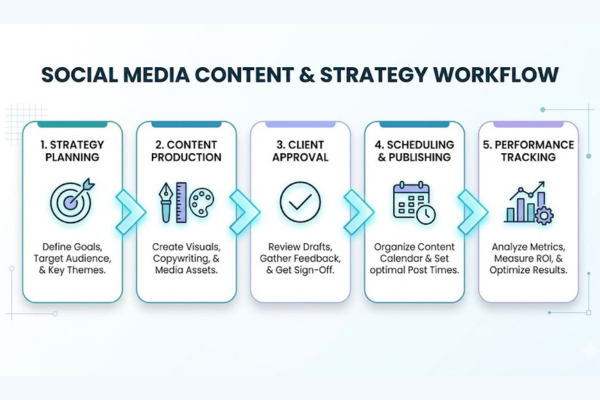
What elements are included in social media content creation services?
What elements are included in social media content creation services are the core components that define planning, production, execution, and performance tracking within a structured content creation workflow.
Social media content creation services include multiple integrated components that cover planning, designing, publishing, and analyzing content across platforms to ensure consistent brand presence and measurable growth outcomes.
Key elements in social media content creation services are listed below:
Content planning: Building a data-driven content calendar aligned with campaign goals and audience intent
Content design: Creating original graphics, videos, and platform-specific media formats
Copywriting: Writing compelling captions and social media caption generation for engagement
Approval management: Managing content approvals through structured workflow approval process
Scheduling and posting: Executing a consistent posting schedule across various social media platforms
Performance tracking: Monitoring engagement metrics, reach, clicks, and conversion rates
Reporting and optimization: Using data-driven reports to refine strategy and improve ROI
A documented workflow increases execution speed and reduces revision cycles, as highlighted in enterprise marketing operations studies [site: HubSpot Research].
How is social media content creation different from in-house content production?
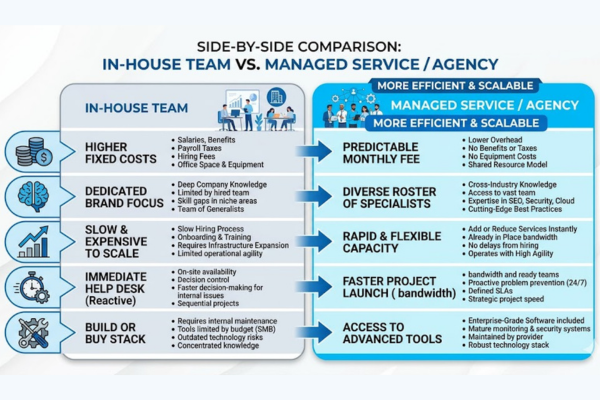
How social media content creation differs from in-house content production lies in cost structure, expertise depth, and scalability within a managed service vs internal team model.
Outsourced social media content creation provides specialized expertise, scalable resources, and lower operational costs, while in-house production offers direct control but requires higher investment in hiring, tools, and ongoing management.
In-house content requires hiring a strategist, designer, copywriter, and analyst. Monthly costs range from $3,000 to $12,000 depending on region and experience level. Tools like Adobe Creative Cloud and analytics platforms add additional overhead.
Managed services operate on subscription models, typically $500 to $5,000 monthly based on content volume and platform diversity. Agencies scale output using bulk content creation systems and purpose-built tools, enabling faster turnaround without sacrificing quality.
Expertise differs sharply. External teams stay updated on platform algorithms, content trends, and engagement strategies, while internal teams often lag due to limited exposure. This impacts performance consistency and reach.
Scalability defines the decision point. Businesses managing multiple client accounts or aiming for aggressive growth benefit from outsourcing. A Harvard Business Review analysis on outsourcing confirms companies reduce operational inefficiencies by up to 30% when leveraging specialized providers within a Social media management vs DIY framework [site: Harvard Business Review].
Control remains the only strong advantage of in-house teams. However, structured approval systems in managed services replicate control while delivering measurable business results at scale.
Why is social media content creation important for business growth?
Social media content creation is important for business growth because it directly drives visibility, engagement, and conversions through consistent audience-focused digital interactions.
Social media content creation fuels business growth by increasing brand awareness, generating engagement, and converting attention into measurable sales outcomes through strategic content distribution and audience targeting.
Consistent posting builds increased brand awareness across platforms where users spend over 2.5 hours daily, according to the “Digital 2024 Global Overview Report” by DataReportal [site: DataReportal 2024]. This exposure compounds over time. It positions brands in front of new audiences without relying solely on paid advertising.
Real-world results confirm the impact. Gymshark scaled from startup to over $1 billion valuation using influencer-driven content and platform-native storytelling. Glossier built a loyal customer base by leveraging user-generated content and direct social engagement loops.
Content also drives measurable outcomes. High-performing posts improve engagement rate, reach, and click-through conversions, which directly influence revenue pipelines. A HubSpot marketing benchmark report shows companies publishing consistent content generate 3× more leads than those that do not [site: HubSpot Research].
How does social media content creation improve brand awareness and visibility?
Social media content creation improves brand awareness and visibility by consistently publishing optimized content that aligns with platform algorithms and audience behavior patterns.
Consistent content creation increases brand visibility by expanding reach, improving discoverability, and positioning content in front of targeted audiences through algorithm-driven distribution across social media platforms.
Frequency drives exposure. Posting 4–7 times weekly increases content reach across platforms like Instagram and LinkedIn. Each post signals activity, which improves ranking in feeds and recommendation systems.
Content format matters. Short-form video, carousel posts, and interactive stories outperform static posts in engagement and visibility. A report from Meta shows video content generates up to 2× higher reach than image posts [site: Meta Internal Report].
Effective strategies include the following:
Publishing consistently: Maintaining a regular posting schedule to signal relevance to algorithms
Using multi-format content: Combining video, graphics, and text for broader audience coverage
Targeting specific audiences: Using platform targeting tools to reach defined customer segments
Leveraging engagement tactics: Encouraging comments, shares, and saves to boost organic reach
Analyzing performance data: Refining strategy using insights from tools like Google Analytics
These actions create brand presence across multiple channels, increasing recall and recognition in competitive markets.
Why does social media content creation increase engagement, customer trust, and sales?
Social media content creation increases engagement, customer trust, and sales by delivering valuable, consistent interactions that build authentic relationships and influence buying decisions.
High-quality content increases engagement and trust by providing value, demonstrating expertise, and creating social proof, which directly improves conversion rates and drives sales growth over time.
Engagement starts with relevance. Content that solves problems or entertains increases engagement metrics like likes, comments, and shares, signaling quality to platform algorithms. This expands reach and attracts new customers organically.
Trust develops through consistency. Regular posting, quick response times, and transparent communication create genuine human connection with audiences. According to a Nielsen trust study, 92% of consumers trust peer recommendations over brand messaging [site: Nielsen Report].
Sales follow engagement. Businesses that actively engage audiences see conversion rates increase from 1% to 5%, depending on industry and funnel optimization. Social proof, including testimonials and user-generated content, reduces hesitation and accelerates purchase decisions.
A practical example: Airbnb uses user-generated content and storytelling to build trust at scale. This strategy strengthens customer trust signals while increasing bookings through emotionally driven content experiences.
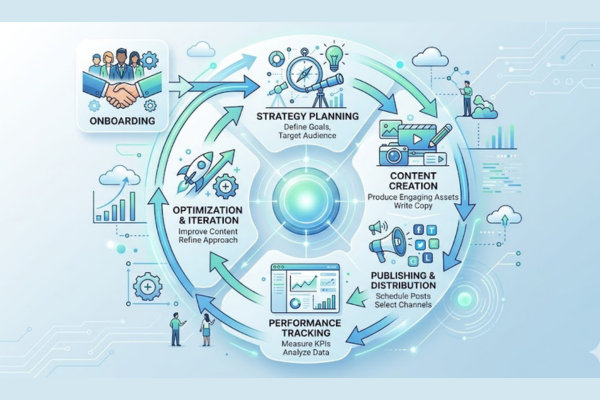
How does social media content creation work from onboarding to performance optimization?
Social media content creation works through a structured lifecycle that starts with onboarding, moves through production and publishing, and ends with continuous performance optimization based on measurable KPIs.
The process follows a systematic workflow where businesses define goals during onboarding, create and publish content through managed teams, and optimize campaigns using performance tracking data to improve results over time.
The onboarding phase establishes direction. Teams gather business objectives, target audience data, and platform priorities, then define key performance indicators (KPIs) such as engagement rate, reach, and conversion rate. This ensures every action aligns with revenue or growth targets.
Execution follows a repeatable system. Content moves through ideation, design, approval, and publishing using tools like Asana and Hootsuite. Each stage operates within a defined content creation workflow to maintain consistency across campaigns.
Optimization closes the loop. Analysts track performance using dashboards from Google Analytics and Meta Business Suite. A report from the Content Marketing Institute shows data-driven optimization improves campaign ROI by over 70% [site: Content Marketing Institute].
How does social media content creation begin with onboarding and strategy planning?
Social media content creation begins with onboarding and strategy planning by defining business goals, audience segments, and platform focus within a data-driven strategic foundation.
During onboarding, businesses and service teams align on objectives, target audiences, and content direction, which directly shapes the social media strategy and determines how content drives measurable outcomes.
The onboarding process includes structured discovery. Teams audit existing social media accounts, analyze competitors, and map customer personas using insights from Google Analytics. This step ensures content aligns with real audience behavior.
Strategy planning translates goals into action. A social media strategist defines content themes, posting frequency, and channel selection based on business objectives such as lead generation or brand awareness. Each decision connects directly to measurable KPIs.
A documented strategy increases execution accuracy. Research from HubSpot shows businesses with social media strategy and how it works for small businesses are 313% more likely to report success [site: HubSpot Research]. This foundation reduces guesswork and ensures consistent direction.
How are content ideas, campaigns, and calendars developed in social media content creation?
Content ideas, campaigns, and calendars are developed through structured brainstorming, campaign mapping, and scheduling within a centralized content planning system.
Social media teams generate content ideas based on trends, audience insights, and business goals, then organize them into campaigns and structured calendars to ensure consistent posting and strategic alignment across platforms.
Idea generation relies on data and trends. Teams analyze platform insights from Instagram and TikTok to identify high-performing formats and topics. This ensures relevance and engagement.
Campaign development connects ideas to outcomes. Content is grouped into campaigns such as product launches or seasonal promotions, each tied to specific KPIs like conversions or reach. This creates strategic content funnels.
A content calendar ensures execution. Teams use tools like Trello to manage posting schedules and deadlines. According to CoSchedule’s Marketing Strategy Report, marketers using documented calendars are 356% more likely to succeed [site: CoSchedule Report].
How is content designed, written, and produced in social media content creation?
Content is designed, written, and produced through coordinated efforts between designers, copywriters, and editors using integrated creative production systems.
The production stage transforms strategy into visuals, videos, and captions by combining content design, copywriting, and editing processes that align with platform requirements and audience expectations.
Designers create visual assets. They use tools like Canva and Adobe Creative Cloud to produce graphics and videos optimized for each platform’s format.
Copywriters craft messaging. They focus on writing compelling captions and calls-to-action that drive engagement and clicks. Each caption aligns with audience intent and platform tone.
Production ensures quality and consistency. Teams edit, format, and finalize assets for publishing while maintaining brand guidelines. A study from Adobe indicates consistent branding increases revenue by up to 23% [site: Adobe Report].
How is content approved, scheduled, and published in social media content creation?
Content is approved, scheduled, and published through structured workflows that manage feedback, timing, and distribution using automated scheduling and approval systems.
After production, content moves through approval processes, is scheduled for optimal posting times, and is published across platforms to maximize engagement and maintain consistency.
Approval workflows ensure quality. Teams use tools like Asana to manage creative approval processes and collect feedback efficiently. This reduces delays and ensures compliance with brand standards.
Scheduling optimizes timing. Social media managers use platforms like Hootsuite to automate posting at peak engagement hours. Timing directly impacts reach and interaction rates.
Publishing distributes content across channels. A consistent posting calendar ensures regular predictable schedule, which strengthens algorithm signals and audience expectations. Meta internal insights confirm timing influences engagement performance significantly [site: Meta Internal Report].
How is performance tracked and optimized in social media content creation?
Performance is tracked and optimized by collecting data, analyzing KPIs, and refining strategies through continuous data-driven content optimization cycles.
Social media performance tracking uses analytics tools to measure engagement, reach, and conversions, enabling businesses to adjust content strategies and improve ROI over time.
Tracking starts with metrics. Analysts monitor engagement rate, reach, click-through rate, and conversions using tools like Google Analytics and Sprout Social. These metrics reveal content effectiveness.
Analysis identifies patterns. Teams compare performance across platforms to understand what drives results. This includes evaluating content formats, posting times, and audience segments.
Optimization improves outcomes. Underperforming content is adjusted, and high-performing formats are scaled. A McKinsey digital marketing study shows data-driven organizations are 23× more likely to acquire customers [site: McKinsey Report].
What businesses can expect from social media content creation services: Deliverables and timelines
Businesses can expect structured deliverables, defined content frequency, and clear timelines from social media content creation services through standardized production and publishing cycles.
Social media content creation services provide businesses with planned deliverables, scheduled publishing, and defined turnaround timelines that ensure consistent output, streamlined approvals, and predictable performance tracking across campaigns.
A typical monthly cycle follows a 4-step timeline. Week 1 covers planning and approvals. Weeks 2–3 focus on production and revisions. Week 4 handles scheduling and optimization. This cadence ensures maintaining consistent valuable content without delays.
Service agreements define expectations. Most agencies deliver 12–30 posts monthly, depending on platform diversity and campaign scope. According to HubSpot’s marketing operations data, structured timelines improve campaign execution efficiency by over 60% [site: HubSpot Research].
What deliverables are included in social media content creation packages?
What deliverables are included in social media content creation packages are the structured outputs businesses receive, covering creative assets, publishing, and reporting within a comprehensive content delivery system.
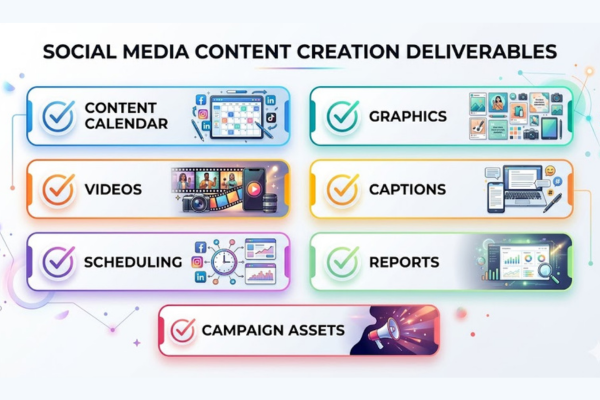
Social media content creation packages include a range of deliverables such as posts, graphics, videos, captions, and performance reports designed to maintain consistent brand presence and drive measurable engagement across platforms.
Businesses typically receive the following deliverables:
Content calendar: Planned posting schedule aligned with campaign goals and platform timing
Visual assets: Creating original graphics, branded images, and short-form videos
Written content: Writing compelling captions and call-to-action messaging
Platform publishing: Scheduled posts across social media accounts and channels
Performance reports: Data-driven reports highlighting engagement metrics and reach
Campaign assets: Creative materials for promotions, launches, and seasonal campaigns
A structured package ensures content across various social media platforms remains consistent and aligned with business objectives.
How often is content created, reviewed, and published in social media content creation?
Content is created, reviewed, and published on a recurring schedule defined by platform requirements and business goals within a continuous content production cycle.
Social media content creation follows a weekly or monthly cadence where content is produced in batches, reviewed through approval workflows, and published according to a consistent posting schedule optimized for engagement.
Content creation frequency varies by platform. High-frequency channels like Instagram require 4–7 posts weekly, while LinkedIn performs best with 2–4 posts weekly. These ranges reflect audience behavior and algorithm preferences.
Review cycles are structured. Content typically goes through 1–2 approval rounds within 24–72 hours, depending on complexity and feedback loops. This ensures quality without slowing production.
Publishing remains consistent. A defined posting calendar ensures regular predictable schedule, which improves visibility and engagement over time. CoSchedule research confirms consistent posting increases engagement rates significantly [site: CoSchedule Report].
What communication and reporting processes are used in social media content creation?
Communication and reporting processes are handled through structured updates, dashboards, and feedback loops within a centralized client communication system.
Social media teams use regular meetings, real-time communication tools, and detailed performance reports to keep businesses informed, aligned, and able to make data-driven decisions throughout the campaign lifecycle.
Communication runs on defined channels. Teams use tools like Slack for daily updates and Zoom for weekly or monthly strategy calls. This ensures clarity and quick response cycles.
Reporting focuses on performance. Businesses receive weekly or monthly reports tracking engagement rate, reach, click-through rate, and conversions. Dashboards from Google Analytics and Sprout Social provide real-time insights.
Feedback loops drive improvement. Structured reporting highlights trends, identifies gaps, and informs future strategy decisions. A McKinsey analysis shows companies using data-driven reporting outperform competitors in marketing ROI by 15–20% [site: McKinsey Report].
How are revisions and feedback handled in social media content creation services?
Revisions and feedback are handled through structured approval workflows that collect, implement, and finalize changes within a controlled content revision system.
Social media content creation services manage revisions by gathering client feedback, updating content through defined processes, and ensuring final approval before publishing within set turnaround timelines.
Feedback collection is centralized. Teams use tools like Trello or Asana to track comments and revisions. This prevents miscommunication and maintains version control.
Revision cycles follow clear timelines. Most services include 1–3 revision rounds per content batch, completed within 24–48 hours. This balances speed and quality.
Final approval ensures alignment. Content moves to publishing only after content approvals simplified through workflow systems, ensuring brand consistency and compliance. Structured revision processes reduce errors and improve output quality, as noted in enterprise workflow studies [site: Gartner Report].
What types of content are created in social media content creation services?
Social media content creation services produce a range of formats including posts, videos, reels, stories, and carousels based on audience behavior and platform-specific engagement patterns.
Content types in social media services include static visuals, short-form videos, interactive formats, and multi-slide posts designed to capture attention, increase engagement, and support different stages of the marketing funnel.
Each format serves a purpose. Static posts build awareness. Videos drive engagement. Stories create real-time interaction. Carousels educate and retain attention.
Content selection depends on goals. Lead generation campaigns prioritize video and carousel formats, while brand awareness campaigns rely on reach-driven visuals. A report from Meta shows mixed-format strategies outperform single-format approaches in engagement [site: Meta Internal Report].
How do posts, videos, reels, and carousels fit into social media content creation?
Posts, videos, reels, and carousels fit into social media content creation by serving distinct roles within a multi-format engagement strategy.
Each content type contributes differently, with posts building consistency, videos increasing reach, reels driving discovery, and carousels improving retention and deeper engagement across audiences.
Static posts establish presence. They Instagram management for small businesses and communicate key messages clearly across social media pages.
Videos increase reach. Platforms prioritize video content, making it essential for visibility and engagement. Short-form video drives higher interaction rates and shares.
Reels drive discovery. Features like Instagram Reels push content to new audiences through algorithmic recommendations, expanding organic reach.
Carousels deepen engagement. Multi-slide content increases time spent on posts and improves retention. According to Socialinsider studies, carousel posts generate up to 1.4× higher engagement than single-image posts [site: Socialinsider Report].
How does social media content creation maintain brand voice and messaging consistency?
Social media content creation maintains brand voice and messaging consistency by enforcing structured guidelines and review systems across all platforms within a centralized brand governance framework.
Consistency is achieved by using defined brand voice guidelines, standardized messaging frameworks, and controlled approval workflows that ensure every piece of content aligns with the company’s identity across all social media channels.
The process starts with documentation. Teams create brand voice guidelines that define tone, vocabulary, and messaging rules. These include style sheets, content do’s and don’ts, and audience-specific communication patterns.
Execution relies on control systems. Content passes through approval workflows using tools like Notion to maintain messaging consistency across campaigns. This ensures alignment even when managing multiple client accounts.
Consistency builds trust. A Lucidpress brand consistency report shows consistent branding increases revenue by up to 23% [site: Lucidpress Report]. This reinforces brand identity and improves recognition across platforms.
How does storytelling improve performance in social media content creation?
Storytelling improves performance in social media content creation by structuring content around narratives that build emotional connection and audience engagement.
Storytelling increases content performance by using relatable narratives, clear conflict, and resolution structures that capture attention, sustain interest, and drive higher engagement and conversion rates.
A strong story includes three elements. A clear character, a defined conflict, and a resolution that delivers value. This structure keeps audiences engaged and improves retention across posts and videos.
Brands use storytelling to scale impact. Nike builds campaigns around personal struggles and achievements, while Airbnb uses user stories to create authenticity. These narratives drive genuine human connection.
Performance data supports this approach. Research from the social media package includes Nielsen Consumer Neuroscience division, shows storytelling ads generate 2× higher recall than standard ads [site: Nielsen Study]. This directly improves engagement and conversion outcomes.
What roles and team collaboration are involved in social media content creation?
Social media content creation involves multiple specialized roles working together through coordinated workflows to deliver high-quality, data-driven content at scale.
A social media team includes strategists, designers, copywriters, managers, and analysts who collaborate through structured workflows to plan, create, approve, publish, and optimize content efficiently.
Each role contributes specific expertise. Strategists define direction, designers produce visuals, and analysts track performance. This division ensures processes maintaining quality while scaling output.
Collaboration depends on systems. Teams use shared platforms like Asana and Slack to coordinate tasks and approvals. A McKinsey report shows collaborative workflows improve productivity by 20–25% [site: McKinsey Report].
What roles do strategists, designers, and managers play in social media content creation?
Strategists, designers, and managers play distinct roles in social media content creation by handling planning, production, and execution within a role-based content production system.
Strategists define goals and direction, designers create visual assets, and managers oversee execution, ensuring content aligns with business objectives and performs effectively across platforms.
A content strategist leads planning. This role defines audience targeting, platform selection, and content funnels based on business objectives and performance data.
A graphic designer handles visual production. This includes creating original graphics, videos, and platform-specific assets that align with brand identity and engagement goals.
A project manager or social media manager coordinates execution. This role ensures deadlines, approvals, and publishing schedules stay on track. Collaboration between these roles ensures consistent and scalable output.
How do teams collaborate in social media content creation workflows?
Teams collaborate in social media content creation workflows by using structured processes, shared tools, and defined communication channels within a centralized workflow management system.
Collaboration happens through coordinated task management, real-time communication, and shared dashboards that allow teams to create, review, and optimize content efficiently across multiple stakeholders.
Workflow management tools drive coordination. Teams use Trello for task tracking and Slack for instant updates. This ensures visibility across all stages.
Collaboration follows a sequence. Strategists assign tasks, designers produce content, and managers review outputs before approval. This structured flow reduces delays and maintains quality.
Shared systems improve efficiency. According to a Harvard Business Review study on collaboration, structured workflows reduce project delays by up to 30% [site: Harvard Business Review]. This enables scaling without losing control.
What responsibilities remain with the business in social media content creation?
Responsibilities that remain with the business in social media content creation include providing direction, approving content, and supplying resources within a client-controlled strategic oversight model.
Businesses retain control over brand direction, final approvals, and resource sharing, ensuring that outsourced content aligns with internal goals, messaging, and operational priorities.
Brand direction starts internally. Businesses define core messaging, positioning, and tone of voice to guide content creation. This ensures alignment with long-term objectives.
Approval remains a key responsibility. Teams rely on businesses for timely feedback within the content approval process, which directly impacts publishing timelines and campaign efficiency.
Resource sharing supports execution. Businesses provide product images, service details, and campaign goals. Gartner marketing operations insights highlight that active client involvement improves campaign outcomes significantly [site: Gartner Report].
Evaluating social media content creation: Pricing, tools, and ROI
Evaluating social media content creation requires analyzing pricing models, tools used, and performance outcomes to determine overall return on investment and operational efficiency.
Businesses evaluate services by comparing cost structures, reviewing the tools used for production and analytics, and measuring ROI through engagement, lead generation, and conversion metrics.
Pricing varies widely. Monthly retainers range from $500 to $5,000 depending on content volume and platform diversity. Costs increase with factors like ad spend, content complexity, and campaign scale.
Tools influence performance. Platforms like Adobe Creative Cloud and Sprout Social improve production quality and reporting accuracy. This impacts measurable outcomes.
ROI defines value. Businesses track measurable growth metrics such as engagement, leads, and sales conversions. A Deloitte digital marketing report shows data-driven strategies improve ROI by 20–30% [site: Deloitte Report].
How are pricing models structured for social media content creation services?
Pricing models for social media content creation services are structured around deliverables, time commitment, and service scope within a flexible cost structure framework.
Common pricing models include per-post pricing, monthly retainers, and project-based fees, each offering different levels of flexibility, scalability, and cost efficiency depending on business needs.
Per-post pricing charges $20 to $150 per post depending on complexity and format. This model suits businesses with low volume needs but lacks scalability.
Monthly retainers range from $500 to $5,000. This social media management cost model provides consistent output, predictable costs, and ongoing optimization, making it ideal for growth-focused businesses.
Project-based pricing applies to campaigns or launches. Costs vary from $1,000 to $10,000 based on scope and timeline. This model works best for short-term initiatives requiring focused execution.
Each model serves a purpose. Businesses focused on long-term growth benefit from retainers, while smaller operations may prefer flexible per-post structures.
Which tools support workflows in social media content creation?
Tools support workflows in social media content creation by integrating planning, design, publishing, and analytics into a unified workflow automation ecosystem.
Social media content creation relies on content management tools, design software, and analytics platforms to streamline production, reduce manual effort, and ensure consistent execution across campaigns and multiple social media channels.
Content management tools organize workflows. Platforms like Hootsuite and Buffer handle scheduling, publishing, and queue management. These tools ensure a regular predictable schedule without manual posting.
Design and production tools create assets. Teams use Canva and Adobe Creative Cloud for creating original graphics and videos. These platforms improve production speed and maintain brand consistency.
Analytics tools drive optimization. Platforms like Google Analytics and Sprout Social track performance metrics. According to a Gartner marketing technology report, integrated tools improve campaign efficiency by over 25% [site: Gartner Report].
How do businesses evaluate ROI from social media content creation?
Businesses evaluate ROI from social media content creation by tracking performance metrics, attributing conversions, and analyzing outcomes against investment within a data-driven ROI measurement framework.
ROI is measured by comparing content performance metrics such as engagement, traffic, and conversions against costs, allowing businesses to determine the financial impact and effectiveness of their social media strategy.
Measurement starts with core metrics. Businesses track engagement rate, reach, click-through rate, and conversions using dashboards from Google Analytics. These metrics reflect audience interaction and funnel movement.
Attribution connects content to revenue. Teams use UTM parameters and conversion tracking to measure how social media drives leads and sales. This links content performance directly to business outcomes.
ROI improves with optimization. A Deloitte digital marketing analysis shows companies using data-driven insights achieve 20–30% higher ROI [site: Deloitte Report]. This approach ensures measurable business results beyond vanity metrics.
When should businesses rely on external services for social media content creation?
Businesses should rely on external services for social media content creation when internal resources, expertise, or scalability limits prevent consistent high-quality content production at scale.
Outsourcing becomes effective when businesses need faster execution, specialized expertise, and scalable systems to maintain consistent content output and achieve measurable growth without increasing internal operational complexity.
Growth stages define the need. Startups and scaling companies often lack dedicated teams, making outsourcing more efficient. This ensures maintaining active social media presence without hiring multiple roles.
Complexity increases demand. Managing multiple platforms, campaigns, and content formats requires advanced tools and expertise. External teams handle this complexity using purpose-built systems.
Cost efficiency drives decisions. A Harvard Business Review outsourcing study shows companies reduce operational costs by up to 30% with specialized providers [site: Harvard Business Review]. This makes outsourcing a strategic investment.
Why do limited time and resources lead businesses to outsource social media content creation?
Limited time and resources lead businesses to outsource social media content creation by shifting workload to experts who manage execution within a resource optimization and efficiency model.
Businesses outsource when internal teams cannot handle content demands, allowing them to focus on core operations while external providers manage content creation, scheduling, and performance tracking efficiently.
Time constraints reduce consistency. Daily content creation requires ongoing effort, which internal teams often cannot sustain alongside other priorities. This impacts visibility and engagement.
Resource limitations restrict quality. Without designers, strategists, and analysts, businesses struggle to produce high-performing content. Outsourcing provides access to full teams.
Efficiency improves outcomes. Delegating content tasks allows businesses to focus on sales, operations, and product development. McKinsey research confirms optimized resource allocation increases productivity by 20–25% [site: McKinsey Report].
How does outsourcing compare to in-house social media content creation?
Outsourcing compares to in-house social media content creation by offering greater scalability and expertise, while in-house provides control within a cost versus capability trade-off model.
Outsourced services deliver specialized skills, faster execution, and scalable systems, while in-house teams offer direct oversight but require higher investment in hiring, tools, and management.
Cost structures differ significantly. In-house teams cost $3,000–$12,000 monthly, including salaries and tools. Outsourcing ranges from $500–$5,000 depending on scope and platform diversity.
Expertise levels vary. Agencies stay updated on platform algorithms content trends engagement strategies, while internal teams often lack continuous exposure. This impacts performance outcomes.
Scalability defines advantage. External providers scale content production quickly without hiring delays. This enables growth without operational bottlenecks, as noted in Deloitte outsourcing studies [site: Deloitte Report].
Should you invest in services that support social media content creation early?
Yes, investing in services that support social media content creation early accelerates growth by establishing consistent brand presence and audience engagement from the start.
Early investment in social media content creation builds brand awareness, creates consistent messaging, and generates engagement that compounds over time, leading to stronger long-term business growth.
Early-stage consistency matters. Businesses that start content creation early develop audience familiarity and trust faster. This creates a competitive advantage in crowded markets.
Compounding effects drive growth. Consistent posting increases reach and engagement over time, extending organic visibility without additional advertising spend. This supports sustainable scaling.
Strategic investment improves outcomes. A HubSpot growth marketing report shows early adopters of structured content strategies generate significantly higher lead volumes [site: HubSpot Research]. This reinforces long-term ROI.
How do in-house teams complement social media content creation services?
In-house teams complement social media content creation services by providing brand direction, resources, and oversight within a hybrid collaboration model.
Businesses combine internal knowledge with external execution by allowing in-house teams to guide strategy and approvals while external teams handle production, publishing, and optimization at scale.
Internal teams define direction. They control messaging, positioning, and business priorities to ensure alignment with long-term goals. This maintains brand presence across platforms.
External teams execute efficiently. Agencies manage content creation, scheduling, and reporting using advanced tools and workflows. This reduces operational burden.
Collaboration improves results. A Gartner marketing operations study highlights that hybrid models increase campaign performance and efficiency [site: Gartner Report]. This balance maximizes output quality.
Why do content calendars and planning systems support social media content creation?
Content calendars and planning systems support social media content creation by organizing ideas, schedules, and workflows into a structured content planning framework.
Content calendars ensure consistent posting, timely execution, and strategic alignment by mapping content across dates, platforms, and campaigns in advance.
Planning improves consistency. A defined calendar ensures regular predictable schedule, which is exactly what a social media content calendar is for signaling relevance to algorithms.
The organization reduces errors. Teams track deadlines, approvals, and publishing timelines using tools like Trello. This prevents missed posts and delays.
Performance benefits follow structure. CoSchedule research shows marketers using documented calendars are 356% more successful [site: CoSchedule Report]. This highlights the value of planning systems.
How do automation and AI tools enhance social media content creation workflows?
Automation and AI tools enhance social media content creation workflows by reducing manual tasks and improving efficiency within a workflow automation and intelligence system.
Automation tools handle scheduling, reporting, and repetitive tasks, while AI tools assist with content generation, optimization, and performance analysis, enabling faster and more accurate execution.
Automation streamlines execution. Tools like Hootsuite automate posting and scheduling across platforms. This reduces manual workload.
AI improves content quality. Platforms like ChatGPT assist with caption generation and idea creation. This accelerates production cycles.
Analytics become predictive. AI-powered tools analyze trends and suggest optimizations. According to a PwC AI report, automation increases productivity by up to 40% [site: PwC Report]. This improves decision-making.
How does social media content creation support long-term content strategy?
Social media content creation supports long-term content strategy by building consistency, data insights, and audience relationships within a sustained growth and engagement framework.
Consistent social media content creation contributes to long-term strategy by maintaining brand visibility, generating ongoing engagement, and providing data that informs future marketing decisions.
Consistency builds authority. Regular posting establishes credibility and strengthens brand consistency across platforms over time. This improves recognition and trust.
Data drives strategy evolution. Performance insights reveal what works, allowing businesses to refine content approaches continuously. This supports smarter decision-making.
Long-term growth compounds. Continuous engagement increases audience loyalty and lifetime value. A Deloitte digital trends report confirms consistent digital strategies drive sustained growth outcomes [site: Deloitte Report].
How does social media content creation build consistency across platforms?
Social media content creation builds consistency across platforms by applying unified guidelines, structured workflows, and synchronized publishing within a cross-platform brand consistency system.
Consistency is achieved by aligning messaging, visuals, and tone across all platforms while adapting formats to each channel’s requirements, ensuring a cohesive brand presence without losing platform relevance.
The process starts with standardization. Teams use brand voice and content guidelines to maintain messaging consistency across social media accounts. These guidelines define tone, style, and communication rules for every platform.
Execution adapts without breaking identity. Content is customized for platforms like Instagram and LinkedIn while preserving core messaging. This ensures brand presence across channels remains unified.
Systems enforce alignment. Scheduling tools and approval workflows ensure all content follows the same direction. A Lucidpress brand consistency study shows consistent branding increases revenue by up to 23% [site: Lucidpress Report].
Why does social media content creation strengthen overall marketing strategy?
Social media content creation strengthens overall marketing strategy by aligning messaging, campaigns, and audience engagement within an integrated marketing execution framework.
It strengthens marketing strategy by connecting content with broader campaigns, ensuring consistent messaging across channels, and supporting lead generation, brand awareness, and customer retention simultaneously.
Integration drives impact. Social media content aligns with email marketing, SEO, and paid ads to create unified campaigns. This ensures consistent messaging across all touchpoints.
Content supports funnel stages. Awareness posts attract audiences, while conversion-focused content drives leads and sales. This creates strategic content funnels that support overall marketing goals.
Real-world execution proves value. HubSpot integrates blog content, email campaigns, and social distribution to maximize reach. Their approach reflects findings from a HubSpot marketing report showing integrated strategies improve lead generation significantly [site: HubSpot Research].
How does social media content creation scale with business growth?
Social media content creation scales with business growth by increasing output, expanding platforms, and refining targeting within a scalable content production and distribution model.
Scaling occurs by increasing content volume, adding new platforms, and leveraging data-driven targeting to reach larger and more segmented audiences without compromising quality or consistency.
Content volume increases systematically. Businesses move from 8–12 posts monthly to 30–60 posts as demand grows. This supports higher engagement and broader reach.
Platform expansion extends visibility. Brands expand from 1–2 platforms to 4–6 channels, including TikTok and YouTube. This captures diverse audience segments.
Targeting becomes more precise. Teams use analytics tools to refine audience segmentation and optimize campaigns. A McKinsey digital growth study shows data-driven scaling increases marketing efficiency by over 20% [site: McKinsey Report].