
What Is a Social Media Content Calendar and Why Does Your Business Need One?
What is a social media content calendar in digital marketing?
A social media content calendar in digital marketing is a structured system used to plan, organize, and schedule content across platforms in advance.
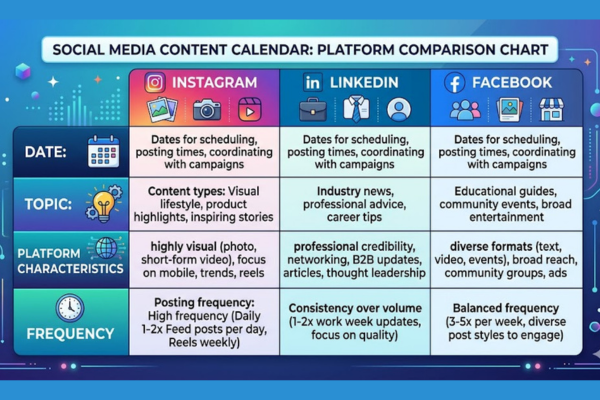
A social media content calendar is a centralized content planning framework that maps posts by date, topic, audience, and platform. It aligns publishing status, SEO intent, and campaign goals while ensuring consistent messaging across social media platforms like Facebook, Instagram, and LinkedIn.
It functions as both a planning and execution tool. Teams assign author ownership, define posting frequency, and track publishing status. This reduces last-minute stress and improves content scheduling efficiency, especially in fast-paced environments where one person manages social media efforts.
The structure typically includes key elements:
Date, topic, author, and target audience
Platform-specific formats and publishing status
Campaign alignment with broader organizational goals
Performance tracking metrics like shares per post and engagement rate
A well-built calendar drives data-driven adjustments. Marketers use individual platform analytics from tools like Meta Business Suite or Hootsuite to refine timing, format, and messaging. This creates a proactive workflow that improves reach and maintains a consistent online presence.
In practice, organizations integrate calendars with tools like Adobe Express or Google Sheets. These systems manage design assets, including logos, fonts, and visual elements, while supporting mobile-first content strategies. This operational discipline reflects standard digital marketing practices recognized by institutions like HubSpot Academy training frameworks [site: industry training, HubSpot].
How does a social media content calendar organize posts, platforms, and publishing dates?
A social media content calendar organizes posts, platforms, and publishing dates by structuring content into a time-based workflow with assigned formats and channels.
A social media content calendar uses a time-based publishing schedule mapped to platforms to align each post with a date, audience, and objective. It connects content planning with platform organization, ensuring every asset moves through a defined content workflow from creation to publishing.
It starts with a clear content calendar structure. Marketers define core fields such as date, topic, author, publishing status, and target audience. Each entry links to a platform like Instagram or LinkedIn, with format-specific details such as captions, hashtags, and design assets.
Execution follows a repeatable process:
Define content themes aligned with campaign goals and broader organizational objectives
Assign publishing dates using daily or weekly time blocking schedules
Allocate platforms based on audience behavior and platform analytics
Track KPIs such as engagement rate, shares per post, and click-through rate
Teams use tools like Google Sheets, Notion, or Adobe Express to maintain visibility. These systems support visual assets like icons, logos, and personalized fonts while enabling mobile-first content creation. This structured approach reduces last-minute planning and improves consistency across social media efforts.
Platform-specific optimization drives performance. A Facebook post may publish at 18:00 (6 PM), while LinkedIn performs better between 08:00–10:00 (8–10 AM), based on industry engagement benchmarks [site: industry research, Sprout Social Index]. This precision allows marketers to make data-driven adjustments using individual platform analytics.
Why is a social media content calendar different from a content strategy or editorial calendar?
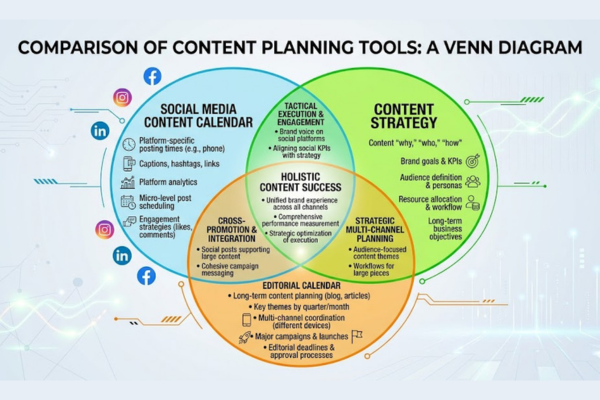
A social media content calendar differs from a content strategy and editorial calendar by focusing on execution timing, while the others define direction and content scope.
A social media content calendar provides execution-level scheduling and platform allocation, while a content strategy defines goals, audience, and messaging, and an editorial calendar plans long-form topics and publishing cadence. Together, they form a layered system within marketing planning and social media management.
A content strategy sets the foundation. It defines target audience segments, brand voice, SEO priorities, and conversion goals. This strategic layer aligns with broader organizational goals and requires research, competitor analysis, and performance benchmarks.
An editorial calendar translates strategy into content themes. It organizes blog topics, campaign narratives, and publishing frequency across weeks or months. This layer focuses on storytelling consistency and aligns with content categories like product education or thought leadership.
A social media content calendar operates at the final stage. It assigns exact dates, platforms, formats, and publishing status for each post. This granular control ensures efficient execution, especially when one person manages social media duties alongside other responsibilities.
This separation improves workflow clarity. The Content Marketing Institute framework highlights strategy, editorial planning, and execution as distinct layers for scalable content operations [site: industry research, Content Marketing Institute].
Which core elements define an effective social media content calendar structure?
Core elements that define an effective social media content calendar structure include clearly defined goals, timelines, content categories, and resource allocation.
An effective structure relies on clearly defined goals, timelines, and content categories to organize posts by date, platform, and audience. It integrates posting frequency, content types, and workflow stages, ensuring consistent execution and measurable outcomes across all social media efforts.
These elements create a functional system:
Define measurable goals such as engagement rate targets or lead generation volume
Establish timelines using daily or weekly publishing schedules
Organize content categories like educational, promotional, and user-generated content
Assign resources including authors, designers, and approval workflows
Specify content types such as video, carousel, static image, or short-form reels
A strong structure supports operational clarity. Teams track publishing status, align posts with SEO intent, and maintain a consistent online presence. This approach reduces last-minute planning and ensures efficient execution across multiple platforms.
Advanced setups integrate tools like Notion or Airtable. These platforms connect design assets, track KPIs, and enable data-driven adjustments using platform analytics. This reflects structured content workflow models used in enterprise marketing systems [site: industry standard, HubSpot Academy].
Why does a social media content calendar improve business growth and marketing results?
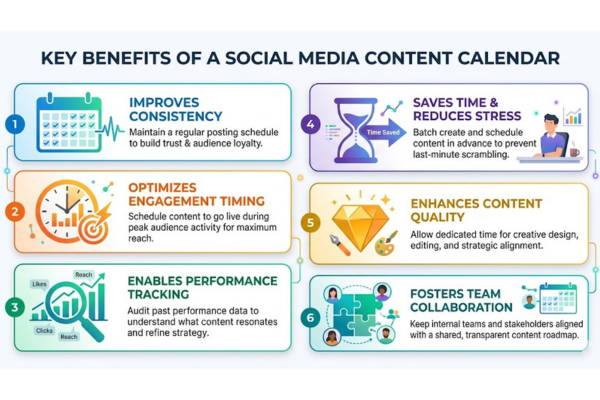
A social media content calendar improves business growth and marketing results by enforcing consistency, optimizing engagement timing, and enabling performance tracking.
A social media content calendar drives consistent posting and measurable performance optimization by aligning content planning with audience behavior and platform algorithms. It ensures regular publishing, improves engagement rates, and supports real-time strategy adjustments using analytics data.
Consistency is the first impact. Brands that publish 3–5 times per week maintain higher visibility in platform feeds, increasing reach and engagement. This regular cadence builds audience trust and strengthens overall social media presence.
Performance tracking delivers the second advantage. Marketers monitor KPIs such as engagement rate, click-through rate, and shares per post. These metrics guide data-driven adjustments, improving campaign outcomes over time.
Real-time optimization completes the system. Tools like Meta Business Suite and Hootsuite provide individual platform analytics, allowing teams to refine posting times and content formats. This feedback loop increases marketing efficiency and reduces wasted effort.
Structured planning supports scalable growth. A Harvard Business School research summary on digital engagement highlights that consistent content execution improves customer retention and brand recall [site: academic research, Harvard Business School].
How does a social media content calendar increase consistency and brand visibility?
A social media content calendar increases consistency and brand visibility by scheduling posts in advance and maintaining a predictable publishing cadence.
A social media content calendar ensures consistent posting across planned time intervals by organizing content distribution by date, platform, and audience. This structured approach improves brand visibility, strengthens audience engagement, and keeps businesses active in platform algorithms that prioritize regular content delivery.
Consistency builds recognition. Publishing 3–5 posts weekly across platforms like Instagram or LinkedIn increases exposure frequency and recall. This repetition reinforces brand identity and keeps content visible in crowded feeds.
Planning in advance removes execution gaps. Teams use time blocking, weekly scheduling, and predefined content categories to avoid last-minute posting delays. This proactive workflow minimizes disruptions and maintains a consistent online presence.
Visibility compounds over time. Platform algorithms favor accounts with steady activity, increasing reach and impressions. The Sprout Social Index report confirms consistent posting improves engagement rates and organic reach [site: industry research, Sprout Social Index].
Why does a social media content calendar align content with marketing funnels and goals?
A social media content calendar aligns content with marketing funnels and goals by mapping each post to a specific stage in the customer journey.
A social media content calendar enables strategic content alignment with funnel stages by assigning posts to awareness, consideration, and conversion phases. This ensures content supports lead nurturing, meets audience intent, and drives measurable progress toward defined business goals.
Each stage requires different content types. Awareness content educates, consideration content builds trust, and conversion content drives action. This structured mapping ensures every post serves a clear purpose within the marketing funnel.
Alignment improves efficiency. Teams connect publishing schedules with campaign objectives, ensuring posts promote key events, product launches, or seasonal offers. This coordination strengthens overall marketing planning and reduces wasted effort.
Performance tracking validates alignment. Marketers measure click-through rates, conversions, and engagement across funnel stages. This data-driven approach refines messaging and improves outcomes, following frameworks outlined in Google Analytics certification materials [site: industry certification, Google Analytics Academy].
How does a social media content calendar improve team collaboration and workflow efficiency?
A social media content calendar improves team collaboration and workflow efficiency by centralizing tasks, timelines, and responsibilities in a shared system.
A social media content calendar creates centralized workflow visibility and task ownership by assigning roles, deadlines, and publishing status within a unified dashboard. This structure enhances team collaboration, reduces miscommunication, and ensures content moves efficiently from planning to publishing.
Clear role assignment drives accountability. Writers, designers, and managers each handle defined tasks with set deadlines. This reduces bottlenecks and ensures timely delivery of content assets.
Workflow efficiency improves through integration. Tools like Trello, Asana, and Notion connect content scheduling with project management. These platforms track progress, manage approvals, and store design assets like logos, fonts, and visual templates.
Collaboration becomes scalable. Teams use shared calendars to coordinate campaigns across multiple platforms while maintaining consistency. This system supports efficient execution, especially when balancing social media duties with broader responsibilities.
Structured workflows reduce delays. Research from the Project Management Institute shows standardized processes improve team productivity by up to 28% in marketing operations [site: industry research, Project Management Institute].
Why does a social media content calendar enable data-driven decisions and performance tracking?
A social media content calendar enables data-driven decisions and performance tracking by linking each post to measurable metrics and outcomes.
A social media content calendar supports continuous performance tracking tied to scheduled content by recording publishing dates, platforms, and KPIs for every post. This structure allows marketers to analyze trends, optimize content, and improve results using real-time social media analytics.
Tracking starts with defined metrics. Teams measure engagement rate, click-through rate, impressions, and shares per post. These values reveal which content types and posting times produce the highest returns.
Analysis drives optimization. Marketers compare performance across platforms and adjust content distribution, formats, and timing. This iterative process improves audience engagement and aligns content with proven patterns.
Data informs strategy refinement. Insights from tools like Meta Business Suite and Google Analytics guide future planning decisions. This approach reflects standard measurement frameworks used in digital marketing certification programs [site: industry certification, Google Analytics Academy].
How does a social media content calendar work in a real content workflow?
A social media content calendar works in a real content workflow by structuring planning, creation, approval, and publishing into a coordinated system.
A social media content calendar operates as a central workflow system connecting planning to publishing by organizing tasks, deadlines, and responsibilities across teams. It ensures content moves efficiently through each stage, maintaining consistency and alignment with campaign objectives.
The workflow begins with planning. Teams define content themes, assign topics, and set publishing dates based on campaign goals. This stage aligns with broader marketing planning and audience needs.
Execution follows structured stages. Content moves from creation to review, then approval, and finally publishing. Each step includes assigned roles, deadlines, and status tracking to maintain workflow efficiency.
Real-world implementation uses tools like Asana, Trello, or Notion. These platforms manage tasks, approvals, and publishing schedules while integrating design assets and platform-specific requirements. This reflects operational models used in enterprise social media management systems [site: industry standard, HubSpot Academy].
How does a social media content calendar manage planning, creation, approval, and publishing stages?
A social media content calendar manages planning, creation, approval, and publishing stages by assigning tasks, timelines, and status updates within a structured workflow.
A social media content calendar ensures end-to-end content lifecycle management within one system by tracking each stage from idea generation to final publishing. It connects planning stages with execution, ensuring deadlines are met and content quality remains consistent.
Planning defines direction. Teams outline topics, content categories, and publishing schedules using weekly or monthly timelines. This stage aligns content with campaign goals and audience intent.
Creation produces assets. Writers, designers, and editors develop captions, visuals, and videos while linking files to calendar entries. This keeps all content resources centralized and accessible.
Approval ensures quality control. Managers review content for brand alignment, compliance, and accuracy before marking posts as approved. This step prevents publishing errors and maintains consistency.
Publishing completes the flow. Approved posts are scheduled through tools like Hootsuite or Meta Business Suite, ensuring timely distribution. This structured publishing flow improves efficiency and reduces last-minute delays, aligning with documented workflow practices in the Project Management Institute guidelines [site: industry research, Project Management Institute].
Why does a social media content calendar require defined roles for teams and content managers?
A social media content calendar requires defined roles for teams and content managers to ensure accountability, clear ownership, and efficient execution.
A social media content calendar depends on clearly assigned roles and task ownership across teams to manage each stage of the content workflow. Defined responsibilities improve coordination, reduce delays, and ensure consistent output within structured project management systems.
Role clarity eliminates confusion. Writers handle content creation, designers manage visuals, and managers oversee approvals and publishing status. This separation ensures each task progresses without overlap or missed deadlines.
Accountability improves performance. Each calendar entry includes an assigned person, deadline, and status update. This structure allows teams to track progress and identify bottlenecks early.
Efficient workflows scale operations. Even a one-person social media manager benefits from role segmentation across planning, creation, and publishing tasks. This aligns with workflow frameworks recommended by the Project Management Institute for marketing teams [site: industry research, Project Management Institute].
How does a social media content calendar integrate with scheduling and automation tools?
A social media content calendar integrates with scheduling and automation tools by syncing planned posts with platforms that publish content automatically.
A social media content calendar connects with automated scheduling systems for seamless content posting by linking each entry to tools that handle publishing, timing, and distribution. This integration reduces manual effort and ensures accurate execution across multiple social media platforms.
Integration starts at the scheduling layer. Tools like Hootsuite, Buffer, and Meta Business Suite pull content directly from calendar entries. They schedule posts based on predefined dates, times, and platform requirements.
Automation improves consistency. Posts publish at optimal times without manual intervention, even across different time zones. This ensures consistent posting and maximizes audience engagement.
Advanced systems enable optimization. Automation tools provide analytics dashboards, allowing marketers to adjust timing, formats, and frequency. This closed-loop system supports continuous improvement, following automation practices outlined in HubSpot marketing software documentation [site: industry standard, HubSpot].
What should a social media content calendar include for high performance?
A high-performance social media content calendar should include audience research, clear content goals, structured posting frequency, and measurable performance metrics.
A high-performance calendar requires aligned audience insights, goals, and structured posting strategy to drive engagement and results. It combines data-backed planning with consistent execution, ensuring every post contributes to measurable marketing outcomes and long-term growth.
Core components create performance:
Define audience research using demographics, behavior data, and platform preferences
Set content goals such as engagement targets, lead generation, or conversions
Establish posting strategy with fixed frequency and optimal timing windows
Track KPIs including engagement rate, reach, and shares per post
Strong calendars integrate data into execution. Marketers use Google Analytics and platform insights to refine content types and distribution. This ensures content remains relevant and performance-driven.
Structured planning improves outcomes. Research from the Content Marketing Institute shows documented strategies increase marketing success rates significantly across organizations [site: industry research, Content Marketing Institute].
How do content pillars and topic clusters fit into a social media content calendar?
Content pillars and topic clusters fit into a social media content calendar by organizing posts into structured themes that align with business objectives.
A social media content calendar uses content pillars as core themes with supporting topic clusters to maintain consistency and relevance. This structure ensures content aligns with overall content strategy, improves organization, and delivers targeted messaging across different audience segments.
Content pillars define direction. Examples include education, product promotion, and community engagement. These pillars reflect brand values and guide long-term messaging.
Topic clusters expand coverage. Each pillar breaks into related subtopics, allowing deeper exploration of themes while maintaining relevance. This approach supports consistent content distribution without repetition.
Alignment drives results. Structured themes ensure posts connect with business goals and audience needs. This method mirrors topic clustering strategies used in SEO frameworks from Google Search Central documentation [site: official guidance, Google Search Central].
How do content pillars and topic clusters fit into a social media content calendar?
Content pillars and topic clusters fit into a social media content calendar by organizing posts into structured themes that align with business objectives.
A social media content calendar uses content pillars as core themes with supporting topic clusters to maintain consistency and relevance. This structure ensures content aligns with overall content strategy, improves organization, and delivers targeted messaging across different audience segments.
Content pillars define direction. Examples include education, product promotion, and community engagement. These pillars reflect brand values and guide long-term messaging.
Topic clusters expand coverage. Each pillar breaks into related subtopics, allowing deeper exploration of themes while maintaining relevance. This approach supports consistent content distribution without repetition.
Alignment drives results. Structured themes ensure posts connect with business goals and audience needs. This method mirrors topic clustering strategies used in SEO frameworks from Google Search Central documentation [site: official guidance, Google Search Central].
What posting frequency and timing should a social media content calendar define?
Posting frequency and timing in a social media content calendar should define how often content is published and the optimal times for maximum engagement.
A social media content calendar sets optimal posting frequency and timing based on audience behavior data to maximize reach and engagement. It ensures consistent publishing while aligning posts with peak activity periods across different platforms.
Frequency varies by platform. Instagram performs well with 3–5 posts per week, while LinkedIn ranges from 2–4 posts weekly. These ranges depend on audience size, industry, and content type.
Timing affects visibility. Peak engagement often occurs between 08:00–10:00 and 18:00–20:00 local time, depending on platform usage patterns. Scheduling within these windows increases interaction rates.
Consistency improves retention. Regular posting keeps audiences engaged and strengthens brand recall over time. Studies from Sprout Social show timing and frequency directly impact engagement performance [site: industry research, Sprout Social Index].
How should a social media content calendar adapt content for different platforms?
A social media content calendar adapts content for different platforms by customizing format, messaging, and timing based on platform-specific behavior and technical requirements.
A social media content calendar applies platform-specific content tailoring based on user behavior to optimize performance across channels. It adjusts visuals, captions, and formats to match platform algorithms and audience expectations, ensuring effective cross-platform strategy and consistent engagement.
Each platform demands variation. Instagram prioritizes 1:1 (1080×1080 px) visuals and short captions, while LinkedIn favors longer text posts and professional tone. TikTok requires vertical 9:16 video with fast pacing.
Messaging also shifts. A product update on LinkedIn uses data-driven language, while Instagram uses storytelling and visual appeal. This differentiation improves audience relevance and interaction rates.
Optimization improves results. Marketers align content with platform best practices, including hashtag usage, caption length, and posting time. Meta’s official business guides confirm tailored content increases engagement and reach [site: official guidance, Meta Business Help Center].
Why should a social media content calendar include captions, hashtags, and media assets?
A social media content calendar should include captions, hashtags, and media assets to ensure consistent messaging, discoverability, and higher audience engagement.
A social media content calendar integrates captions, hashtags, and media assets for optimized discoverability by attaching all post components within a single workflow. This ensures every post is complete, aligned with brand voice, and ready for efficient publishing across platforms.
Captions drive communication. Well-structured text explains the message, includes calls to action, and aligns with audience intent. This increases engagement and improves click-through rates.
Hashtags improve reach. Strategic hashtag placement categorizes content and increases visibility in search and discovery feeds. Platforms like Instagram use hashtags as indexing signals for content distribution.
Media assets enhance impact. High-quality visuals, videos, and branded elements like logos or fonts improve attention and retention. Adobe’s creative workflow standards emphasize visual consistency for stronger brand recall [site: industry standard, Adobe Creative Cloud documentation].
How does a social media content calendar plan campaigns, events, and seasonal content?
A social media content calendar plans campaigns, events, and seasonal content by mapping key dates and aligning posts with strategic timelines.
A social media content calendar enables structured campaign planning around key dates and events by organizing content in advance for launches, holidays, and promotions. It ensures timely execution and consistent messaging across all campaign touchpoints.
Campaign planning starts with timeline mapping. Teams schedule posts for product launches, sales campaigns, or events like Black Friday or Ramadan promotions. This ensures content aligns with peak audience interest periods.
Event-based planning improves coordination. Businesses promote key events such as webinars, conferences, or campus-wide activities with pre, during, and post-event content. This structured flow increases engagement and participation.
Seasonal content drives relevance. Brands align messaging with trends, holidays, and cultural moments. The Content Marketing Institute highlights seasonal planning as a key driver of engagement in annual campaigns [site: industry research, Content Marketing Institute].
How can a social media content calendar be created step by step?
A social media content calendar can be created step by step by defining goals, researching the audience, planning content, and scheduling posts systematically.
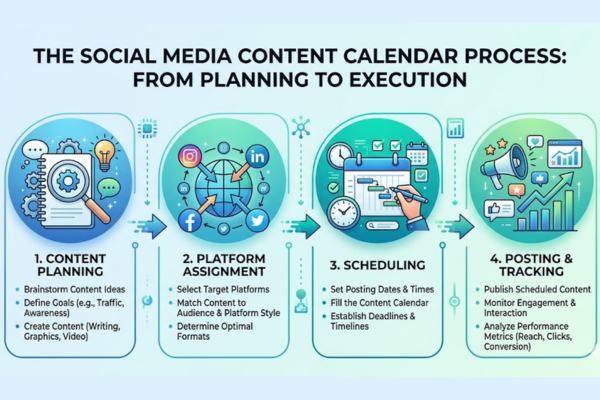
A social media content calendar follows a structured step-by-step workflow from planning to scheduling to ensure consistent execution and measurable results. It integrates goal setting, content creation, and publishing timelines into a unified system for effective social media planning.
The process follows clear stages:
Define content goals aligned with business objectives and KPIs
Conduct audience research to understand behavior and preferences
Create content categories and assign topics for each date
Develop content assets including captions, visuals, and formats
Schedule posts using tools like Hootsuite or Buffer
Execution requires consistency. Teams update publishing status, monitor performance, and refine the calendar regularly. This iterative approach improves efficiency and aligns with structured marketing workflows used in HubSpot training systems [site: industry standard, HubSpot Academy].
How does a social media content calendar start with goal setting and audience research?
A social media content calendar starts with goal setting and audience research by defining clear objectives and understanding the target audience’s needs.
A social media content calendar begins with clear goal-setting aligned with audience insights to ensure every post serves a measurable purpose. This foundation connects content alignment with business objectives and improves relevance across all social media efforts.
Goal setting defines direction. Businesses set targets such as increasing engagement by 20% or generating qualified leads. These goals guide content themes and posting strategy.
Audience research informs execution. Marketers analyze demographics, behavior patterns, and platform preferences using tools like Google Analytics and Meta Insights. This ensures content resonates with the intended audience.
Alignment drives performance. When goals and audience data connect, content becomes more targeted and effective. Research from the Pew Research Center highlights that audience-specific content increases engagement and retention across digital platforms [site: research, Pew Research Center].
How are content ideas and topics mapped inside a social media content calendar?
Content ideas and topics are mapped inside a social media content calendar by aligning brainstorming outputs with business goals and audience interests.
A social media content calendar uses structured content mapping aligned with strategic objectives to organize ideas into actionable posts. It connects brainstorming ideas with audience intent, ensuring content relevance and consistent messaging across platforms within a defined content workflow.
Brainstorming starts with inputs. Teams analyze audience data, trending topics, and competitor content to generate ideas. These ideas are grouped into themes that reflect business priorities and campaign goals.
Mapping ensures alignment. Each topic is assigned a date, platform, and content type, linking it to specific objectives. This structured approach prevents random posting and improves strategic alignment.
Relevance drives engagement. Content mapped to audience needs performs better in reach and interaction. This method follows topic planning frameworks outlined in HubSpot content strategy training materials [site: industry standard, HubSpot Academy].
How does a social media content calendar assign tasks, deadlines, and responsibilities?
A social media content calendar assigns tasks, deadlines, and responsibilities by linking each content item to specific team roles and timelines.
A social media content calendar enables clear task delegation with defined deadlines and ownership by assigning each post to a responsible person and tracking progress through status updates. This structure ensures accountability and smooth execution within a coordinated project management system.
Task delegation starts with role definition. Writers, designers, and managers receive assigned responsibilities for each content piece. This prevents confusion and overlaps in execution.
Deadline management ensures timely delivery. Each task includes a fixed due date aligned with the publishing schedule. This reduces last-minute stress and keeps workflows predictable.
Responsibility tracking improves efficiency. Teams monitor progress through status labels such as draft, review, or approved. This approach aligns with standardized project management practices recommended by the Project Management Institute [site: industry research, Project Management Institute].
Which tools help build and automate a social media content calendar effectively?
Tools that help build and automate a social media content calendar include scheduling platforms, project management systems, and content planning software.
A social media content calendar relies on integrated automation and scheduling tools for efficient execution to manage planning, publishing, and performance tracking. These tools streamline workflows, reduce manual work, and ensure consistent content delivery across multiple platforms.
Scheduling tools handle publishing. Platforms like Hootsuite, Buffer, and Later automate posting based on predefined dates and times. This ensures consistent posting without manual intervention.
Project management tools organize workflows. Trello, Asana, and Notion assign tasks, track deadlines, and manage approvals. These systems improve team coordination and visibility.
Content planning software centralizes data. Tools like Airtable or CoSchedule integrate calendars, assets, and analytics. This unified system enhances efficiency and supports scalable social media management practices.
How is performance tracked and optimized using a social media content calendar?
Performance is tracked and optimized using a social media content calendar by linking each post to measurable metrics and analyzing results over time.
A social media content calendar enables continuous performance tracking with data-driven optimization cycles by recording KPIs for each scheduled post. It allows marketers to evaluate content performance, identify trends, and refine strategies based on real engagement data.
Tracking focuses on key metrics. Teams monitor engagement rate, impressions, click-through rate, and shares per post. These indicators measure content effectiveness across platforms.
Optimization follows analysis. Marketers adjust posting frequency, timing, and content types based on performance insights. This improves audience engagement and overall results.
Analytics tools provide feedback loops. Platforms like Google Analytics and Meta Insights deliver actionable data for refining campaigns. This iterative approach aligns with measurement frameworks from Google Analytics Academy [site: industry certification, Google Analytics Academy].
Which tools and templates support a social media content calendar?
Tools and templates that support a social media content calendar include spreadsheets, scheduling platforms, and dedicated content planning software.
A social media content calendar is supported by flexible tools and templates for structured content planning that allow businesses to organize, schedule, and track posts efficiently. These solutions range from simple spreadsheets to advanced automation platforms, supporting different levels of complexity and scale.
Free tools provide accessibility. Google Sheets and Excel offer customizable templates for organizing dates, topics, authors, and publishing status. These tools suit small teams or individual marketers.
Advanced platforms enhance functionality. Tools like Hootsuite, Sprout Social, and CoSchedule integrate scheduling, analytics, and collaboration features. These systems support automation and performance tracking.
Templates standardize workflows. Pre-built content calendar templates ensure consistency in structure and reporting. This approach reflects operational models used in modern content planning software ecosystems.
What are the benefits of using spreadsheets for a social media content calendar?
Spreadsheets provide a simple, flexible, and cost-effective way to manage a social media content calendar.
A social media content calendar built in spreadsheets offers high customization with simple data tracking capabilities by allowing users to structure content based on their specific needs. This makes it an accessible solution for organizing posts, tracking performance, and managing workflows.
Customization is a key advantage. Users define columns for date, topic, author, platform, and publishing status. This flexibility supports tailored content organization without tool limitations.
Data tracking improves visibility. Teams monitor KPIs such as engagement rate and shares per post directly within the sheet. This creates a centralized performance overview.
Ease of use accelerates adoption. Google Sheets enables real-time collaboration and version control. This supports efficient content management, especially for small teams or solo marketers.
Which social media scheduling tools enhance a social media content calendar workflow?
Social media scheduling tools enhance a content calendar workflow by automating publishing, optimizing timing, and centralizing management.
A social media content calendar becomes more efficient with automated scheduling and centralized content management tools that handle posting, analytics, and coordination. These tools reduce manual effort and improve consistency across multiple platforms.
Popular tools provide key capabilities:
Automate post scheduling across platforms with precise timing controls
Optimize publishing times using built-in analytics and recommendations
Manage multiple accounts from a single dashboard interface
Track performance metrics such as engagement and reach
Examples include Buffer, Later, and Sprout Social. These platforms integrate scheduling, analytics, and reporting features, improving workflow efficiency and ensuring timely content delivery.
Automation drives scalability. Businesses using scheduling tools maintain consistent posting and adapt quickly to performance insights, aligning with best practices documented in social media management research [site: industry research, Sprout Social].
How do AI-powered tools improve a social media content calendar process?
AI-powered tools improve a social media content calendar process by automating content creation, optimizing scheduling, and enhancing decision-making through data analysis.
A social media content calendar benefits from AI-driven automation and predictive content optimization by analyzing performance data and generating insights for better planning. These tools streamline social media management, reduce manual workload, and improve content performance through continuous learning.
Automation accelerates execution. AI tools like ChatGPT, Jasper, and Copy.ai generate captions, hashtags, and post ideas based on audience data. This reduces content creation time and increases output consistency.
Optimization improves results. AI analyzes engagement patterns, suggesting optimal posting times and content formats. Platforms like Hootsuite Insights use machine learning to refine scheduling decisions.
Decision-making becomes data-backed. AI processes large datasets from social media analytics, identifying trends and performance gaps. This aligns with automation frameworks highlighted in MIT Sloan research on AI-driven marketing systems [site: academic research, MIT Sloan].
What are the advantages and limitations of different social media content calendar tools?
Different social media content calendar tools offer varying advantages and limitations depending on complexity, scalability, and automation capabilities.
Social media content calendar tools present trade-offs between flexibility, automation, and scalability across spreadsheets, templates, and software platforms. Each option supports different content planning needs, requiring businesses to balance ease of use with advanced functionality.
Spreadsheets offer flexibility. Google Sheets allows full customization and simple data tracking but lacks automation and advanced analytics. This suits small teams or individual marketers.
Templates provide structure. Pre-built templates standardize workflows and improve consistency but limit customization in complex campaigns. They work well for basic content planning.
Software platforms deliver automation. Tools like Sprout Social and Hootsuite enable scheduling, analytics, and collaboration. However, costs range from $49–$249 per month depending on features and user seats.
Tool selection depends on scale. Small businesses prioritize simplicity, while enterprises require automation and integration. This comparison reflects evaluation frameworks used in Gartner marketing technology reports [site: industry analysis, Gartner].
How do different businesses use a social media content calendar in practice?
Different businesses use a social media content calendar in practice by adapting its structure to their specific goals, resources, and audience needs.
A social media content calendar functions as a flexible execution system tailored to business models across industries. It supports planning, scheduling, and optimization, allowing businesses to align content strategies with operational requirements and marketing objectives.
Usage varies by business type. Small businesses focus on efficiency and consistency, while e-commerce brands prioritize campaigns and conversions. Agencies manage multiple clients, requiring structured workflows and automation.
Adaptation drives effectiveness. Each business configures posting frequency, content types, and platform focus based on audience behavior and goals. This ensures relevant content distribution and measurable outcomes.
This practical use aligns with case studies from HubSpot and Content Marketing Institute, which show tailored content planning improves engagement and ROI across industries [site: industry research, Content Marketing Institute].
How is a social media content calendar used for small businesses and startups?
A social media content calendar is used for small businesses and startups to streamline planning, maximize limited resources, and maintain consistent posting.
A social media content calendar enables efficient resource management with structured content planning by organizing tasks, timelines, and publishing schedules. It helps small teams maintain visibility and engagement without requiring large marketing resources.
Efficiency is critical. Small businesses often rely on one person managing social media efforts. A structured calendar reduces workload and ensures consistent execution.
Planning reduces stress. Scheduling posts weekly or monthly minimizes last-minute work and improves content quality. This proactive approach supports steady audience engagement.
Resource optimization improves outcomes. Free tools like Google Sheets or Buffer allow startups to manage content without high costs. This aligns with lean marketing strategies promoted in Small Business Administration resources [site: government resource, SBA].
How does an e-commerce brand structure a social media content calendar?
An e-commerce brand structures a social media content calendar by aligning posts with product launches, promotions, and conversion-focused campaigns.
A social media content calendar for e-commerce uses conversion-focused content planning tied to product lifecycle events to drive sales and engagement. It integrates promotional content, seasonal campaigns, and audience targeting into a structured publishing schedule.
Product launches drive planning. Brands schedule teaser content, launch announcements, and post-launch promotions across multiple platforms. This builds anticipation and increases conversions.
Seasonal campaigns boost sales. Events like Black Friday or Eid promotions are mapped in advance, ensuring consistent messaging and timely execution.
Content supports conversion. Posts include product showcases, user-generated content, and reviews. This mix improves trust and drives purchase decisions, following Shopify marketing playbooks [site: industry platform, Shopify].
How do agencies manage multiple clients with a social media content calendar?
Agencies manage multiple clients with a social media content calendar by segmenting workflows, assigning dedicated teams, and using centralized tools.
A social media content calendar enables multi-client workflow management with segmented tracking systems by organizing content, schedules, and approvals for each brand separately. This ensures clarity, scalability, and consistent execution across different client accounts.
Segmentation ensures organization. Each client has a dedicated calendar with unique content strategy, posting schedule, and KPIs. This prevents overlap and confusion.
Centralized tools improve efficiency. Platforms like Asana, Trello, and Sprout Social allow agencies to manage multiple workflows within one dashboard. This streamlines scheduling and reporting.
Performance tracking supports optimization. Agencies monitor metrics for each client and adjust strategies accordingly. This structured approach aligns with agency workflow models documented in HubSpot Agency Partner resources [site: industry program, HubSpot Agency].
How does a personal brand scale content using a social media content calendar?
A personal brand scales content using a social media content calendar by systemizing content creation, scheduling, and audience engagement.
A social media content calendar enables scalable content production through consistent planning and batching by organizing ideas, formats, and posting schedules. It helps personal brands maintain visibility while growing audience engagement efficiently.
Consistency builds authority. Regular posting establishes credibility and strengthens brand identity over time. This increases audience trust and retention.
Batching improves efficiency. Creators produce multiple posts in one session, then schedule them in advance. This reduces daily workload and increases output.
Engagement drives growth. Personal brands track comments, shares, and interactions to refine content. This iterative approach aligns with creator growth strategies highlighted in YouTube Creator Academy resources [site: platform training, YouTube Creator Academy].
Why is long-term content strategy connected to a social media content calendar?
A long-term content strategy is connected to a social media content calendar by ensuring consistent execution aligned with business goals over time.
A social media content calendar supports long-term strategic alignment through consistent content execution by mapping posts to future campaigns, audience needs, and business objectives. It ensures content remains relevant, structured, and performance-driven across extended periods.
Consistency sustains growth. Regular posting over months builds audience trust and strengthens brand visibility. This cumulative effect improves engagement and retention.
Planning improves foresight. Teams align content with quarterly goals, seasonal campaigns, and product roadmaps. This reduces reactive marketing and increases strategic control.
Long-term alignment drives impact. Businesses that plan content in advance achieve better results, as shown in Content Marketing Institute research on documented strategies [site: industry research, Content Marketing Institute].
How does a content calendar support topical authority and content consistency?
A content calendar supports topical authority and content consistency by organizing content around specific themes and maintaining regular publishing patterns.
A social media content calendar builds topical authority through consistent, theme-based content publishing by aligning posts with defined subject areas. This structured approach improves SEO relevance, strengthens brand authority, and ensures a unified voice across all platforms.
Consistency reinforces expertise. Publishing regularly on focused topics signals authority to both audiences and search engines. This increases trust and visibility.
Thematic organization improves clarity. Content grouped into pillars and clusters ensures depth and relevance. This supports better audience understanding and engagement.
SEO benefits follow structure. Google Search Central guidelines emphasize consistent, relevant content for improved rankings. This approach strengthens long-term visibility and thought leadership [site: official guidance, Google Search Central].
Why does a social media content calendar strengthen SEO and cross-channel marketing?
A social media content calendar strengthens SEO and cross-channel marketing by aligning content distribution across platforms with search optimization strategies.
A social media content calendar enables integrated cross-channel content strategy aligned with SEO goals by synchronizing social posts with website content, keywords, and campaigns. This alignment increases visibility, improves engagement, and supports consistent messaging across channels.
Cross-channel consistency improves reach. Sharing blog content, landing pages, and campaigns across social platforms amplifies visibility and drives traffic. This reinforces SEO performance.
Keyword alignment enhances relevance. Social posts incorporate target keywords and topics, supporting search intent and content discoverability. This creates synergy between social media and search engines.
Integrated strategy drives results. Businesses combining SEO and social media see higher engagement and traffic, as reported in HubSpot’s State of Marketing research [site: industry research, HubSpot].
How does a social media content calendar improve brand messaging over time?
A social media content calendar improves brand messaging over time by enforcing consistency, refining tone, and aligning content with evolving audience expectations.
A social media content calendar strengthens consistent brand voice through structured content repetition and refinement by organizing messaging across posts and campaigns. This consistency allows businesses to test, analyze, and improve communication style while maintaining clarity and recognition.
Consistency builds identity. Repeated use of tone, language, and visuals reinforces brand messaging across platforms. This improves audience recall and trust over time.
Refinement comes from iteration. Teams analyze engagement data and adjust messaging style, keywords, and formats. This creates a feedback loop that strengthens communication effectiveness.
Alignment ensures clarity. Every post follows defined messaging guidelines, preventing mixed signals. Nielsen brand research shows consistent messaging improves customer trust and recognition [site: industry research, Nielsen].
How are common mistakes related to a social media content calendar avoided?
Common mistakes in a social media content calendar are avoided by maintaining balance between planning, flexibility, and performance analysis.
A social media content calendar avoids common execution errors through structured planning and continuous optimization by combining consistent scheduling with analytics tracking and adaptive workflows. This ensures the calendar supports, rather than restricts, overall social media strategy.
Over-scheduling is controlled through realistic planning. Teams set achievable posting frequency based on resources and audience engagement patterns. This prevents burnout and content quality decline.
Analytics integration prevents blind execution. Regular performance reviews ensure content aligns with audience preferences and campaign goals. This enables data-driven adjustments.
Consistency maintains effectiveness. Structured scheduling avoids gaps in posting while allowing flexibility for trends. This balanced approach aligns with best practices outlined in HubSpot content management frameworks [site: industry standard, HubSpot Academy].
Why is overplanning without flexibility harmful to a social media content calendar?
Overplanning without flexibility is harmful to a social media content calendar because it limits responsiveness to trends, audience feedback, and market changes.
A social media content calendar becomes ineffective when rigid planning restricts real-time content adaptation and prevents timely engagement opportunities. Flexibility is required to adjust content based on trends, performance data, and audience interaction.
Rigid schedules reduce relevance. Pre-planned posts may miss trending topics or emerging conversations that drive engagement. This lowers content performance.
Flexibility increases impact. Teams that adjust schedules for real-time events achieve higher visibility and interaction rates. This includes reacting to viral trends or breaking news.
Balanced planning improves agility. Incorporating buffer slots or flexible posting windows allows adaptation without disrupting overall strategy. This approach aligns with real-time marketing principles from Deloitte Digital reports [site: industry research, Deloitte Digital].
How does ignoring analytics weaken a social media content calendar performance?
Ignoring analytics weakens a social media content calendar performance by removing data-driven insights needed for optimization.
A social media content calendar fails without data-backed decision-making from performance analytics because it cannot identify what content works or why. This leads to repeated mistakes, reduced engagement, and inefficient content distribution.
Lack of data limits improvement. Without tracking metrics like engagement rate or click-through rate, teams cannot refine content strategy. This results in stagnant performance.
Missed opportunities reduce growth. High-performing content types remain unidentified, preventing scaling of successful formats. This directly impacts audience engagement.
Analytics-driven optimization is essential. Tools like Google Analytics and Meta Insights provide actionable data for refining content. This aligns with measurement standards from Google Analytics Academy [site: industry certification, Google Analytics Academy].
Why does inconsistent posting reduce the effectiveness of a social media content calendar?
Inconsistent posting reduces the effectiveness of a social media content calendar by weakening brand visibility and disrupting audience engagement patterns.
A social media content calendar loses impact when irregular posting disrupts audience expectations and algorithm signals that prioritize consistent activity. This inconsistency reduces reach, engagement, and long-term brand growth.
Visibility declines quickly. Platforms reduce exposure for inactive accounts, limiting content reach and impressions. This affects overall performance.
Audience engagement drops. Followers expect regular updates, and gaps in posting reduce interaction and retention. This weakens brand connection.
Consistency drives results. Maintaining a fixed posting schedule improves engagement and visibility. Research from Sprout Social confirms consistent posting increases performance metrics [site: industry research, Sprout Social Index].
How does lack of content diversity impact a social media content calendar?
Lack of content diversity impacts a social media content calendar by reducing audience interest and limiting engagement opportunities.
A social media content calendar becomes ineffective when limited content variety reduces audience engagement and retention across platforms. Diverse content types and topics are required to maintain interest and deliver value to different audience segments.
Monotony reduces interaction. Repeating similar post formats or topics leads to lower engagement rates. Audiences disengage when content lacks variation.
Diversity improves performance. Mixing videos, images, carousels, and text posts increases reach and interaction. Different formats appeal to different audience preferences.
Strategic variety maintains alignment. Content diversity within defined themes ensures relevance while avoiding repetition. This approach aligns with content mix strategies recommended in HubSpot marketing research [site: industry research, HubSpot].
When should businesses rely less on a social media content calendar for flexibility?
Businesses should rely less on a social media content calendar for flexibility when real-time opportunities, trends, or audience-driven content require immediate action.
A social media content calendar should allow strategic flexibility for real-time and trend-based content execution when pre-planned posts limit responsiveness. Adjusting the calendar ensures brands stay relevant and engage effectively with current events and audience conversations.
Real-time marketing demands speed. Events, viral trends, or breaking news require immediate content creation and publishing. Pre-scheduled posts may need to be paused or replaced.
Audience-driven content requires adaptation. User-generated content, comments, and feedback often create opportunities for spontaneous engagement. This improves authenticity and interaction.
Flexible systems maintain balance. Teams reserve open slots or adjust schedules dynamically to incorporate timely content. This approach aligns with agile marketing frameworks used in modern digital strategies [site: industry research, McKinsey Digital].
Why can rigid planning reduce real-time engagement in social media content calendar usage?
Rigid planning reduces real-time engagement in social media content calendar usage by preventing timely responses to trends and audience interactions.
A social media content calendar limits engagement when strict scheduling blocks participation in real-time conversations that drive visibility and interaction. Flexibility is essential to capture trending opportunities and maintain relevance.
Delayed responses reduce impact. Trending topics often peak within 24–48 hours, and missed timing lowers engagement potential. This affects reach and impressions.
Agility increases performance. Brands that adapt quickly to trends achieve higher interaction rates and visibility. This strengthens audience connection.
Controlled flexibility solves the issue. Maintaining a mix of scheduled and open content slots allows real-time adjustments without disrupting strategy. This aligns with agile marketing principles from Deloitte insights [site: industry research, Deloitte Digital].
How do trends and moment marketing challenge a social media content calendar structure?
Trends and moment marketing challenge a social media content calendar structure by requiring immediate changes that disrupt pre-planned schedules.
A social media content calendar must adapt to real-time trend integration without breaking strategic consistency to remain effective. Trends demand rapid execution, often replacing or reshuffling scheduled content to capture audience attention.
Moment marketing requires speed. Viral trends and cultural events demand same-day or next-day content creation. Delayed responses reduce relevance and engagement.
Pre-planned content may conflict. Scheduled posts may feel outdated or irrelevant during trending events. This requires quick adjustments to maintain brand relevance.
Adaptability ensures success. Teams use flexible scheduling, content buffers, and rapid approval workflows to respond effectively. This approach aligns with real-time marketing strategies documented in Think with Google reports [site: industry research, Think with Google].
Should you adjust strategies when a social media content calendar limits creativity?
Yes, you should adjust strategies when a social media content calendar limits creativity to maintain innovation and audience engagement.
A social media content calendar must allow creative flexibility within structured planning frameworks to balance consistency with originality. Adjusting strategies ensures content remains fresh, engaging, and aligned with evolving audience expectations.
Creativity drives engagement. Repetitive or overly structured content reduces interest and interaction rates. Audiences respond better to unique and dynamic content.
Flexibility enables innovation. Allowing space for experimentation introduces new formats, ideas, and storytelling approaches. This improves performance and differentiation.
Balanced structure sustains growth. Combining planned content with creative freedom ensures consistency without limiting innovation. This approach reflects creative strategy models used in Adobe Creative Cloud marketing resources [site: industry standard, Adobe Creative Cloud].
Which alternatives or complements work alongside a social media content calendar?
Alternatives and complements to a social media content calendar include real-time content strategies, agile marketing approaches, and automation tools that enhance flexibility and responsiveness.
A social media content calendar works best when combined with flexible marketing approaches and real-time execution systems that adapt to trends and audience behavior. These complementary tools and strategies ensure content remains relevant, responsive, and aligned with dynamic market conditions.
Real-time content strategies capture immediate opportunities. Agile marketing frameworks allow rapid adjustments to campaigns and messaging. Automation tools streamline execution while maintaining consistency across platforms.
These systems operate together. The calendar provides structure, while complementary strategies introduce adaptability and speed. This integrated approach reflects modern digital marketing models outlined in McKinsey Digital transformation research [site: industry research, McKinsey Digital].
How do real-time content strategies complement a social media content calendar?
Real-time content strategies complement a social media content calendar by enabling immediate content creation and publishing around trends and events.
A social media content calendar integrates real-time content execution alongside scheduled planning to capture audience attention during trending moments. This combination ensures brands remain relevant while maintaining consistent content distribution and engagement.
Trend marketing drives visibility. Brands respond to viral topics, news events, or cultural moments within hours. This rapid response increases reach and engagement rates.
Scheduled content provides stability. Pre-planned posts maintain consistency, while real-time content adds spontaneity. This balance strengthens overall content strategy.
Audience engagement improves with timing. Real-time responses feel authentic and timely, increasing interaction. Google’s “Think with Google” insights highlight trend responsiveness as a key engagement driver [site: industry research, Think with Google].
Why are content batching and repurposing related to a social media content calendar?
Content batching and repurposing are related to a social media content calendar because they improve efficiency, consistency, and content scalability.
A social media content calendar benefits from batch content creation and strategic content reuse processes to maximize output while reducing effort. These methods streamline content planning and ensure consistent publishing across multiple platforms and time periods.
Batching improves efficiency. Teams create multiple posts in one session, reducing daily workload and maintaining consistent output. This supports structured scheduling.
Repurposing extends value. A single blog post becomes multiple social posts, videos, or infographics. This increases reach without creating new content from scratch.
Scalability improves performance. Businesses maintain consistent posting while optimizing resources. This approach aligns with content efficiency frameworks used in HubSpot marketing systems [site: industry standard, HubSpot Academy].
How do agile marketing approaches adapt beyond a social media content calendar?
Agile marketing approaches adapt beyond a social media content calendar by enabling rapid iteration, testing, and response to changing conditions.
A social media content calendar integrates with agile marketing frameworks that prioritize flexibility and rapid iteration to adjust strategies based on real-time data and market shifts. This approach ensures content remains relevant and aligned with evolving audience needs.
Agile systems focus on short cycles. Teams plan, execute, analyze, and adjust content within weekly or bi-weekly sprints. This improves responsiveness and performance.
Data drives adaptation. Marketers use real-time analytics to refine messaging, formats, and timing. This creates continuous optimization loops.
Flexibility enhances competitiveness. Businesses respond quickly to trends, competitor actions, and audience feedback. This aligns with agile marketing methodologies outlined in Harvard Business Review case studies [site: academic research, Harvard Business Review].