
Social Media Management vs DIY: Which Is Better for Your Business?
What Is DIY Social Media Management and How Does It Work?
DIY social media management is the process of businesses handling their own social platforms without external help.
DIY social media management means managing content, posting, engagement, and analytics internally using in-house resources instead of outsourcing to agencies or freelancers. It relies on consistent execution, platform knowledge, and structured workflows to drive organic growth.
In self-managed social media, the business owner or internal team controls every activity. That includes manual content creation, caption writing, scheduling posts, replying to comments, and tracking performance using tools like Meta Business Suite or Hootsuite. This approach prioritizes direct brand voice control.
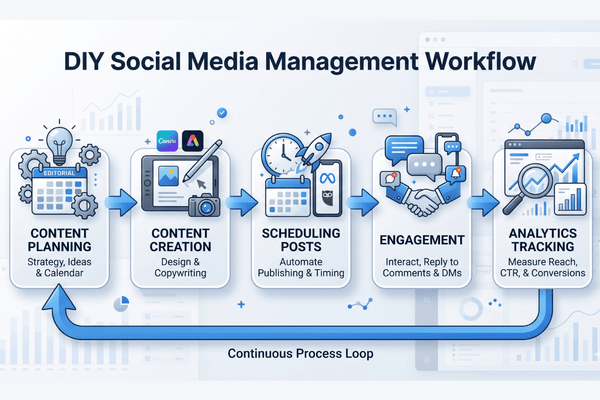
The workflow follows a repeatable cycle that supports organic social media work:
Planning a content calendar aligned with business goals
Creating visuals, videos, and copy in-house
Publishing through native apps or schedulers
Engaging with audience messages and comments
Analyzing metrics like reach, CTR, and conversions
A typical small business spends 6–15 hours per week on in-house posting and engagement, depending on platform count and content depth [site: HubSpot report, 2024]. That workload increases with video-first platforms like Instagram and TikTok, where frequency and quality directly impact reach.
What Tasks Are Involved in DIY Social Media Management?
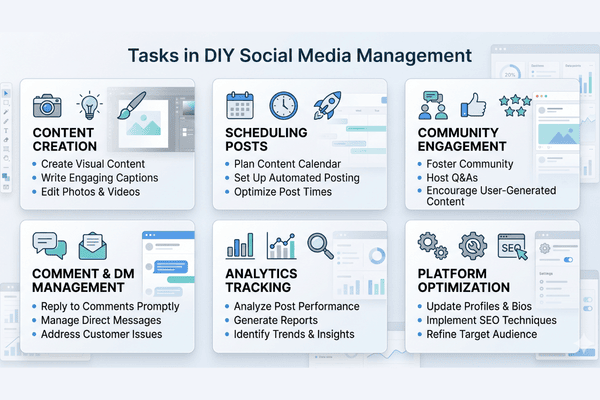
The tasks involved in DIY social media management include content production, scheduling, engagement, analytics, and ongoing platform optimization.
Managing social media independently requires handling multiple daily operational tasks across content, communication, and performance tracking without external support. These tasks demand consistency, technical skill, and structured execution to maintain visibility and growth.
The main tasks involved in DIY social media management are listed below.
Creating original content creation assets, including graphics, short videos, captions, and brand-aligned messaging using tools like Canva or Adobe Express.
Scheduling posts through post scheduling systems such as Buffer or native tools, ensuring consistent publishing frequency across platforms and optimal engagement timing windows. A structured content calendar makes this process far more manageable and reduces the risk of missed publishing dates.
Managing audience interactions through community management, including direct messages, brand mentions, and maintaining response times under 24 hours for algorithmic visibility signals.
Responding to user engagement with comment replies, addressing queries, moderating discussions, and reinforcing brand tone across public and private interactions.
Monitoring performance through analytics review, tracking reach, click-through rate (CTR), impressions, and conversions using dashboards like Google Analytics [site: Google Analytics documentation].
Overseeing multi-channel operations through platform management, ensuring consistent branding, profile optimization, and feature updates across platforms like Facebook and LinkedIn.
What Skills Are Required for DIY Social Media Management?
The skills required for DIY social media management include content creation, communication, analytics, and platform-specific execution abilities.
Effective social media management depends on mastering creative, analytical, and operational skills simultaneously to produce consistent growth and measurable engagement results. These skills directly impact reach, conversions, and long-term brand positioning in competitive digital environments.
The essential skills required for DIY social media management are listed below.
Writing persuasive copywriting that drives engagement, improves click-through rates (CTR), and aligns messaging with brand voice across different audience segments.
Applying visual design skills to create scroll-stopping graphics, thumbnails, and short-form videos using tools like Canva or Adobe Photoshop.
Developing a clear social media strategy that defines content goals, audience targeting, posting frequency, and funnel alignment for measurable business outcomes.
Understanding platform knowledge including algorithms, content formats, and ranking signals on platforms like Instagram and LinkedIn.
Managing workflows through strong time management, ensuring consistent posting schedules, task prioritization, and efficient handling of multiple social media channels.
Interpreting data through analytics interpretation, analyzing metrics like impressions, engagement rate, and conversions using tools like Google Analytics [site: Google Analytics documentation].
What Is Professional Social Media Management and How Does It Work?
Professional social media management is the practice of hiring experts or agencies to handle a brand’s social media strategy, execution, and performance optimization.
Professional social media management involves outsourcing strategy, content, publishing, and analytics to specialists who deliver structured, data-driven growth. This model integrates planning, execution, and continuous improvement using proven frameworks and platform-specific expertise.
In outsourced social media, agencies or specialists manage end-to-end operations. They develop a tailored social media strategy, produce high-quality content, schedule posts, and optimize campaigns using tools like Sprout Social and HubSpot. This approach ensures consistent branding and measurable outcomes.
The service model follows a structured workflow. It starts with audience research and competitor analysis, then moves into content production and expert execution across platforms like Instagram and Facebook. Performance tracking uses key metrics such as engagement rate, cost per acquisition (CPA), and return on investment (ROI), aligning with frameworks outlined in industry reports like the “State of Social Media” by HubSpot [site: HubSpot report].
What Services Are Included in Professional Social Media Management?
Professional social media management includes strategy development, content production, audience engagement, paid promotion, and performance reporting. A complete social media management package delivers end-to-end services covering planning, execution, and optimization for consistent brand growth. These services operate within structured workflows aligned with business goals and platform-specific performance metrics.
The services included in professional social media management are listed below.
Developing strategic content creation pipelines that include branded visuals, short-form videos, and conversion-focused copy aligned with audience intent.
Building and maintaining a structured content calendar that schedules posts weekly or monthly based on engagement data and campaign priorities.
Managing audience interactions through community management, including message handling, brand mentions, and maintaining response times within platform-recommended thresholds.
Running targeted campaigns using paid ads across platforms like Facebook Ads Manager, optimizing for cost per click and conversions.
Delivering performance insights through reporting, including reach, engagement rate, and return on investment using dashboards like Sprout Social [site: Sprout Social Index].
Improving visibility through platform optimization, refining profiles, hashtags, and posting formats based on algorithm updates and platform-specific ranking signals.
How Does a Social Media Manager Handle Strategy and Execution?
A social media manager handles strategy and execution by planning campaigns, creating content systems, managing publishing workflows, and continuously optimizing performance.
A social media manager executes strategy through structured planning, targeted publishing, audience engagement, and data-driven optimization cycles. This process ensures consistent growth, efficient resource use, and measurable business outcomes across multiple platforms.
The main ways a social media manager handles strategy and execution are listed below.
Conducting detailed campaign planning that aligns marketing goals with audience behavior, seasonal trends, and competitive positioning insights.
Designing a scalable content strategy that balances educational, promotional, and engagement-driven posts tailored to platform-specific algorithms and formats.
Managing a consistent publishing schedule using tools like Hootsuite to maintain optimal posting frequency and timing.
Refining reach through precise audience targeting, segmenting users based on demographics, behavior, and engagement patterns across platforms like Instagram.
Monitoring results through performance tracking, analyzing key metrics such as engagement rate, impressions, and conversion rate using tools like Google Analytics [site: Google Analytics documentation].
Improving outcomes through continuous optimization, adjusting creatives, timing, and targeting based on real-time data and A/B testing results.
How Does DIY Social Media Compare to Professional Management in Time, Cost, Quality, and ROI?
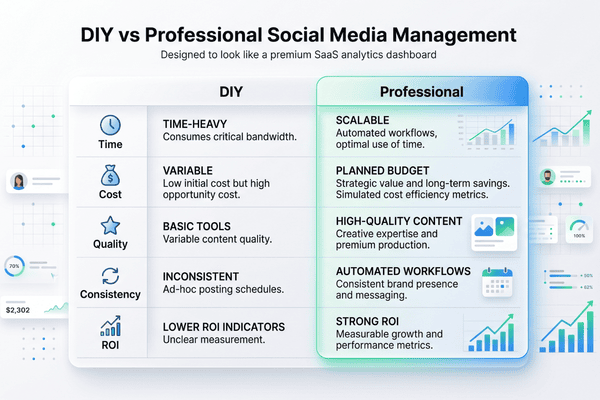
DIY social media compares to professional management by requiring more time, lower upfront cost, inconsistent quality, and often lower long-term returns.
Professional management delivers higher efficiency, better content quality, stronger consistency, and measurable ROI compared to DIY efforts. The difference becomes clear when evaluating time allocation, execution quality, and revenue impact across sustained campaigns.
Time investment is significantly higher in DIY models. Business owners spend 6–15 hours weekly managing content, engagement, and analytics, reducing focus on revenue-generating activities [site: HubSpot report]. Professional teams distribute workload across specialists, improving execution speed and operational efficiency.
Management cost appears lower in DIY initially but increases through hidden costs. Time value, tool subscriptions, and missed opportunities raise total expense. Outsourced services range from $500–$5,000 monthly, depending on scope and platform complexity.
Content quality differs due to expertise and production capability. DIY efforts rely on basic tools and limited skills, while agencies use advanced design systems, brand guidelines, and tested content frameworks to improve engagement rates.
Consistency is harder to maintain with DIY workflows. Posting gaps, delayed responses, and irregular campaigns reduce algorithm visibility. Professional management enforces structured publishing schedules and real-time engagement cycles across platforms.
Return on investment (ROI) improves with professional execution. Agencies track conversion metrics, optimize campaigns, and scale strategies systematically. DIY approaches often lack data-driven optimization, reducing long-term growth potential and measurable business impact.
How Does Time Investment Differ Between DIY and Professional Management?
Time investment differs between DIY and professional management because DIY requires full manual execution, while professional services distribute tasks across specialized teams.
DIY demands continuous hands-on involvement, while professional management reduces time commitment through structured workflows and outsourced execution. This difference directly affects productivity, consistency, and the ability to scale marketing efforts efficiently.
The time-related differences between DIY and professional management are listed below.
Handling full-time commitment in DIY requires 6–15 weekly hours for planning, creation, posting, and engagement across multiple platforms. Understanding how many times per week a business should post is one of the first decisions that shapes the total time cost.
Managing inefficient workflow in DIY slows execution, while agencies streamline processes using systems and automation tools like Hootsuite.
Performing manual content planning in DIY consumes hours weekly, whereas professionals batch-plan monthly calendars aligned with campaigns and audience behavior.
Overseeing constant daily management tasks like replies, monitoring, and updates in DIY increases workload and reduces focus on core business operations.
Leveraging outsourced support reduces workload significantly, allowing businesses to reallocate 70–80% of time toward sales and operations [site: HubSpot report].
Improving overall efficiency through professional systems ensures faster turnaround, consistent publishing, and reduced delays compared to fragmented DIY execution.
How Does Cost Compare Between DIY and Outsourced Social Media Management?
Cost compares differently between DIY and outsourced social media management because DIY shifts spending toward tools and owner labor, while outsourcing shifts spending toward agency fees and specialist execution.
DIY looks cheaper upfront, but outsourced management often lowers hidden costs by reducing wasted time, tool duplication, and missed opportunities. Budget pressure changes with posting volume, platform count, and how much internal labor the business absorbs.
The cost differences between DIY and outsourced social media management are listed below.
DIY spending centers on budget control, but outsourced support converts fixed internal effort into recurring service fees with clearer monthly planning.
Tool expenses stay lower in outsourcing because agencies already own scheduling, reporting, and design systems.
DIY carries higher labor cost when owners or staff spend hours on posting, replies, and analytics instead of core work.
Agency fees buy strategy, execution, and optimization, which removes hiring, training, and management overhead from the business.
DIY creates hidden costs through inconsistent posting, slow approvals, and missed leads that reduce revenue efficiency.
Outsourcing produces more predictable outsource cost structures, especially when a contract includes reporting, creative production, and platform optimization.
How Does Content Quality Differ Between DIY and Professional Management?
Content quality differs between DIY and professional management because DIY often relies on limited tools and experience, while professionals use stronger creative systems and brand controls. Professional content usually delivers tighter brand voice, stronger visual consistency, and higher audience appeal across every post. The quality gap appears in design polish, message clarity, and the ability to keep output consistent during busy periods. The decision between formats also matters, and understanding static posts vs video posts helps clarify which content type drives stronger results for your specific platform mix.
The content quality differences between DIY and professional management are listed below.
DIY content often shows uneven content quality because production depends on limited time, basic tools, and inconsistent review cycles.
Professional teams protect brand voice through style guides, approvals, and editorial standards that keep messaging aligned across platforms.
Visual consistency improves with professional design systems, while DIY posts often vary in color, layout, and formatting.
Outsourced teams deliver stronger creative quality because specialists handle copy, design, motion, and optimization together.
Professional output feels more like professional content because it uses tested hooks, cleaner structure, and better pacing.
Higher audience appeal comes from sharper visuals, clearer messaging, and posts built for platform-specific engagement patterns.
How Does Consistency Affect Results in DIY vs Professional Social Media?
Consistency affects results in DIY vs professional social media because regular publishing shapes engagement, retention, and brand reliability.
Professional management sustains posting consistency more reliably, while DIY workflows often break when time, content, or attention runs short. That difference affects audience expectations and platform performance over time [site: platform help documentation].
The consistency factors affecting results are listed below.
Posting consistency keeps content visible in feeds, while irregular DIY publishing weakens momentum and reduces engagement signals.
A content calendar gives structure, but DIY teams often miss planned dates when other business tasks take priority.
Regular publishing builds audience habits, making followers more likely to return and interact with future posts.
Better audience retention comes from steady delivery, while gaps in posting make followers forget the brand faster.
Higher engagement follows predictable cadence, because audiences respond more often when content appears on schedule.
Strong brand reliability comes from consistent output, and that reliability supports long-term trust and algorithmic visibility.
How Does ROI Compare Between DIY and Social Media Management Services?
ROI compares between DIY and social media management services because professional execution usually converts more efficiently than self-managed posting. DIY often lowers upfront spend, but professional services usually produce stronger return on investment through better lead generation and conversion value. The gap appears in performance results, tracking discipline, and the quality of strategic decisions [site: marketing analytics guidance]. Reviewing a detailed breakdown of social media management cost gives you a clearer picture of what professional execution actually costs against what it returns.
The ROI differences between DIY and social media management services are listed below.
DIY ROI often looks lower because weak tracking hides the real return on investment from time, tools, and lost opportunity.
Professional services improve business growth by aligning campaigns with measurable goals, funnels, and sales outcomes.
Stronger lead generation comes from targeted strategy, better creative, and faster optimization across active campaigns.
Higher conversion value results when specialists refine messaging, audience targeting, and landing page alignment together.
Better performance results appear because agencies test, measure, and adjust campaigns more systematically than DIY teams.
Overall, ROI improves when outsourced work turns social media from a task into a managed revenue channel.
How Does Business Size Affect the Choice Between DIY and Social Media Management?
Business size affects the choice between DIY and social media management by determining resource availability, complexity, and required execution speed.
Smaller businesses rely on DIY for cost control, while larger businesses require structured management for scale, consistency, and measurable performance. The decision depends on workload, growth targets, and how critical social media is to revenue generation.
A small business typically manages simple posting and engagement internally due to limited budgets and lower content volume. A growing business requires more structured workflows, consistent publishing, and performance tracking, often pushing toward partial outsourcing. An established business operates across multiple platforms, campaigns, and audiences, making professional management essential for maintaining efficiency and competitive positioning.
Service needs evolve with scale. Early-stage brands focus on visibility and basic engagement. Growth-stage companies demand lead generation and conversion tracking. Mature brands require advanced analytics, paid campaigns, and multi-channel integration aligned with broader marketing systems like HubSpot.
When Should Small Businesses Choose DIY Social Media Management?
Small businesses should choose DIY social media management when resources are limited, and marketing needs remain simple and manageable.
DIY works best for small businesses with limited budgets, simple posting needs, and direct owner involvement in brand communication. This approach supports early-stage visibility without requiring significant financial investment or external dependencies.
The situations where small businesses should choose DIY social media management are listed below.
Operating with a limited budget, where allocating $0–$300 monthly toward tools is more feasible than agency retainers.
Managing simple posting needs such as basic updates, product highlights, and occasional promotions without complex campaign structures.
Building basic branding where consistency matters, but advanced design systems and multi-platform strategies are not yet required.
Running startup marketing initiatives focused on awareness, early traction, and testing content ideas before scaling efforts.
Handling owner-managed social media, where founders communicate directly with audiences to build trust and authentic engagement.
When Should Growing Businesses Hire Social Media Management Services?
Growing businesses should hire social media management services when expansion demands structured execution and internal capacity starts limiting lead growth.
The situations where growing businesses should hire social media management services are listed below.
Hiring becomes necessary when content volume increases and the team cannot sustain consistent publishing without outsourced support.
Social media services help when scale marketing requires campaign planning, stronger creative output, and faster execution across platforms. Knowing how to choose the right social media management package at this stage prevents overspending on services that do not match your current growth needs.
Professional help becomes valuable when lead growth depends on tracked funnels, conversion messaging, and coordinated audience targeting.
Outsourcing is practical when expansion creates too many daily tasks for founders to manage alone.
Services add value when reporting, optimization, and platform management need specialist attention to support faster growth.
When Should Established Businesses Avoid DIY Social Media?
Established businesses should avoid DIY social media when brand reputation and scaling needs demand advanced strategy and reliable execution.
The reasons established businesses should avoid DIY social media are listed below.
DIY becomes risky when advanced strategy is required for multi-channel campaigns, segmentation, and performance optimization.
Internal handling fails when resource limits reduce the quality of content, approvals, and response management.
Professional management is necessary when brand reputation depends on consistent messaging across teams, markets, and platforms.
DIY breaks down when scaling needs require coordinated paid media, analytics, and conversion-focused planning.
Outsourcing is the better fit when established brands need stable governance and specialized social media leadership.
How Do You Decide Between DIY and Social Media Management for Your Business?
You decide between DIY and social media management by evaluating budget, goals, time availability, expertise, and current growth stage.
The right choice depends on aligning your business goals with available resources, required skills, and the level of growth you want to achieve. A structured decision framework prevents wasted time, inconsistent execution, and poor return on investment.
Start with business goals. If goals focus on awareness and basic engagement, DIY fits. If goals include lead generation, conversions, and scaling, professional management becomes necessary. According to a widely cited HubSpot “State of Marketing” report, strategy alignment directly impacts campaign performance [site: HubSpot report].
Assess time availability and expertise next. Managing content, analytics, and engagement requires 6–15 hours weekly plus platform knowledge. Limited time or skill gaps reduce consistency and performance. Professional services solve this with structured execution and specialized roles.
Evaluate budget against growth expectations. DIY reduces upfront cost but increases hidden costs. Outsourcing ranges from $500–$5,000 monthly depending on scope and platform count. Choose based on expected return, not just expense.
Match your growth stage to the management model. Small businesses can manage internally. Growing businesses benefit from hybrid or outsourced support. Established businesses require full professional management to maintain scale, efficiency, and competitive positioning.
What Questions Should You Ask Before Choosing DIY or Professional Management?
The questions you should ask before choosing DIY or professional management include evaluating goals, resources, skills, and expected outcomes. Clear decision questions help determine whether your current resources can support consistent execution or if professional management is required. These questions reduce risk and ensure the chosen approach aligns with measurable business objectives. If you move toward outsourcing, this list of questions to ask a social media management company gives you a proven framework before any agency conversation begins.
The key questions to ask before choosing DIY or professional management are listed below.
What are your business goals, and do they require awareness, engagement, or measurable conversions from social media campaigns?
What level of time commitment can you consistently dedicate weekly to planning, creating, posting, and analyzing social media content?
Does your current budget support agency fees, or is self-management necessary to control short-term marketing expenses?
Do you have the required skills in content creation, analytics, and strategy to manage performance effectively across platforms?
Is the chosen approach the right service fit for your growth stage, content volume, and expected marketing outcomes?
What Signs Indicate You Should Stop DIY and Hire a Professional?
The signs you should stop DIY and hire a professional include burnout, weak results, and operational drag.
The signs that indicate it is time to hire a professional are listed below.
Your burnout keeps rising, and social posting starts consuming time you need for sales, service, or operations.
Your results stay poor, with low engagement, weak reach, and no clear movement in leads or revenue.
Your posting becomes inconsistent, and missed deadlines create gaps that weaken audience trust and algorithmic visibility.
Your team misses opportunities because nobody has time to answer comments, follow trends, or refine campaigns quickly.
Your workload outgrows internal capacity, and critical tasks pile up without the specialist attention professional management provides.
Why Does Professional Social Media Management Perform Better in the Long Term?
Professional social media management performs better in the long term because it compounds strategy, efficiency, and scalability across campaigns.
It creates systems, not one-off posts.
That structure supports stronger business results, steadier execution, and more consistent growth as the brand expands.
How Does Scaling a Business Change Social Media Management Needs?
Scaling a business changes social media management needs because growth increases content volume, platform complexity, and strategic coordination.
Scaling demands a more structured management model, with clearer workflows, stronger targeting, and faster optimization across channels. That shift changes how teams plan, publish, and measure results as the brand expands.
The ways scaling a business changes social media management needs are listed below.
Growth complexity increases when more offers, audiences, and campaigns require coordinated messaging across multiple channels.
Content volume rises fast, forcing teams to produce more posts, videos, and stories without losing quality or timing.
Strategy needs become sharper because larger brands require audience segmentation, funnel alignment, and campaign planning.
Platform expansion adds more work, since each network needs unique formats, cadence, and optimization.
Resource demand increases as reporting, approvals, and engagement require more people, time, and specialized skills.
How Does Outsourcing Social Media Improve Efficiency and Growth?
Outsourcing social media improves efficiency and growth because professional support removes bottlenecks and strengthens execution. Outsourcing converts scattered effort into a repeatable workflow that saves time, improves performance, and supports business growth. It helps teams stay consistent while specialists handle strategy, creation, and optimization. Understanding what to expect from social media content creation for businesses helps you evaluate whether an outsourced team can match your brand's quality and output requirements.
The ways outsourcing social media improves efficiency and growth are listed below.
Efficiency improves when specialists handle posting, monitoring, and reporting, freeing internal teams for higher-value work.
Growth accelerates because professional support brings stronger targeting, cleaner messaging, and better campaign execution.
Professional support reduces delays by replacing ad hoc work with organized processes and clear approval paths.
Workflow improvement happens through batching, scheduling, and standardized production systems that reduce wasted effort.
Performance rises when experts test content, refine campaigns, and adjust tactics based on data.
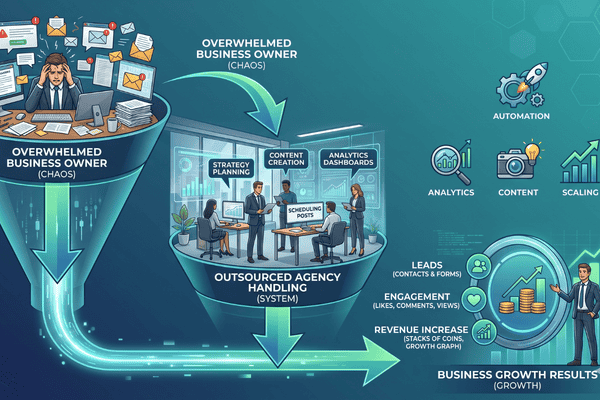
Choosing between DIY and professional social media management depends on your business's size, goals, and resources. Small businesses may thrive with DIY efforts, while growing and established businesses often require professional support for scalability, strategy, and efficiency.
Outsourcing enhances content quality, engagement, and ROI by leveraging expert knowledge, streamlined workflows, and data-driven optimization, leading to better long-term growth. By evaluating your budget, time, and expertise, you can make an informed decision that aligns with your business objectives.