
What Is Social Media Engagement Rate and Why Does It Matter for Your Business?
Only 22% of businesses say they fully understand how to measure social media performance beyond follower count [source: Salesforce State of Marketing, 2025]. The metric they are missing is engagement rate, and it changes every decision from content strategy to platform budget allocation.
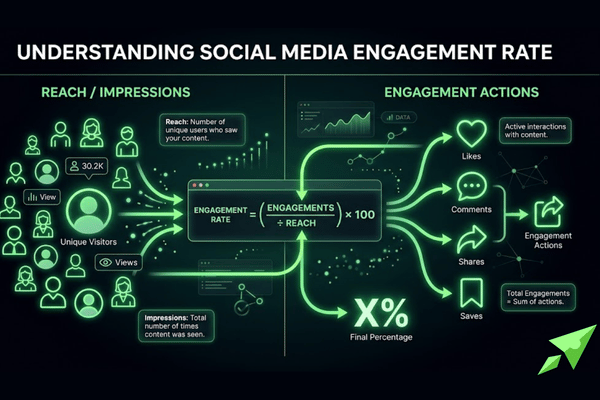
Social media engagement rate is the percentage of people who actively interact with your content relative to the number of people who saw it or follow your account. It measures genuine audience response, not passive exposure. The formula produces a percentage that tells you whether your audience finds your content worth responding to. A high engagement rate accelerates algorithm distribution, builds brand trust, and connects more directly to revenue than reach or impressions ever can.
This guide covers the definition of social media engagement rate, how to calculate it using the three main formulas, what a good rate looks like by platform and business size, how it connects to ROI, and the most common measurement mistakes businesses make. It also covers platform selection, stakeholder reporting, influencer vetting by engagement rate, and how audience interaction rate data feeds back into a smarter content strategy.
What is social media engagement rate?
Social media engagement rate is a performance metric that measures the percentage of your audience that actively interacts with a piece of content. It goes beyond followers and views to capture genuine audience response and content resonance in a single percentage figure.
Where reach tells you how many people saw your content, engagement rate tells you how many of those people responded to it. A post with 10,000 impressions and 50 interactions has a 0.5% engagement rate. A post with 500 impressions and 40 interactions has an 8% rate. The second post performed far better, even though fewer people saw it. That distinction is why engagement rate is a more reliable content performance signal than any raw volume metric.
Audience interaction rate reflects the quality of your relationship with your followers. It answers one question that raw numbers cannot: Does your content move people to act?
What types of interactions count toward social media engagement rate?
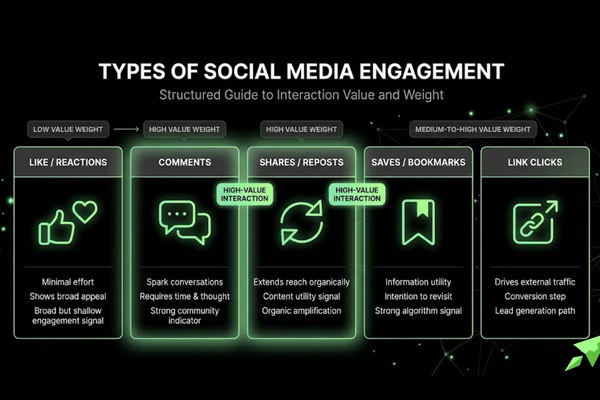
Interactions that count toward social media engagement rate are listed below.
Likes and reactions: The most basic engagement signal. On Facebook and LinkedIn, reactions (love, care, insightful) count separately from standard likes and carry slightly different algorithmic weight.
Comments and replies: Higher-value interactions than likes. Comments require active effort and signal deeper audience connection to the content.
Shares and reposts: The highest-value organic engagement signal. Each share distributes your content to a new cold audience at zero additional cost.
Saves and bookmarks: On Instagram and Pinterest, saves indicate high-value content the user plans to return to. Saves are a strong purchase-intent signal for product-based businesses.
Link clicks: Counted as engagement on LinkedIn, Twitter/X, and TikTok. Measures direct audience intent to learn more or take action beyond the platform.
Video views: Counted as engagement when they exceed a minimum watch threshold, typically 3 seconds on Facebook and 2 seconds on TikTok.
Story replies and poll responses: Platform-specific interactions on Instagram Stories and Facebook Stories that count as direct audience engagement with ephemeral content.
How does social media engagement rate differ from reach and impressions?
Social media engagement rate differs from reach and impressions because it measures active audience response rather than passive content exposure. Reach equals the number of unique accounts that saw your content. Impressions equal the total number of times your content was displayed, including repeat views from the same person. Neither number tells you whether the audience cared.
Engagement rate converts that exposure data into a quality signal. You divide active interactions by reach or followers, then multiply by 100 to get a percentage. A post with 50,000 impressions and zero saves or comments produced no measurable audience connection regardless of how large that impression number looks. Engagement rate is the metric that separates content performance from content presence.
How do you calculate social media engagement rate?
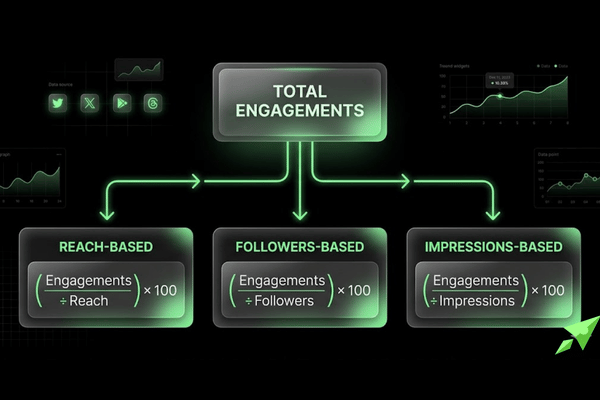
To calculate social media engagement rate, you divide total engagements by a base number, either reach, followers, or impressions, then multiply by 100 to produce a percentage. The base you choose determines what the percentage measures and which business question it answers. The most widely used social media engagement rate formulas are listed below.
Engagement Rate by Reach (ERR): Most accurate for measuring content performance on a post-by-post basis.
Engagement Rate by Followers: Best for benchmarking account-level performance over time.
Engagement Rate by Impressions: Most useful for evaluating paid content and ad campaigns.
Each formula produces a different number from the same data set. Understanding which formula fits your reporting goal prevents misinterpretation when comparing performance across posts or accounts.
What is the engagement rate by the reach formula?
The engagement rate by reach formula is: ERR = (Total Engagements / Reach) × 100. ERR (Engagement Rate by Reach) measures how many of the unique accounts that actually saw your post chose to interact with it.
Example: A post receives 320 total engagements (likes, comments, saves, shares) and reached 8,000 unique accounts. ERR = (320 / 8,000) × 100 = 4% engagement rate by reach.
Use ERR when evaluating organic post performance and comparing content formats against each other. It is the most widely cited formula in social media reporting. Its limitation is that reach fluctuates post by post, so ERR can vary significantly across a single account's content without reflecting a real change in audience relationship quality.
What is the engagement rate by followers formula?
The engagement rate by followers formula is: ER by Followers = (Total Engagements / Total Followers) × 100. This formula measures how active your overall follower base is relative to your total audience size.
Example: A business account with 12,000 followers receives 240 total engagements on a post. ER = (240 / 12,000) × 100 = 2% engagement rate by followers.
Follower-based engagement rate is most useful for benchmarking an account against competitors or industry standards because follower count is a stable denominator that does not change between posts. Its limitation is that it underestimates performance for accounts with large follower bases where organic reach is algorithmically restricted, meaning many followers never see the post being measured.
What is the engagement rate by impressions formula?
The engagement rate by impressions formula is: ER by Impressions = (Total Engagements / Total Impressions) × 100. This formula is particularly useful for paid content and ad campaigns where impressions are the primary distribution metric tracked by the platform.
Example: A Facebook ad generates 180 engagements across 45,000 impressions. ER = (180 / 45,000) × 100 = 0.4% engagement rate by impressions.
Impression-based engagement rates are typically lower than reach-based or follower-based rates because impressions count repeat views, inflating the denominator. Use this formula when comparing paid campaign performance or when your analytics platform reports impressions rather than reach as the primary distribution figure.
How does the engagement rate formula vary across social media platforms?
Here is how the engagement rate formula varies across major social media platforms:
Platform
Primary Engagement Actions
Recommended Formula
Notes
Likes, comments, saves, shares, Story replies
ERR (reach-based)
Saves weighted heavily by algorithm
Reactions, comments, shares, link clicks
ERR or follower-based
Group engagement tracked separately
Reactions, comments, reposts, clicks, follows
Follower-based
Impressions-based common for company pages
TikTok
Likes, comments, shares, saves, watch time
Reach-based
Watch completion rate also tracked
X (Twitter)
Likes, replies, reposts, link clicks, bookmarks
Impression-based
Impressions are the primary distribution metric
Platform variation matters because using a reach-based formula on X, where impressions data dominates, produces misleading results compared to other platforms.
Why does social media engagement rate matter for your business?
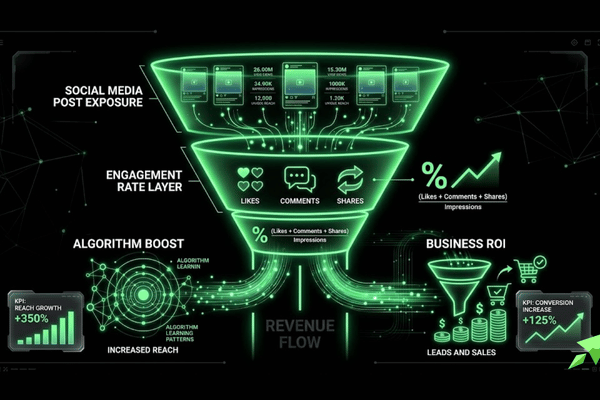
Social media engagement rate matters for your business because it tells you whether your content strategy is working before you spend more money on it. A high engagement rate signals audience alignment. A low one signals a content-to-audience mismatch that, left uncorrected, compounds into wasted budget over months. Key reasons social media engagement rate matters for your business are listed below.
Engagement rate reveals content quality: High engagement confirms the audience finds your content relevant, valuable, and worth responding to.
Engagement rate drives algorithm distribution: Platforms reward high-engagement content with wider organic reach at no additional cost.
Engagement rate builds brand trust: Active comment sections and share counts signal social proof to new profile visitors who do not yet know your brand.
Engagement rate predicts conversion likelihood: Engaged audiences convert at higher rates than passive audiences across all social platforms [source: HubSpot Benchmark Report, 2025].
Engagement rate justifies social media investment: It provides the data to demonstrate content performance to leadership, clients, or investors beyond vanity metrics like follower count.
How does engagement rate indicate content quality for your brand?
Social media engagement rate indicates content quality for your brand by measuring whether the audience finds your content worth their time and attention. A post with a 5% engagement rate performed five times better than the platform average on most channels, signaling that the content delivered genuine value to its audience [source: Rival IQ Social Media Benchmark Report, 2025].
Low engagement rate signals a content-audience mismatch. The content format, topic, or message does not connect with the people seeing it. That signal requires a strategy adjustment, not more volume. Producing more posts with the same low-engagement formula trains the algorithm to limit distribution further, because the platform interprets the low engagement as evidence that the content is not useful to its audience.
High engagement signals the opposite. It tells the algorithm your content earns attention, which triggers wider distribution without additional spend. For brand managers, engagement rate data identifies which content topics to expand and which to cut, making it the primary input for content strategy decisions.
How does a high engagement rate influence social media algorithms?
A high engagement rate influences social media algorithms by triggering wider organic content distribution to users who do not yet follow your account. Platforms including Instagram, Facebook, TikTok, and LinkedIn use engagement rate as a distribution ranking signal, prioritizing content that generates strong early interactions over content that receives passive views [source: Meta Developer Documentation, 2025].
The mechanism works in stages. A new post is distributed to a small test segment of your followers first. If that segment engages at a high rate within the first 30 to 60 minutes, the algorithm expands distribution to a broader audience including non-followers. Low early engagement results in restricted distribution.
This is why engagement rate directly affects organic reach. It is not a separate metric from reach. It is the input that determines how much reach your content earns. Accounts with consistently high engagement rates accumulate algorithmic trust over time, which lowers the threshold needed for new content to receive broad distribution.
How does engagement rate build brand trust and authority for a business?
Engagement rate builds brand trust and authority for a business by producing visible social proof on every piece of content a new visitor encounters. An active comment section with 40 replies signals credibility in a way that a post with 500 likes and zero comments never can, because comments require the audience to invest time and opinion, not just a tap.
New profile visitors make trust decisions within the first 8 seconds of landing on a business's social page [source: Nielsen Norman Group, 2024]. An account with consistently engaged posts signals that real people find the content worth responding to, which transfers credibility to the brand by association. High engagement rates also attract media attention, partnership inquiries, and influencer collaboration requests, because brands with engaged audiences are demonstrably more valuable to partner with than brands with large but passive followings.
What is a good social media engagement rate for your business?
A good social media engagement rate for your business is any rate above the platform average for your audience size and industry, with 1% to 5% representing the healthy performance range across most platforms for organic content [source: Rival IQ, 2025]. The specific target shifts based on platform, account size, and the industry you operate in.
Here is a breakdown of good engagement rate benchmarks by platform:
Instagram
Average Engagement Rate: 0.5%–1%
Good Rate: 1%–3%
Strong Rate: 3%+
Facebook
Average Engagement Rate: 0.06%–0.2%
Good Rate: 0.2%–1%
Strong Rate: 1%+
LinkedIn
Average Engagement Rate: 2%–3%
Good Rate: 3%–5%
Strong Rate: 5%+
TikTok
Average Engagement Rate: 2%–4%
Good Rate: 4%–8%
Strong Rate: 8%+
X (Twitter)
Average Engagement Rate: 0.04%–0.15%
Good Rate: 0.15%–0.5%
Strong Rate: 0.5%+
No single number applies universally. A 1% engagement rate on TikTok indicates underperformance. The same rate on Facebook is above the platform average. Always benchmark against the correct platform norm, not a cross-platform average.
What are the average engagement rate benchmarks by platform in 2026?
Average social media engagement rate benchmarks by platform in 2026 are listed below.
LinkedIn: Average engagement rate of 2.8%, driven by a smaller, more professionally targeted audience that engages deliberately rather than passively scrolling [source: Hootsuite Digital Trends, 2026].
Instagram: Average engagement rate of 0.5% to 1% on feed posts. Reels average 1.5% to 2% due to the platform's algorithm prioritizing short-form video distribution [source: Rival IQ, 2025].
Facebook: Average engagement rate of 0.06% to 0.2%, reflecting algorithmic suppression of organic Page content since 2018, which prioritizes paid reach over organic post distribution.
TikTok: Average engagement rate of 2% to 4%, supported by the For You Page algorithm that distributes content based on watch time and interaction signals rather than follower relationships.
X (Twitter): Average engagement rate of 0.04% to 0.15%, the lowest of all major platforms, driven by the high-volume, fast-scroll nature of the feed and the platform's shift toward impression-based content distribution.
How does business size affect what a good engagement rate looks like?
Business size affects what a good engagement rate looks like because smaller accounts receive proportionally higher engagement rates than larger ones. Nano accounts with fewer than 10,000 followers average engagement rates of 3% to 8%, while macro accounts with over 1 million followers average 0.5% to 1.5% [source: Influencer Marketing Hub, 2025].
This happens for two reasons. Smaller accounts attract tightly niche audiences who followed for a specific reason, producing stronger content-audience alignment. Larger accounts accumulate passive followers who followed during a viral moment but no longer engage consistently, which dilutes the engagement rate denominator without adding active interactions.
For benchmarking accuracy, compare your engagement rate against accounts of similar follower size in your industry, not against platform-wide averages that mix account sizes. A 2% engagement rate for a 50,000-follower account is strong. The same rate for a 500-follower account is below expectation.
How do industry verticals affect social media engagement rate benchmarks?
Industry verticals affect social media engagement rate benchmarks because niche audiences engage at higher rates than broad consumer audiences, and purchase frequency influences how often followers interact with brand content.
Industries with above-average engagement rates include health and wellness (3.5% average on Instagram), home decor and interior design (2.8%), and food and beverage (2.5%). Industries with below-average rates include B2B SaaS (0.4% to 0.8%) and financial services (0.3% to 0.6%), where audiences are smaller, more cautious, and less likely to publicly comment on brand content [source: Sprout Social Benchmark Report, 2025].
eCommerce brands on Instagram and Pinterest consistently outperform B2B brands on the same platforms because product photography, lifestyle imagery, and aspirational content generate save behavior, which carries strong engagement weight. B2B brands on LinkedIn outperform those same eCommerce brands on that platform because the professional context better matches the content type. Accurate goal-setting requires checking industry-specific benchmarks, not just platform-wide averages.
How does social media engagement rate connect to your business ROI?
Social media engagement rate connects to your business ROI by bridging content performance data to audience conversion behavior. Engaged audiences convert at 6.9 times the rate of passive audiences on social platforms according to a 2024 analysis by Salesforce [source: Salesforce Connected Customer Report, 2024]. That gap makes engagement rate one of the strongest leading indicators of social media revenue impact available without expensive tracking infrastructure.
Ways social media engagement rate connects to your business ROI are listed below.
Engaged audiences show higher purchase intent: Comments, saves, and link clicks indicate active consideration, not passive exposure.
High engagement reduces paid distribution costs: Platforms reduce cost-per-click and cost-per-impression for high-engagement content in paid campaigns.
Engaged followers generate word-of-mouth: Shares and reposts extend reach to new cold audiences at zero additional spend.
Engagement rate data improves content investment decisions: Identifying top-performing content formats prevents spending time on low-ROI content types.
Engagement benchmarks build the business case for continued social media investment when presenting to leadership or clients.
How does a strong engagement rate drive conversions and sales?
A strong engagement rate drives conversions and sales by moving your audience through the purchase funnel through repeated, active interaction with your brand content. Each save, share, and link click is a micro-conversion that indicates the user is progressing from awareness toward purchase intent.
The mechanism is psychological as much as it is algorithmic. A user who saves a product post plans to return to it. A user who shares your content recommends your brand to their network without any prompting. A user who clicks your link-in-bio has demonstrated enough interest to leave the platform and visit your website. Each of these actions produces a compounding effect: the algorithm rewards the engagement with wider distribution, which generates more exposure, which produces more interactions from new audience members.
Advocacy built through an engaged audience base also drives referral purchases. A 2023 Nielsen study found that 92% of consumers trust peer recommendations over brand advertising [source: Nielsen Global Trust in Advertising Report, 2023], and engaged social media followers function as peer recommenders when they share or comment publicly on brand content.
How do you use engagement rate data to justify social media investment?
You use engagement rate data to justify social media investment by framing it in the language of business outcomes rather than presenting raw interaction numbers to decision-makers. Cost per engagement (CPE), total social media spend divided by total engagements, converts engagement data into a cost-efficiency metric that budget-holders recognize immediately.
Example: If a managed social media program costs $1,500 per month and produces 3,000 engagements, the CPE is $0.50. Compare that to the average cost-per-click on Google Ads at $2.00 to $4.00 across most industries [source: WordStream Industry Benchmarks, 2025], and the efficiency of social engagement becomes a clear argument for continued investment.
Trend data strengthens that argument further. Showing a 40% month-over-month improvement in engagement rate demonstrates that the strategy is building momentum, which makes a budget approval conversation easier than presenting a single month's static numbers.
What is the difference between vanity metrics and meaningful engagement rate?
The difference between vanity metrics and meaningful engagement rate is that vanity metrics measure passive exposure while engagement rate measures active audience response. Vanity metrics include raw follower count, total impressions, and aggregate likes. They look impressive in reports but do not indicate whether the audience has any intention to purchase, return, or refer others to your brand.
Follower count is the most misleading vanity metric for business. An account with 100,000 followers and a 0.1% engagement rate has an actively disengaged audience. An account with 4,000 followers and a 6% engagement rate has a community that consistently responds to its content. The second account delivers more business value despite appearing smaller by every vanity metric.
Meaningful engagement signals include saves (purchase intent), shares (advocacy), comments (community depth), and link clicks (website intent). For a business making decisions about where to invest content production time, these four signals carry more weight than any vanity number.
How should your business set and track social media engagement rate goals?
Your business should set and track social media engagement rate goals by anchoring each goal to a specific business outcome, then working backward to identify the engagement rate required to produce that outcome. Steps to set and track social media engagement rate goals for your business are listed below.
Define the business objective first: Lead generation, brand awareness, and product sales each require different engagement rate targets and measurement approaches.
Establish your current baseline: Pull 90 days of historical engagement rate data per platform before setting any target. A target without a baseline is a guess.
Set a platform-specific target: Use the platform benchmarks in the previous section to set goals that are achievable relative to your current account size and industry.
Choose your measurement formula and stick to it: Switching between reach-based and follower-based formulas between reporting periods makes trend data unreliable.
Review performance monthly, not weekly: Weekly data fluctuates too widely to reveal genuine trends. Monthly reporting smooths outliers and reveals direction.
Adjust goals quarterly: As your account grows and content strategy matures, revise your targets upward to maintain meaningful performance standards.
A clearly defined social media strategy for your small business connects these engagement rate goals to the broader objectives driving your content decisions, so each metric you track maps back to a real business outcome rather than floating as an isolated number.
How does platform choice affect the engagement rate your business can achieve?
Platform choice affects the engagement rate your business can achieve because each platform uses different algorithms, rewards different content formats, and attracts audiences with different interaction behaviors. Choosing the wrong platform for your audience type produces structurally low engagement regardless of content quality.
A B2B consulting firm posting on TikTok reaches a predominantly 18 to 34 year-old audience unlikely to need its services. The same firm posting on LinkedIn reaches decision-makers actively seeking professional service providers. The content quality is identical. The platform match determines the engagement outcome.
Platform selection also determines which engagement actions are available to your audience. Instagram prioritizes saves and Reels interactions. Facebook prioritizes comments and shares within Groups. TikTok prioritizes watch time and sound-on viewing behavior. Matching your content format strengths to the platform's preferred interaction types is the fastest way to improve achievable engagement rates without changing your content volume or budget.
Why does B2B engagement rate differ from B2C on social media?
B2B engagement rate differs from B2C on social media because B2B audiences are smaller, more professionally focused, and more deliberate in their interaction behavior than general consumer audiences.
LinkedIn is the dominant B2B engagement platform, where the average engagement rate of 2.8% reflects an audience that actively comments, reposts, and follows brands for professional development reasons [source: Hootsuite, 2026]. That rate exceeds Instagram's average despite LinkedIn's smaller total audience size, because B2B audiences engage with intent rather than habit.
B2C platforms like Instagram and TikTok serve broad consumer audiences where high-volume, visually engaging content triggers fast emotional responses. B2C engagement is faster, more impulsive, and more influenced by trends, hashtags, and aesthetics. B2B engagement on LinkedIn is slower, more considered, and more influenced by professional credibility and thought leadership positioning. The two contexts require entirely different content strategies, posting cadences, and engagement rate benchmarks to evaluate performance accurately.
For businesses building a B2B presence, LinkedIn management for small businesses details the content cadence, engagement protocols, and posting strategy that produce measurable engagement growth on the platform within 6 to 12 months.
How do content type and posting frequency affect your business engagement rate?
Content type and posting frequency affect your business engagement rate by determining whether your content earns active interactions or passive scrolls, and whether your posting rhythm maintains algorithmic momentum or disrupts it.
Video content outperforms static image posts across every major platform. Instagram Reels generate 22% more interaction than standard video posts, and TikTok video receives 3x more saves than static graphics [source: Meta for Business, 2025]. Carousel posts on Instagram produce the highest average save rate of all post formats, making them the strongest format for audiences with high purchase intent.
Understanding the performance differences between static posts and video content on social media directly informs which format to prioritize for your content calendar and where to invest production resources for maximum engagement return.
Posting frequency affects engagement rate through algorithm training. Too frequent posting with inconsistent quality dilutes your average engagement rate, because low-performing posts drag down the account baseline. Too infrequent posting loses algorithmic momentum built over weeks of consistent publishing. The right frequency for your platform produces consistent algorithm distribution without sacrificing content quality on any individual post.
For businesses deciding between 3 and 7 posts per week, the data on how often a business should post on social media provides platform-specific guidance based on algorithm behavior rather than generic best-practice estimates.
How do you report social media engagement rate to stakeholders and clients?
You report social media engagement rate to stakeholders and clients by translating raw percentage data into business-context narratives that connect engagement performance to the outcomes they care about. Never present an engagement rate number without a benchmark comparison to give it meaning. A 2% engagement rate sounds meaningless without context. A 2% engagement rate that sits 40% above the industry average tells a clear performance story.
Key elements of a social media engagement rate report for stakeholders are listed below.
Executive summary: A 3 to 5 sentence overview of the reporting period, the primary metric movement, and the single most important takeaway for the business.
Platform-by-platform engagement breakdown: Engagement rate per platform compared against the previous period and the industry benchmark for that platform.
Benchmark comparison: Your engagement rate positioned against 2 to 3 competitor accounts or the industry vertical average to contextualize performance.
Top-performing content examples: The 3 highest-engagement posts from the reporting period with engagement rate, format type, and topic identified.
Engagement trend analysis: Month-over-month or quarter-over-quarter engagement rate trend shown as a directional indicator of strategy momentum.
Strategic recommendations: 2 to 3 specific adjustments for the next reporting period based on what the engagement data reveals about content-audience alignment.
For businesses receiving social media management as a service, the analytics and reporting delivered as part of a managed social media package covers this reporting structure as a standard deliverable, including benchmark comparisons and content performance breakdowns.
What tools do businesses use to track engagement rate across platforms?
Tools businesses use to track social media engagement rate across platforms are listed below.
Hootsuite: Multi-platform analytics dashboard tracking engagement rate, reach, impressions, and follower growth across 35+ social networks. Starts at $99 per month [source: Hootsuite pricing, 2026].
Sprout Social: Advanced engagement tracking with competitive benchmarking, share-of-voice reporting, and custom engagement rate calculations by platform. Starts at $249 per month.
Buffer Analyze: Simplified engagement and growth tracking for small teams managing up to 10 social profiles. Available from $6 per month.
Brandwatch: Enterprise-level social listening and engagement analytics with sentiment analysis and audience demographic breakdowns.
Instagram Insights (native): Free engagement rate data, reach, impressions, saves, and Story metrics directly inside the Instagram app for business and creator accounts.
Meta Business Suite (native): Free cross-platform analytics for Facebook and Instagram, covering post engagement, reach, and audience demographics at no cost.
LinkedIn Analytics (native): Free engagement tracking for company pages including impressions, clicks, reactions, comments, shares, and follower demographics.
How do you structure an engagement rate report for leadership or clients?
Steps to structure a social media engagement rate report for leadership or clients are listed below.
Executive summary (1 paragraph): State the reporting period, the overall engagement rate trend (up, down, or flat), and the primary business implication. Keep it under 80 words. Decision-makers read this section and skip the rest if it does not earn their attention.
Platform-by-platform engagement breakdown: Present each active platform's engagement rate for the period, the previous period comparison, and the directional change as a percentage. Include the platform benchmark for context.
Benchmark comparison against industry averages: Position your engagement rate against 2 competitors and the industry vertical average for the same platform to demonstrate relative performance.
Top-performing content examples: Show the 3 highest-engagement posts with the post format (video, carousel, static), topic, and engagement rate listed for each. Identify the pattern.
Engagement trend analysis: Display 3 to 6 months of engagement rate data as a trend line. A rising trend with occasional dips is healthy. A flat trend signals strategy stagnation requiring adjustment.
Strategic recommendations: List 2 to 3 specific content or posting frequency changes for the next period, tied directly to what the engagement data reveals. Every recommendation must reference a specific data point from the report.
Should your business use influencer engagement rate when evaluating partnerships?
Your business should use influencer engagement rate when evaluating partnerships because follower count alone is the least reliable indicator of influencer marketing value. An account with 500,000 followers and a 0.3% engagement rate reaches fewer genuinely interested people than an account with 30,000 followers and a 5% engagement rate [source: Influencer Marketing Hub Benchmark Report, 2025].
Inflated follower counts from purchased followers and bot activity are widespread across Instagram and TikTok. A purchased follower never engages, which suppresses the engagement rate of the account that bought them. When you vet an influencer by engagement rate rather than follower count, you bypass the follower inflation problem entirely and evaluate the actual active audience size.
Apply a minimum engagement rate threshold before initiating any partnership conversation. For nano-influencers (1,000 to 10,000 followers), set a minimum of 4%. For micro-influencers (10,000 to 100,000 followers), set a minimum of 2%. For macro-influencers (100,000 to 1 million followers), 1% represents a healthy benchmark. Any account below these thresholds by more than half warrants investigation before committing budget.
How does micro-influencer engagement rate compare to macro-influencer rates for business?
Micro-influencer engagement rate compares to macro-influencer rates for business in that micro-influencers (1,000 to 100,000 followers) consistently achieve 3 to 5 times higher engagement rates than macro-influencers in the same category [source: Influencer Marketing Hub, 2025].
A micro-influencer in the home decor category with 25,000 followers averages a 4% to 6% engagement rate. A macro-influencer in the same category with 800,000 followers averages 0.8% to 1.5%. The micro-influencer's audience is smaller but proportionally far more active and trusting of the content they see.
The business case for prioritizing micro-influencers in niche campaigns is also financial. A single macro-influencer partnership costs $10,000 to $50,000 per post [source: Creator IQ, 2025]. Five micro-influencer partnerships in the same niche cost $1,000 to $5,000 combined, reach a more targeted combined audience, and produce higher total engagement at a fraction of the cost. For smaller businesses managing tight marketing budgets, micro-influencer programs deliver measurably stronger cost efficiency per engagement delivered.
What common mistakes do businesses make when measuring social media engagement rate?
Common mistakes businesses make when measuring social media engagement rate are systematic errors that produce misleading data and lead to wrong strategy decisions. Common mistakes businesses make when measuring social media engagement rate are listed below.
Comparing engagement rates across platforms without accounting for platform norms. A 0.5% engagement rate is strong on Facebook and weak on TikTok. Cross-platform comparisons without platform context produce meaningless relative rankings that lead to incorrect budget allocation decisions.
Ignoring account size when interpreting engagement rate. A 1% engagement rate from a 500-follower account indicates underperformance. The same rate from a 200,000-follower account indicates above-average performance for that audience size. Applying one benchmark to all account sizes distorts the performance picture entirely.
Treating all engagement types equally. A like, a comment, a save, and a share carry entirely different weight for both the algorithm and the business. Reporting a single aggregate engagement number without breaking it down by interaction type conceals whether the content is building purchase intent or just passive approval.
Not separating organic engagement from paid engagement in reporting. A paid boost artificially inflates engagement rate for the duration of the promotion. Including boosted post data in your organic benchmark makes your organic content appear to perform better than it does, which leads to overconfidence in organic strategy and underinvestment in content quality.
Focusing on engagement rate without connecting it to business outcomes. A 6% engagement rate is meaningless if it cannot be linked to website traffic, lead form submissions, or revenue. Engagement rate reporting without downstream conversion data floats as a performance signal with no business anchor.
Buying followers, which structurally lowers engagement rate. Every purchased follower who never interacts increases the denominator in the engagement rate formula without adding to the numerator. An account that buys 5,000 followers at a moment of 3% engagement rate will see that rate drop to 1.5% or below immediately, making the account appear to have declined in performance when it has only inflated its audience with non-participants.