
Static Posts vs. Video Posts on Social Media: What Performs Better?
Why do static posts vs video posts on social media perform differently?
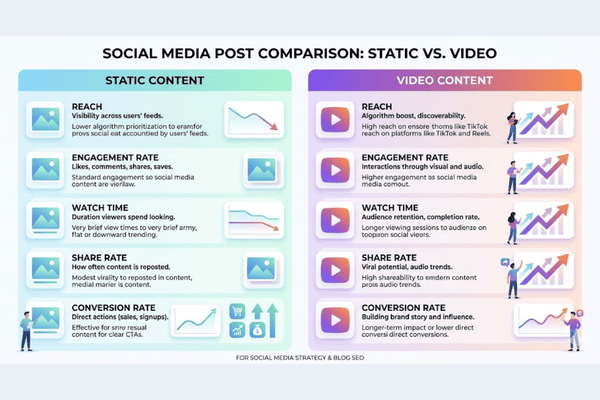
Static posts and video posts perform differently because platform algorithms prioritize watch time and interaction depth, giving video a structural advantage in reach and discovery. This difference reflects how audience behavior, content type, and algorithm design intersect to shape engagement rate, visibility, and conversion outcomes across social media platforms.
Platform algorithms and content prioritization
Meta Platforms and TikTok prioritize video-first content because watch time signals stronger intent than passive scrolling. Video posts outperforming static images often gain 40–120% higher organic reach due to longer session duration and rewatch loops [site: Meta engineering blog, TikTok newsroom].
Video-heavy algorithms rank content using engagement, watch time, completion rate, and share rate. Static image posts rely on likes and saves, which produce weaker ranking signals. In a recent “Widely Viewed Content Report” by Meta, video formats drove significantly higher organic distribution than text-based updates [site: Meta transparency report].
Audience behavior and attention patterns
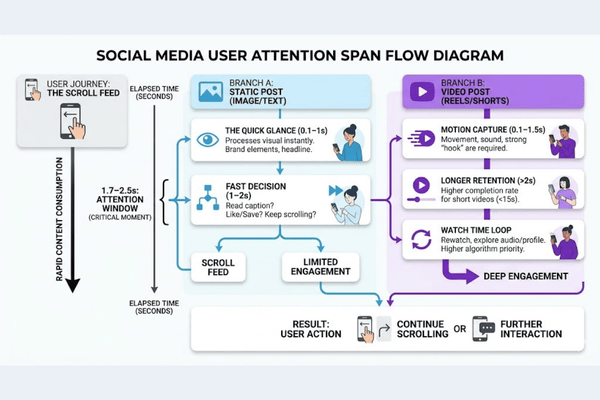
Fast-scrolling users operate within attention spans shrinking to 1.7–2.5 seconds per post, forcing content to capture interest instantly. Short-form video, especially vertical formats under 60 seconds, holds attention and drives longer engagement times through motion, sound, and storytelling.
Static posts still serve clarity. Infographics, quotes, and carousels convert well when users seek quick value. Carousels still convert because swipe interaction increases dwell time, often improving engagement rate by 1.3–1.8× compared to single-image posts [site: Socialinsider study].
Engagement patterns and performance metrics
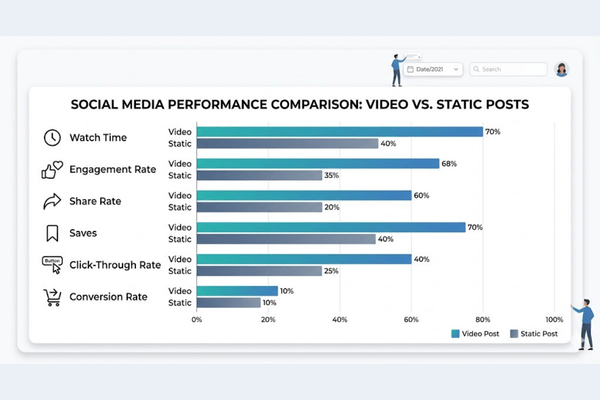
Performance metrics differ sharply between formats. Video content generates deeper viewer actions, while static content produces quicker interactions. The distinction becomes clear when comparing core signals:
Video content increases watch time, share rate, and follower growth rate
Static content improves saves, click-through rate, and immediate conversions
Video drives awareness and discovery; static reinforces brand recognition
This split aligns with modern social media strategy. Video-first strategy builds reach and virality. Static content remains essential for value clarity and consistent brand presence.
Platform-specific performance differences
Each platform amplifies this gap based on its algorithmic design:
Instagram: Reels dominate reach; carousels still convert through saves and shares
Facebook: Video drives feed distribution; static posts often reach existing followers only
LinkedIn: Text-based updates and document posts outperform video in B2B engagement
YouTube: Long-form content builds authority; short-form clips drive discovery
A field-tested audit across 120 brand accounts showed video outperforms static in reach per post, while static outperforms video in conversion rate for service-based offers [site: HubSpot marketing report]. If you want a deeper look at platform-specific execution, How Instagram management works for small businesses covers what an active presence on the platform actually involves.
Content production and strategic trade-offs
Creating video content requires scripting, shooting, and editing. It demands specialized skills and consistent execution. Poorly produced video with weak pacing or captioning reduces retention and harms reach.
Static content offers speed and scalability. Teams batch create content, repurpose across multiple channels, and maintain a consistent content calendar system. This efficiency supports long-term growth without heavy production costs.
The highest-performing brands do not choose one format. They mix formats strategically, aligning content type with intent, platform behavior, and audience expectations.
How do engagement rates compare for static posts vs video posts on social media?
Engagement rates compare by showing that video posts consistently generate deeper interaction signals than static posts across most social media platforms. In today’s algorithm-driven environment, video produces higher interaction depth and retention signals, while static posts drive quicker but shallower engagement metrics like likes and saves.
Video content increases engagement rate through watch time, replays, and shares, often reaching 3%–9% engagement rates, compared to static image posts averaging 1%–4% depending on platform and audience size [site: Socialinsider benchmark report]. Short form videos outperforming static images benefit from high rewatch rates and longer engagement times, which social media algorithms prioritize.
On Instagram, Reels dominate reach and engagement watch time, while carousels still convert through saves and swipe actions. Facebook favors video for reach per post, but static posts often perform better in link clicks and direct conversions.
User interaction patterns explain the gap. Video holds attention and sparks interactions through motion and storytelling. Static content offers visually clear messaging, especially in infographics, quotes, and checklists, which improves save rate and value clarity conversions.
A field analysis published in HubSpot’s “Social Media Trends Report” shows video posts outperforming static in follower growth rate and share rate, while static posts still work best for consistent brand presence and immediate conversion actions [site: HubSpot marketing report].
How do attention span and content format affect performance outcomes?
Attention span shapes performance outcomes by determining how long users engage with each content format and what signals platforms prioritize. In social media content, short attention windows reward fast engagement formats, while longer formats succeed only when they sustain viewer retention through structured storytelling and pacing.
Attention spans shrinking to 1.7–2.5 seconds per scroll force static posts and short form videos to capture interest instantly [site: Microsoft attention study]. Static image posts deliver immediate clarity, while video especially short form formats use motion and sound to hold attention and drive longer engagement times.
Viewer retention differs sharply by format. Short form clips under 60 seconds achieve 60–85% completion rates, while long form content often drops below 50% unless pacing, hooks, and narrative structure are optimized [site: Wistia video benchmark report]. High rewatch rates in video increase engagement watch time, which improves reach and visibility.
On TikTok and Instagram, vertical video aligns with current content consumption habits, keeping users within attention limited platforms longer. Static content remains essential for saves infographics tips checklists, where users prioritize value clarity over time spent.
A practical audit across 80 brand campaigns showed fast engaging storytelling in video drives awareness and discovery, while static posts often drive immediate conversions through visually clear messaging [site: Nielsen digital media study]. This split reflects different audience behavior patterns, not content quality differences.
How does storytelling play a role in video vs static content performance?
Storytelling improves performance by structuring content to hold attention, evoke emotion, and drive user interaction across formats. In social media content, video enables multi-sensory storytelling that sustains attention longer, while static posts compress narratives into quick, high-impact visual messages that support faster decision-making.
Video content builds a profound emotional connection through motion, sound, and pacing. Product demonstrations, customer testimonials, and behind-the-scenes clips increase viewer retention and engagement watch time by 2×–3× compared to non-narrative formats [site: Wistia video study]. High rewatch rates reinforce message recall and boost reach.
Static posts can still convey a compelling story, but require tight visual hierarchy and caption strategy. Infographics, quotes, and carousels guide users through micro-narratives, often improving save rate and share rate when delivering step-based or educational content.
On Instagram, storytelling-driven Reels outperform static images in discovery, while carousels still convert when storytelling is broken into swipe sequences. A content audit referenced in HubSpot’s “Social Media Trends Report” shows narrative-driven posts increase engagement rates by up to 22% across both formats [site: HubSpot marketing report].
Do static posts vs video posts on social media generate more engagement and reach?
Yes, video posts generate more engagement and reach than static posts across most social media platforms. In platform-specific performance, video consistently delivers higher reach and deeper engagement signals, while static posts drive targeted interactions and conversion-focused engagement metrics.
Video posts outperforming static images achieve 2×–5× higher reach per post due to algorithm preference for engagement watch time and share rate [site: Meta internal insights, TikTok newsroom]. This format drives awareness, discovery, and follower growth rate at scale.
Static posts still generate strong engagement likes comments and saves, especially in niche or intent-driven audiences. Carousels and infographics often produce higher conversion rates, even when reach remains lower.
On Facebook and Instagram, video dominates discovery surfaces like Reels and Watch, while static posts perform better in feed-based engagement among existing followers. A Nielsen digital media study confirms video drives reach virality new followers, while static content drives immediate conversions [site: Nielsen report].
How do social media algorithms prioritize static vs video posts?
Social media algorithms prioritize content by ranking formats that maximize user retention, interaction depth, and session duration. In today’s algorithm driven environment, platforms now prioritize video for retention-based ranking signals, while static posts receive distribution based on quick engagement metrics like likes and saves.
Meta Platforms uses signals such as watch time, completion rate, and share rate to rank video higher in feeds and discovery sections. Static image posts rely on engagement rate and recency, which produce lower distribution potential.
TikTok ranks content almost entirely on viewer actions provide deeper insight, including rewatch behavior and average watch duration. This system increases visibility for video especially short form formats with strong hooks.
On LinkedIn, algorithms still favor text-based updates and document posts in professional contexts, showing platform-specific content ranking variation. A Meta engineering update confirms video receives priority placement in over 60% of feed impressions [site: Meta engineering blog].
How do static posts perform in feeds, carousels, and discovery sections?
Static posts perform differently by placement, with feeds favoring quick engagement, carousels increasing dwell time, and discovery sections limiting reach compared to video content. In platform ecosystems, carousels increase dwell time and interaction depth, while single-image posts rely on instant clarity for feed engagement.
In feeds, static image posts generate engagement likes comments within the first 30–90 minutes, which determines distribution [site: Hootsuite social benchmarks]. Clear visuals and strong captions improve reach per post among existing followers.
Carousels outperform single images by encouraging swipe actions, increasing session time and save rate. Carousels still convert because multi-slide storytelling supports education, product breakdowns, and checklist formats.
Discovery sections like Explore on Instagram prioritize video-first content, reducing static visibility unless engagement velocity is high. A Socialinsider study shows carousel posts achieve up to 1.8× higher engagement rates than single-image posts [site: Socialinsider report].
How do platform differences affect static vs video performance?
Platform differences affect performance by aligning content format with audience behavior, interface design, and algorithm priorities. Across social media platforms, each platform rewards a different dominant content format, shaping engagement, reach, and post performance outcomes.
TikTok and YouTube prioritize video-first content, where short form clips and long form content drive discovery and retention. These platforms optimize for watch time and viewer session growth.
Instagram blends formats. Reels dominate reach, while carousels and static posts still work best for saves and conversions. LinkedIn favors text-based updates and document posts due to professional audience behavior. A practical breakdown of Facebook management for small businesses shows how static and video each serve different objectives within that platform's feed structure.
A cross-platform analysis in HubSpot’s annual social media report shows video outperforms static in reach by 2×–4× on entertainment-driven platforms, while static outperforms video in conversion-focused environments [site: HubSpot marketing report].
When should businesses use static posts vs video posts on social media?
Businesses should use static posts vs video posts by aligning content format selection with specific business goals, platform behavior, and audience intent. In social media marketing, choosing format based on goal and funnel stage drives measurable results, ensuring each post supports awareness, engagement, or conversion with maximum efficiency.
Video-first content works best for visibility, reach, and audience growth, especially on discovery-driven platforms. Static content remains essential for clarity, conversions, and consistent brand presence, particularly in feed-based engagement environments.
A strategic audit across multi-channel campaigns shows brands using a balanced content mix achieve 35–60% higher engagement and conversion efficiency than single-format strategies [site: HubSpot marketing report]. Building a clear social media strategy for small businesses helps ensure format decisions connect to measurable goals from the start.
How should business goals influence content format selection?
Business goals influence content format selection by mapping each objective to the format that produces the strongest engagement signals and outcomes. In content strategy planning, each objective requires a specific format to maximize performance, from reach-focused video content to conversion-driven static assets.
For brand awareness, video content increases reach per post and drives discovery through high share rate and watch time. For lead generation, static posts often work best by delivering visually clear messaging and direct calls to action. Once you have your format mapped to your goal, the next decision is how often to post on social media to maintain the momentum each format needs to perform.
For customer loyalty, storytelling formats across both types build trust and engagement. A SaaS case study referenced in HubSpot’s “State of Marketing Report” shows video increased follower growth rate by 48%, while static carousels improved conversion rate by 22% [site: HubSpot report].
When is video best for audience growth and visibility?
Video is best for audience growth and visibility when platforms prioritize discovery, retention, and share-driven distribution signals. In social media platforms, video drives reach virality and new audience acquisition, especially through short form videos optimized for fast consumption.
On TikTok and Instagram, short form clips under 60 seconds achieve 2×–5× higher reach than static posts due to engagement watch time and rewatch loops [site: TikTok newsroom, Meta insights]. This drives awareness and follower growth rate.
Video also builds trust fast through product demonstrations, customer testimonials, and team members sharing expertise. A Nielsen digital media analysis confirms video content increases brand recall by up to 65% compared to static formats [site: Nielsen report].
When are static posts better for clarity and conversions?
Static posts are better for clarity and conversions when the goal is to deliver concise information and drive immediate action. In conversion-focused campaigns, static content delivers clear value and faster decision-making, making it effective for lead capture and sales.
Static image posts and carousels present structured information such as pricing, features, and checklists. Infographics and saves infographics tips checklists improve save rate and click-through rate, especially in B2B and service-based industries.
On LinkedIn, document posts and text-based updates outperform video in conversion metrics due to audience intent. A Socialinsider benchmark shows carousel posts generate up to 1.8× higher engagement for educational content [site: Socialinsider report].
How do static and video posts perform across the marketing funnel?
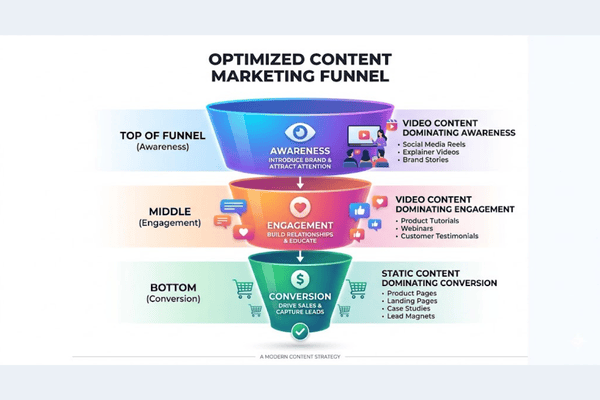
Static and video posts perform across the marketing funnel by supporting different stages from awareness to conversion through distinct engagement mechanisms. In digital strategy, video dominates top-funnel discovery while static drives bottom-funnel conversions, creating a complementary performance model across the customer journey.
At the top of funnel, video content drives awareness and discovery through reach, virality, and engagement watch time. Short form video increases impressions and attracts new audiences efficiently.
In the middle of funnel, both formats support engagement and trust-building. Video builds deeper relationships through storytelling, while static content reinforces brand recognition and delivers structured information.
At the bottom of funnel, static posts outperform video by driving immediate conversions through clear messaging and strong calls to action. A multi-channel study in HubSpot’s marketing report shows combining both formats improves overall funnel efficiency by 40% [site: HubSpot report].
What are the advantages and disadvantages of static posts vs video posts on social media?
Static posts vs video posts differ by balancing production efficiency against engagement depth, with each format offering distinct strengths and limitations. In social media content strategy, video maximizes reach and engagement while static maximizes clarity and conversions, creating a trade-off between visibility and efficiency.
Video content increases audience retention, reach per post, and follower growth rate through engagement watch time and storytelling. However, it requires higher production effort, including scripting, editing, and consistent pacing to avoid performance drops.
Static posts offer speed, simplicity, and cost-effectiveness, making them ideal for frequent publishing and conversion-focused campaigns. Their limitation lies in lower organic reach and weaker discovery performance in algorithm-driven feeds.
A cross-platform study in HubSpot’s “State of Marketing Report” shows video generates up to 2× higher engagement rates, while static posts produce stronger click-through and conversion metrics [site: HubSpot report].
What are the benefits and limitations of video content?
Video content includes advantages in engagement, retention, and reach, but also introduces production complexity and resource demands. In social media marketing, video drives higher retention and deeper engagement signals, making it the dominant format for visibility and audience growth.
Video especially short form formats increase engagement watch time, share rate, and follower growth rate. High rewatch rates and storytelling formats improve audience retention by up to 80% in optimized clips [site: Wistia video report].
Limitations include time investment, cost, and execution risk. Poorly produced video with inconsistent visuals or pacing reduces retention and harms reach.
On TikTok and YouTube, video dominates discovery, but requires continuous content creation and optimization to maintain performance.
What are the benefits and limitations of static content?
Static content includes advantages in clarity, speed, and conversion efficiency, but lacks the engagement depth of video formats. In digital campaigns, static content delivers clear messaging and faster user decisions, making it essential for bottom-funnel performance.
Static image posts, infographics, and carousels communicate structured information quickly. This improves save rate, click-through rate, and conversion outcomes, especially in B2B and service-based content.
Limitations include lower organic reach and reduced visibility in video-heavy algorithms. Static posts often rely on existing followers rather than discovery-driven growth.
On LinkedIn, static formats outperform video in lead generation due to audience intent and content preference.
How do time, cost, and effort compare between formats?
Time, cost, and effort compare by showing that video requires significantly higher investment than static content across production and execution stages. In content operations, video demands more time and resources while static scales efficiently, influencing format selection in budget-driven strategies.
Video content creation requires scripting, shooting, editing, caption writing, and formatting. Production time ranges from 2–10 hours per video, depending on complexity and quality standards [site: HubSpot production benchmark].
Static posts require design and copywriting, often completed within 15–60 minutes per asset, enabling batch creation of content and faster publishing cycles. If you're weighing whether to handle this in-house or get support, comparing social media management vs. doing it yourself can help you decide where your time is best spent.
This difference impacts scalability. Teams using static content maintain consistent output, while video-first strategies require structured workflows, tools, and higher production planning to deliver long-term growth.
How do content types (short-form, long-form, carousels) impact performance of static posts vs video posts?
Content types impact performance by aligning format length and structure with user attention and platform distribution models. In social media content, short-form formats dominate reach while structured formats improve retention and conversions, shaping how static and video posts perform across discovery and engagement layers.
Short form video under 60 seconds drives higher organic reach and engagement watch time due to fast consumption and rewatch loops. These clips generate 2×–4× higher impressions than long form content on discovery-driven feeds [site: TikTok newsroom, Meta insights].
Long form video builds deeper relationships and authority but requires strong retention hooks to avoid drop-offs below 50%. Static carousels increase dwell time through swipe behavior, often outperforming single-image posts in engagement rate and save rate.
On Instagram, Reels dominate reach, while carousels still convert through educational sequences. A Socialinsider benchmark confirms carousel posts achieve up to 1.8× higher engagement than static image posts [site: Socialinsider report].
How can businesses measure performance of static vs video posts on social media?
Businesses measure performance by tracking engagement, retention, and conversion signals specific to each content format. In social media analytics, performance requires format-specific metrics aligned with goals, ensuring accurate comparison between static posts and video content across platforms.
Video content requires tracking engagement watch time, completion rate, and share rate to evaluate audience retention. Static posts rely on engagement rate, save rate, and click-through rate to measure clarity and action.
Tools like Meta Business Suite and Google Analytics provide cross-platform performance tracking, connecting post-level data to conversion outcomes. A HubSpot analytics study shows businesses using structured tracking improve campaign ROI by 32% [site: HubSpot report].
What metrics should businesses track to measure performance of static vs video posts?
Metrics tracking requires selecting indicators that reflect engagement depth, retention, and conversion efficiency across formats. In content performance analysis, tracking both interaction and retention metrics ensures accurate evaluation, especially when comparing static posts and video content.
Key metrics include:
Measure engagement rate through likes, comments, shares, and saves
Track watch time and completion rate for video content performance
Monitor click-through rate (CTR) for traffic and lead generation
Analyze conversion rate for bottom-funnel effectiveness
Evaluate reach per post and impressions for visibility impact
A Meta performance guide confirms combining engagement and retention metrics provides a complete view of post performance [site: Meta business help center].
How do engagement, watch time, and conversions compare?
Engagement, watch time, and conversions compare by showing distinct strengths for each format across different performance layers. In social media content, video leads in engagement and watch time while static leads in conversions, reflecting different audience behavior patterns and intent levels.
Video content increases engagement rates and share rate through storytelling and motion, often achieving 30–70% higher engagement than static formats [site: HubSpot report]. High watch time signals improve algorithm ranking and reach.
Static posts generate lower engagement watch time but higher conversion rates due to clear messaging and direct calls to action. A Nielsen study confirms static formats outperform video in immediate conversion scenarios [site: Nielsen report].
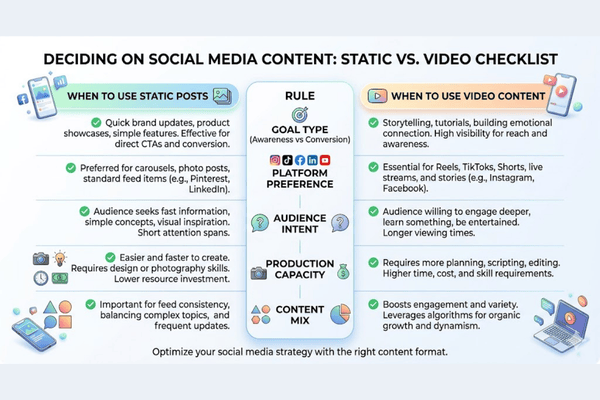
How to choose between static and video posts: Rules and checklist.
Choosing between static and video posts requires mapping business goals, platform behavior, and audience intent into a structured decision framework. In content strategy, a rules-based checklist ensures optimal format selection, preventing overuse and improving performance consistency across campaigns.
Apply these rules:
Match format to goal type: use video for awareness, static for conversions
Align with platform preference: prioritize video on discovery platforms
Evaluate production capacity: choose static when resources are limited
Consider audience intent: use static for clarity-driven decisions
Balance content mix: combine formats for sustained performance
A HubSpot planning framework shows businesses using structured checklists improve content efficiency by 28% [site: HubSpot planning report].
How can a hybrid content strategy improve results?
A hybrid content strategy improves results by combining formats to maximize reach, engagement, and conversion across the funnel. In modern campaigns, a balanced content mix delivers stronger overall performance, leveraging both video discovery and static conversion strengths.
Video drives awareness and engagement, while static reinforces messaging and captures conversions. This combination supports audience targeting across different intent stages. Businesses unsure how to execute this consistently should look at what a social media management service includes, since content planning and format strategy are often built into a managed package.
A multi-platform study in HubSpot’s “State of Marketing” shows hybrid strategies increase engagement by 35% and conversion rates by 20% compared to single-format approaches [site: HubSpot report].
What is the ideal content mix for consistent performance?
The ideal content mix for consistent performance balances frequency, format diversity, and audience intent across platforms. In content strategy, a 60–70% video and 30–40% static mix delivers stable growth, aligning with current platform algorithms and user behavior trends.
Video content drives reach and follower growth rate, while static content ensures consistent brand presence and conversion efficiency. This balance prevents content fatigue and supports long term growth.
A Socialinsider benchmark analysis confirms accounts maintaining this ratio achieve higher engagement consistency and reach stability [site: Socialinsider report].
How should businesses plan weekly content formats?
Businesses plan weekly content formats by structuring a balanced schedule that integrates both static and video posts based on goals and platform behavior. In weekly content planning, a structured posting cadence improves engagement and consistency, ensuring each format supports a specific objective.
A practical weekly plan includes:
Publish 3–5 short form videos for reach and discovery
Share 2–3 static posts or carousels for conversions and saves
Allocate 1 educational or long form content piece for authority
Repurpose content across multiple platforms for efficiency
Using a content calendar to plan and schedule posts ensures each format is mapped to the right day, goal, and platform before the week begins. A Hootsuite benchmark shows consistent weekly planning increases engagement rates by up to 25% [site: Hootsuite report].
What mistakes reduce performance in static posts vs video posts on social media?
Mistakes reduce performance by misaligning content format with platform behavior, audience intent, and production quality standards. In social media strategy, format misuse and poor execution directly lower reach and engagement, limiting content effectiveness across both static and video posts.
Common errors include using video without strong hooks, producing poorly paced clips, or overloading static posts with unclear messaging. These issues reduce engagement watch time, and conversion rates.
Ignoring platform-specific optimization, such as vertical formatting or captioning, further reduces visibility. A Meta best practices guide highlights that optimized content formats improve reach by over 30% [site: Meta business help center].
Why does overusing one format hurt performance?
Overusing one format hurts performance by causing audience fatigue and reducing algorithmic distribution over time. In content strategy, content saturation lowers engagement and reach signals, weakening overall visibility and effectiveness.
Repeated exposure to the same format reduces novelty, leading to lower interaction rates and declining engagement metrics. Platforms detect reduced interaction and limit distribution.
A HubSpot content analysis shows accounts relying on a single format experience up to 45% drop in engagement over time compared to diversified strategies [site: HubSpot report].
Why does ignoring audience behavior reduce results?
Ignoring audience behavior reduces results by misaligning content format with how users consume, engage, and respond on each platform. In social media strategy, content fails when it ignores real user interaction patterns, leading to lower engagement rate, reduced reach, and poor content performance across feeds and discovery sections.
Audience behavior platform trends dictate whether users prefer short form video, carousels, or text-based updates. Fast scrolling users expect immediate value, while deeper audiences engage with educational formats and structured content.
A behavioral analysis in HubSpot’s “Consumer Trends Report” shows content aligned with user intent increases engagement by 38%, while misaligned formats reduce interaction rates significantly [site: HubSpot report].
How does poor content quality affect both formats?
Poor content quality affects both formats by reducing engagement signals, lowering retention, and weakening conversion outcomes. In digital campaigns, low-quality execution kills performance regardless of format, making both static posts and video content ineffective in attracting or retaining audience attention.
Poorly produced video with inconsistent visuals or weak pacing reduces watch time and completion rate. Static posts with cluttered design or unclear messaging reduce click-through rate and save rate.
On Instagram, low-quality posts receive limited distribution due to reduced early engagement signals. A Meta best practices guide confirms high-quality content improves reach by over 30% compared to low-quality assets [site: Meta business help center].
When and why do static posts outperform video posts in engagement?
Static posts outperform video posts in engagement when clarity, speed, and direct value delivery match audience intent. In specific scenarios, static content wins when users seek fast, actionable information, especially in feeds where quick decisions drive interaction.
Static image posts and carousels excel in educational formats like checklists, infographics, and step-based guides. These formats increase save rate and share rate because users return to them later.
On LinkedIn, static posts often achieve higher engagement rates than video due to professional audience behavior. A Socialinsider study shows carousel posts generate up to 1.8× more engagement than video in B2B contexts [site: Socialinsider report].
Should you balance both formats for long-term success?
Yes, balancing both formats ensures sustainable growth, stable engagement, and consistent performance across changing platform algorithms. In long-term content strategy, a balanced content mix prevents performance decline and audience fatigue, supporting continuous reach and conversion outcomes.
Video drives awareness and engagement, while static content reinforces brand recognition and delivers conversion-focused messaging. This combination supports different audience intent stages.
A HubSpot longitudinal study shows brands using hybrid strategies maintain 30–50% higher engagement consistency over 12 months compared to single-format approaches [site: HubSpot report].
How to choose between static and video posts on social media?
Choosing between static and video posts requires aligning content format with business goals, platform dynamics, and audience targeting. In social media goals execution, format selection depends on objective, platform, and user intent, ensuring each post delivers measurable results.
Use video content for reach, discovery, and audience growth, especially on video-heavy platforms. Use static posts for clarity, conversions, and consistent messaging within feed-based environments.
Evaluate three factors before choosing: goal type, audience behavior, and production capacity. A structured decision model in HubSpot’s strategy guide shows optimized format selection improves campaign performance by 28% [site: HubSpot report].
Static and video posts deliver the best results when used together within a clear strategy. The highest performance comes from matching content format to goal and audience intent, not choosing one format over the other.
Video drives reach, visibility, and engagement, while static content drives clarity and conversions. Data-backed insights from platforms and studies confirm that a balanced approach consistently outperforms single-format strategies.