
Social Media Consistency: Why It Matters and How to Maintain It
Brands that post consistently on social media get 5x more engagement per post than those that post sporadically [Buffer, 2024]. That single number explains why a social media consistency strategy is the backbone of any real online brand growth plan.
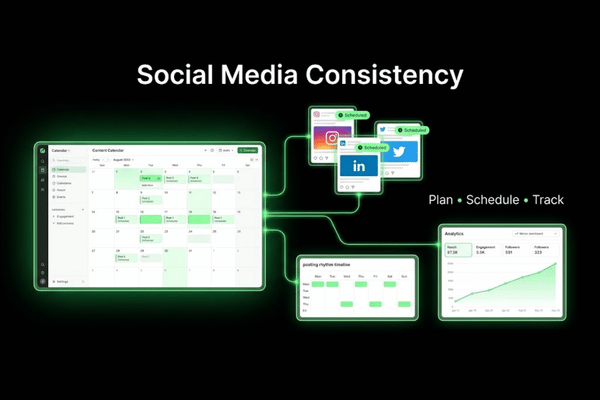
Social media consistency means showing up on your platforms at a predictable frequency with a recognizable voice, visual style, and message. It is not about posting every day. It is about building a sustainable system that your audience can rely on. A consistent social media presence drives algorithmic reach, audience trust, and, over time, direct revenue. This guide covers what consistency looks like in practice, why it matters for your brand, how to build a consistent posting schedule, which tools help automate it, and how to recover if you fall behind.
What is social media consistency?
Social media consistency is the practice of publishing content on a regular schedule while keeping your brand voice, visuals, and messaging predictable across every platform. It goes far beyond how often you post.
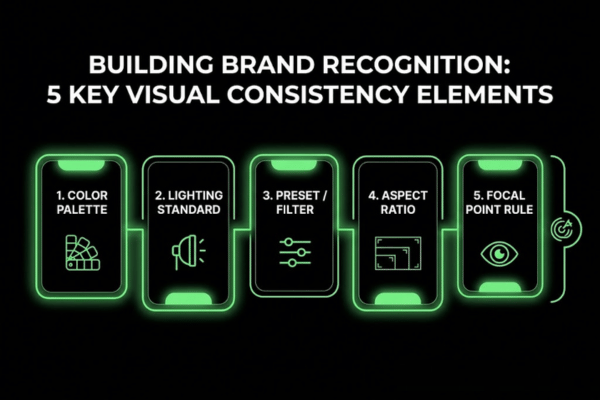
Consistent brand presence includes your posting cadence, how your brand sounds, how it looks, and how reliably you engage with your audience. When all of these stay aligned, you build a cohesive brand experience that followers recognize without thinking. Social media regularity without a matching visual identity or steady content flow produces confusion, not loyalty.
What does being consistent on social media actually mean?
Being consistent on social media means committing to a posting schedule you can sustain and delivering content your audience recognizes every time it appears in their feed.
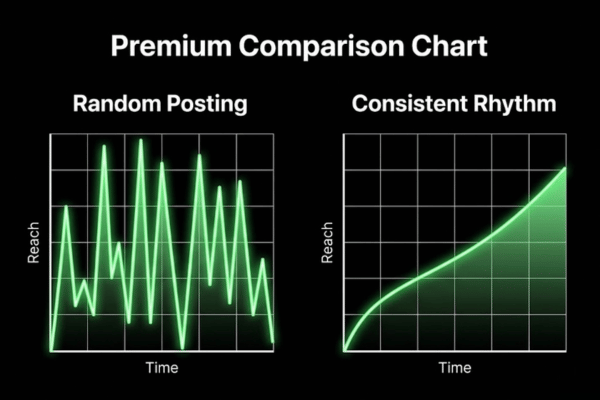
The biggest misconception is that consistency means posting every single day. It does not. A brand posting three times a week, every week, for six months is far more consistent than one posting daily for two weeks then disappearing. True consistency is about content predictability — the same posting cadence, the same tone, the same visual style, and the same content themes. Posting frequency is just one piece. Brand regularity is built across four dimensions: how often, how it sounds, how it looks, and what it covers.
What are the key elements of a consistent social media presence?
The key elements of a consistent social media presence are listed below.
Posting frequency/cadence — Publishing on a fixed schedule that your audience can anticipate, whether that is 3x or 5x per week.
Brand voice and tone — Writing in the same personality across every caption, reply, and story, whether warm, direct, or expert-led.
Visual identity — Using the same colors, fonts, and image templates so every post is instantly recognizable.
Content themes/pillars — Mapping every post to 3–5 core topics so content stays focused and purposeful.
Audience engagement habits — Replying to comments and messages on a consistent timeline, not randomly.
Platform-specific adaptation — Adjusting format and tone per platform while keeping the core brand identity intact.
Why does social media consistency matter for your brand?
Social media consistency matters for your brand because it directly influences how algorithms distribute your content, how much audiences trust you, and how often people choose to buy from you. The leading reasons why social media consistency matters for brands are outlined below.
Consistency is not a vanity metric. It is the engine behind organic reach, audience retention, and long-term revenue. Each reason below connects directly to a measurable business outcome.
How does social media consistency affect platform algorithms?
Social media consistency affects platform algorithms by signaling that an account is active, reliable, and worth distributing to more users.
Instagram, LinkedIn, TikTok, and Facebook all use engagement patterns to decide which accounts get shown to new audiences. An account that posts three times a week, every week, builds a clear engagement history. Algorithms read that pattern as a signal of quality and push the content further. An account that posts ten times in one week, then goes silent for a month, breaks that pattern entirely. The algorithm treats it as low-priority and reduces its distribution. Consistent organic posting reach compounds over time — the longer you maintain a steady schedule, the more the algorithm rewards it with visibility to accounts that do not yet follow you.
How does consistent posting build audience trust and loyalty?
Consistent posting builds audience trust by creating a predictable presence that followers begin to anticipate and rely on — the same way they rely on a weekly newsletter or a morning news show.
The mechanism is simple. Predictability creates familiarity. Familiarity creates trust. When your audience sees your content appear at expected intervals, they form a mental habit around it. That habit becomes brand loyalty and consistent content, and loyal followers convert into customers at a measurably higher rate than casual ones [Sprout Social, 2025]. Reliable brand social presence is not a soft benefit. It directly shortens the time from awareness to purchase.
What does the data say about consistency and engagement rates?
The data on social media consistency and engagement shows that consistent posters receive up to 5x more engagement per post than accounts with irregular posting habits [Buffer, 2024].
Three data points make the case clearly. First, the Buffer posting frequency engagement study found accounts maintaining a consistent schedule for 90-plus days saw 5x higher engagement per post versus irregular posters. Second, HockeyStack research found B2B buyers on LinkedIn needed an average of 71 touchpoints before converting to a marketing-qualified lead — a number impossible to reach without a sustained posting plan. Third, accounts posting at least 3x per week on Instagram show 23% faster follower growth than those posting once a week or less [Later, 2025]. Social media consistency engagement data is consistent across platforms and across industries.
How does social media consistency drive revenue and business growth?
Social media consistency drives revenue by moving social media from a visibility tool into an active channel that influences purchasing decisions before a buyer ever contacts your sales team.
76% of consumers say they are more likely to buy from a brand they follow on social media [Sprout Social, 2025]. A separate study found that 90% of people buy from brands they follow on at least one social platform [Forbes, 2024]. For B2B businesses, consistent posting revenue impact is even more direct—57% of the buyer journey happens before a prospect contacts a sales team [Forrester, 2024]. That entire pre-sales phase is shaped by what your brand publishes consistently. Social media brand revenue results are built post by post, long before a sales conversation begins.
How do you create a social media consistency strategy?
Creating a social media consistency strategy involves building a repeatable system around three decisions: what you post, how often, and how you produce it at scale without burning out.
The key steps to building a social media consistency strategy are outlined below. Each step removes one point of friction that causes most businesses to fall off their posting schedule within the first sixty days.
What are content pillars, and how do they support a consistent posting schedule?
Content pillars are 3–5 core topics that every piece of content maps back to, giving your posting strategy a fixed direction without requiring new ideas every single day.
Without pillars, content creation becomes a daily guessing game. With pillars, you always know what to post next. A social media marketing brand might use these four pillars:
Educational content — Tips, how-tos, and guides about social media strategy
Case studies — Real results from client campaigns
Industry news — Platform updates and algorithm changes
Behind-the-scenes — Team process and tools used daily
These pillars create content pillars and consistent posting; you rotate through themes, and the calendar fills itself. For a full breakdown of how to build this system for your specific business, the guide on what a content pillar strategy is and how to use it for social media walks through the process step by step.
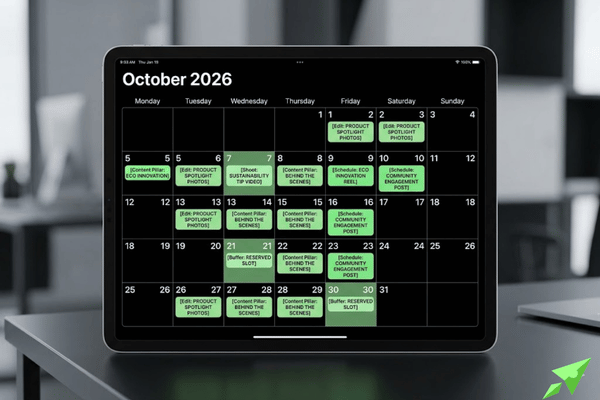
How do you build a social media content calendar you will actually follow?
Steps to building a social media content calendar you will actually follow are listed below.
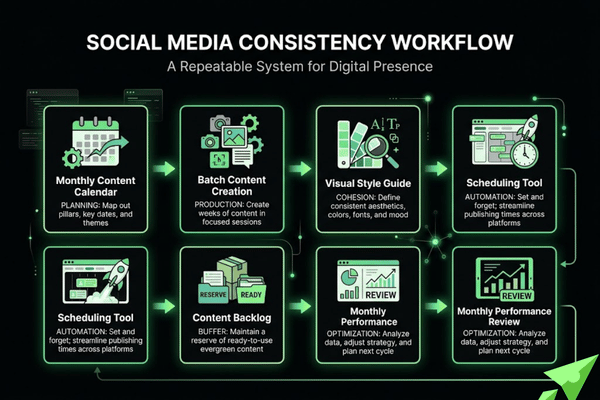
Define your posting frequency per platform — Set a realistic number of posts per week for each channel before planning anything else.
Map your content pillars to calendar slots — Assign each pillar to specific days so the theme rotation happens automatically.
Plan content 2–4 weeks in advance — Build enough buffer so one busy week does not break your entire schedule.
Batch-create content on dedicated creation days — Block two to four focused hours once a week to produce all content for the following week.
Use scheduling tools to automate publishing — Remove the manual step of logging in to post every single day.
Review and adjust monthly — Check what performed, what did not, and refine the next month's calendar accordingly.
A well-structured social media content calendar removes improvisation from the process entirely. That is what makes the schedule sustainable past the first thirty days.
How often should you post on each social media platform?
Recommended posting frequencies for each major social media platform are listed below, based on 2026 algorithm behavior and engagement research [Hootsuite, 2026; Sprout Social, 2026].
Instagram
Recommended Frequency: 3–5x per week
Key Note: Reels outperform static posts for reach
LinkedIn
Recommended Frequency: 3–5x per week
Key Note: Quality matters more than volume here
TikTok
Recommended Frequency: 1–4x daily
Key Note: High frequency is rewarded by the algorithm
Facebook
Recommended Frequency: 3–5x per week
Key Note: Video and link posts drive most reach
X (Twitter)
Recommended Frequency: 1–5x daily
Key Note: Real-time relevance drives performance
Pinterest
Recommended Frequency: 5–10x per week
Key Note: Consistent pinning builds long-term traffic
For a detailed breakdown of optimal social media posting frequency by platform and business type, the guide on how many times per week a business should post on social media gives specific recommendations by industry and audience size.
Recommended Video: Search YouTube for "how often should you post on social media in 2026" to watch a platform-by-platform breakdown with real account examples and engagement data.
What tools help you maintain social media content publishing and consistency?
The tools that help maintain social media consistency fall into two categories: scheduling tools that automate publishing, and content creation tools that speed up production without lowering quality.
Without the right social media management tools, even the best content strategy collapses under the weight of daily manual execution. The right stack removes that friction and makes consistency the default, not the exception.
Which scheduling tools are best for consistent social media posting?
The best scheduling tools for consistent social media posting are listed below.
Buffer — Best for simplicity and small teams. Connects to major platforms and lets you schedule weeks of content in under an hour.
Hootsuite — Best for multi-platform management. Handles up to 35 social accounts with a unified inbox for engagement.
Sprout Social — Best for analytics plus scheduling. Pairs posting automation with detailed reporting tied to real business results.
Later — Best for visual content planning. Drag-and-drop calendar interface built for Instagram-heavy brands.
Metricool — Best for all-in-one, affordable management. Combines scheduling, analytics, and competitor tracking at a lower price point.
Buffer
Best For: Small teams, simplicity
Starting Price (2026): $6/month
Platforms Supported: Instagram, LinkedIn, X, Facebook, Pinterest, TikTok
Hootsuite
Best For: Multi-platform management
Starting Price (2026): $99/month
Platforms Supported: 35+ platforms
Sprout Social
Best For: Analytics + scheduling
Starting Price (2026): $249/month
Platforms Supported: Major platforms with full reporting
Later
Best For: Visual planning
Starting Price (2026): $18/month
Platforms Supported: Instagram, TikTok, Pinterest, Facebook
Metricool
Best For: Budget-friendly all-in-one
Starting Price (2026): $22/month
Platforms Supported: 9+ platforms
How does content batching and repurposing reduce posting inconsistency?
Content batching reduces posting inconsistency by eliminating the daily creation burden that causes most posting schedules to collapse within the first month.
Batching means dedicating one focused block of time — typically two to four hours — to creating all content for the coming week. Instead of making daily decisions about what to post, you make them once. That single shift removes both decision fatigue and the risk of one busy day wiping out your schedule. Content repurposing takes this further. One blog post becomes a LinkedIn article, a carousel, a tweet thread, and three Instagram captions. One recorded interview becomes five short clips. This approach to content repurposing for consistency means one hour of creation produces five to seven pieces of publishable content. For businesses working with a managed service, this batch-and-repurpose model is a core part of how social media content creation is handled at scale without constant new production.
How do you measure social media consistency success?
Measuring social media consistency success requires tracking KPIs over thirty to ninety days — not in isolation — to see whether consistent posting is compounding into real audience growth and business results.
One week of data means nothing. Thirty days shows a direction. Ninety days confirms a trend. The goal is to measure whether consistency is working: whether each month performs better than the last. Understanding social media engagement rate as a core metric is the right starting point before looking at any other number.
What KPIs indicate an effective social media consistency strategy?
The key KPIs that indicate an effective social media consistency strategy are listed below.
Engagement rate per post — Measures likes, comments, and shares as a percentage of reach. A rising rate confirms content is landing with your audience.
Follower growth rate — Tracks net new followers weekly and monthly. Steady growth signals your content is attracting new audiences, not just retaining existing ones.
Reach and impressions growth — Measures how many unique accounts see your content. Growth here confirms improving algorithmic distribution over time.
Post frequency compliance — Compares actual posts published versus your planned schedule. This tells you whether your production system is working.
Website referral traffic from social — Tracks how many visitors arrive at your site from social channels, measurable in Google Analytics 4.
Audience retention rate — Measures how many followers stay over a 30–90 day window versus how many unfollow.
Content-to-conversion rate — Tracks how often social content leads to a lead form, purchase, or consultation booking directly.
For a complete guide on connecting these social media consistency metrics to actual business value, the breakdown of how to measure social media ROI for small businesses covers the full attribution process from post to revenue.
How do you optimize your posting strategy based on consistency data?
Optimizing your posting strategy based on consistency data means reviewing your analytics monthly and adjusting three variables — posting times, content types, and posting frequency — one at a time.
Pull your analytics at the end of each month. Identify your top three performing posts. Look for patterns: same format, same topic, same time of day. Then adjust your calendar to post more of what works. Test one variable at a time — changing posting times and content type simultaneously makes it impossible to identify what drove the result. Run four weeks at 3x per week, then four weeks at 5x per week, and compare engagement rate per post to determine the right volume for your audience. Data-driven social media decisions turn consistency from a habit into a measurable growth system. Posting at the best times for your specific platforms in 2026 compounds the impact of an already consistent schedule.
What happens when social media consistency breaks down?
When social media consistency breaks down, two things happen in parallel: the algorithm reduces your organic reach, and your audience loses the habit of engaging with your content.
Inconsistency is not a permanent death sentence for a brand's social presence, but it carries measurable costs on both the algorithmic and audience side. The next two sections cover what those costs look like and how to recover without starting from zero.
How does posting inconsistency affect your brand reach and audience trust?
Posting inconsistency affects your brand reach by triggering algorithmic de-prioritization and eroding the audience familiarity you spent months building, post by post.
On the algorithmic side, Instagram and LinkedIn both interpret a break in posting as reduced account quality. The algorithm shifts distribution toward accounts showing consistent activity. Your content reaches fewer people even after you return. On the audience side, the effect is slower but equally damaging. Followers lose the habit of engaging with your posts. The social media trust and loyalty that consistent presence built fades without regular reinforcement. When you come back after a gap, you rebuild from a lower baseline — less reach, lower engagement rate, and an audience that has moved on to more consistent accounts in your space.
How do you recover your social media presence after a posting gap?
Steps to recover your social media presence after a posting gap are listed below.
Audit your existing content and account health — Check your follower count, engagement rate, and which content performed best before the gap.
Re-establish your content pillars before reposting — Clarify your themes first so your return feels deliberate, not random.
Start with a realistic, lower-frequency schedule and build gradually — Begin at 2–3 posts per week rather than immediately trying to match your previous pace.
Lead with high-value educational content, not promotional posts — Give your audience a reason to re-engage before asking them to buy anything.
Use Stories, Reels, and interactive formats early — These formats get strong early reach and signal active return to the algorithm quickly.
Be transparent if the gap was business-related — Acknowledging a pause builds more trust than pretending it never happened.
Monitor recovery metrics for 4–6 weeks before scaling volume — Track engagement rate and reach weekly to confirm the algorithm is re-prioritizing your account before increasing output.
Should you prioritize quality or consistency in social media posting?
Whether to prioritize quality or consistency in social media posting depends on how you define quality — and most brands define it in a way that guarantees burnout.
Quality does not mean highly produced. It means useful, relevant, and clear to your target audience. For short-form social content, a well-written 60-word caption on a clean branded graphic often outperforms an expensive video with no strategic message. The false choice between social media quality versus frequency comes from overcomplicating content creation standards. The real goal is sustainable quality at a consistent frequency. Set a standard your team can hit every post, every week, not a gold-plated standard that causes gaps. For context on what content type gives you the best quality-to-effort ratio, comparing static posts versus video posts and their actual performance data helps calibrate that standard.
How do you maintain high-quality content without sacrificing a consistent schedule?
Maintaining high-quality content without sacrificing consistency requires three operational decisions made before you ever sit down to create a single post.
First, define what quality means for your brand in concrete terms — accuracy, visual clarity, usefulness per post. A vague standard produces inconsistent output. A specific one does not. Second, build brand templates that maintain visual consistency at speed. Five Canva templates mean every post looks on-brand without starting from scratch each time. Third, use content batching to create at full quality without daily time pressure. Creating under a tight daily deadline produces lower-quality work than creating in a focused two-hour weekly session. Repurposing your highest-performing posts — content that drove strong engagement six months ago will perform again in a new format for a new segment of your audience. This is how you maintain content quality consistent posting without the burnout cycle that breaks most brand schedules within ninety days.
Should you outsource social media management to maintain consistency?
Outsourcing social media management to maintain consistency should be considered when the cost of posting inconsistency — lost reach, declining engagement, eroded brand trust — exceeds the monthly cost of professional management.
This is a resource-allocation decision. If your internal team cannot maintain a consistent posting schedule because client work comes first — and it always should — the cost of that inconsistency compounds silently every month. At some point it exceeds what a social media management package costs. Knowing where that line sits determines whether outsourcing is smart strategy or unnecessary spend.
When does it make sense to hire a social media manager for consistent posting?
Signs that it makes sense to hire a social media manager for consistent posting are listed below.
Posting has been inconsistent for 3-plus months despite repeated intentions — A broken pattern over multiple months is a systems problem, not a motivation problem.
Content creation is consistently deprioritized because of core business demands — When client work always beats social media, the posting schedule will never hold internally.
Growth goals exceed what internal bandwidth can realistically support — Posting 5x per week across three platforms requires dedicated capacity most small businesses do not have in-house.
Engagement is declining and no one has time to analyze why — Falling engagement without analysis means the underlying problem compounds with no fix applied.
Brand voice is inconsistent because multiple people post without clear guidelines — Multiple voices with no framework produce an inconsistent brand identity online that erodes audience trust over time.
If two or more of these apply, the social media management versus DIY comparison lays out the cost and time trade-offs directly. For real numbers on what professional management costs by service tier, the breakdown of social media management pricing in 2026 removes the guesswork from that decision.
A consistent social media presence is not a content challenge — it is a systems challenge. Build the right system, track the right social media consistency metrics, and the results follow.