
Best Times to Post on Instagram, Facebook, and LinkedIn in 2026
Posts published at peak times receive up to 3x more engagement than the same content posted during low-traffic windows on the same day [source: Sprout Social Platform Benchmark Report, 2026]. The content does not change. The audience availability does. And that gap determines whether the algorithm distributes your post broadly or buries it before anyone scrolls past.
Posting time optimization means publishing content at the moment when your specific audience is most active and most likely to interact within the first 30 to 60 minutes of it going live. That early engagement window is the signal platform algorithms use to decide how many more people to show your content to next. Miss the window and strong content underperforms. Hit it, and average content outperforms.
This guide covers the best posting times for Instagram, Facebook, and LinkedIn, broken down by platform, day of week, content format, and industry. It also covers the 2026 shift in LinkedIn's peak engagement window, time zone adjustments for USA-targeted accounts, posting consistency versus timing, how to find your personalized best times using native analytics, and the scheduling tools that automate peak-time publishing across all three platforms.
Why do posting times affect your reach on Instagram, Facebook, and LinkedIn?
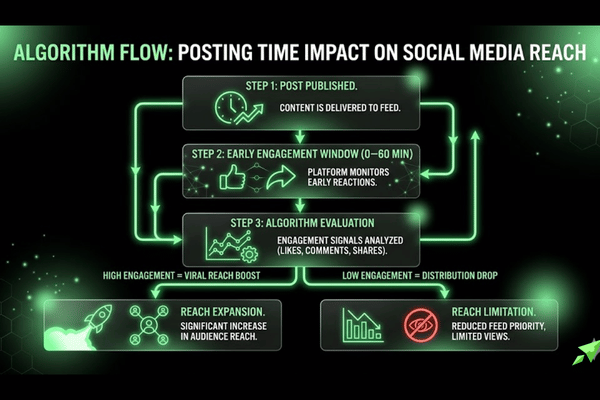
Posting times affect your reach on Instagram, Facebook, and LinkedIn because recency is a core algorithmic ranking signal on all three platforms. Each algorithm evaluates newly published content against the current feed activity level. Content posted during peak audience activity hours enters a high-engagement environment where early interactions accumulate fast, triggering wider distribution. Content posted during low-traffic hours sits in a quieter feed and collects fewer early signals before the algorithm deprioritizes it.
The first 30 to 60 minutes after publishing determine how far content travels organically. A post that earns 40 interactions in its first hour tells the algorithm its content earns attention. A post that earns 4 interactions in the same window gets flagged as low-value, regardless of how strong the creative is. The social media algorithm treats early engagement momentum as a proxy for content relevance. Publishing during peak windows does not guarantee success, but publishing outside them actively limits how much reach quality content can earn.
How does recency signal drive early engagement on the Instagram algorithm?
The recencythe early signal drives early engagement on the Instagram algorithm by creating a time-limited distribution window where the first wave of likes, comments, saves, and shares determines whether a post reaches beyond the original follower set. Instagram's algorithm distributes new content to a test segment of your followers first, then measures the engagement rate from that group before deciding whether to expand distribution to non-followers and Explore placements [source: Meta Developer Documentation, 2026].
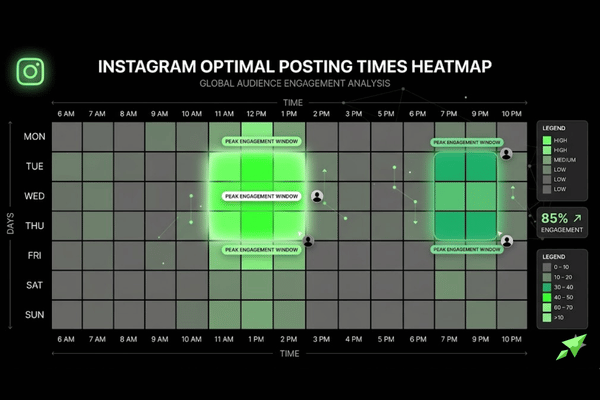
Posting during Instagram's peak windows, primarily 11 a.m. to 1 p.m. and 7 p.m. to 9 p.m. on weekdays, ensures that the initial test segment is actively scrolling when the post arrives. Active scrollers interact faster. Faster interactions lead to a higher early engagement rate. A stronger early rate triggers the expanded distribution that turns a good post into a high-reach post.
Visual content posted at low-traffic times, such as 4 a.m. or midnight on a Tuesday, enters a near-empty feed. Even if the content is strong, the algorithm closes the distribution window before enough people scroll to interact with it.
How does publishing at peak hours influence Facebook and LinkedIn organic reach?
Publishing at peak hours influences Facebook and LinkedIn organic reach by giving new content the best chance to collect rapid engagement before competing against older, already-engaged posts for the same feed position. Both platforms rank feed content by engagement velocity, meaning content that receives interactions quickly outranks content that receives the same total interactions over a longer period [source: Meta Business Benchmark Report, 2025].
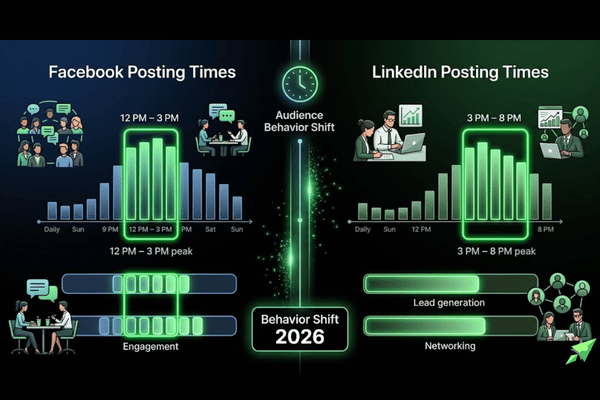
Facebook's strongest organic reach window sits in the afternoon between 12 p.m. and 3 p.m. on weekdays, reflecting the lunch-break and post-lunch scrolling pattern of its primary 35 to 65 year-old demographic. LinkedIn's peak shifted in 2026 to late afternoon and evening, between 3 p.m. and 8 p.m. on Wednesday through Friday, reflecting the growing influence of flexible work schedules and commute-hour browsing on professional network behavior. Publishing outside these windows means your post competes in the feed against content that already has hours of engagement behind it, a structural disadvantage that timing alone can prevent.
The best times to post on Instagram in 2026 by day of the week are listed below
The best times to post on Instagram in 2026 are Tuesday through Thursday between 11 a.m. and 1 p.m., with a secondary evening window from 7 p.m. to 9 p.m. producing strong results for Reels and Stories [source: Sprout Social Best Times to Post, 2026]. These windows reflect Instagram's user behavior pattern of midday discovery browsing and evening leisure scrolling.
The best times to post on Instagram in 2026 by day of the week are listed below.
Monday (11 a.m. – 1 p.m.)
Strong start-of-week discovery window
Tuesday (10 a.m. – 1 p.m.)
Highest midweek engagement day
Wednesday (11 a.m. – 2 p.m.)
Peak midweek window, strongest for carousels
Thursday (11 a.m. – 1 p.m.)
Consistent performer, strong for Reels
Friday (10 a.m. – 12 p.m.)
Pre-weekend browsing spike
Saturday (9 a.m. – 11 a.m.)
Morning-only window; afternoon drops significantly
Sunday
Avoid publishing
Lowest engagement day across all formats
What are the best times to post on Instagram by day of the week?
The best times to post on Instagram for each day of the week in 2026 are listed below.
Monday: Post between 11 a.m. and 1 p.m. Monday represents a strong re-engagement day as audiences return to feed browsing after the low-engagement weekend.
Tuesday: Post between 10 a.m. and 1 p.m. Tuesday consistently ranks as the top-performing Instagram day in 2026 data from both Sprout Social and Later, with midday posting producing the strongest reach [source: Later Best Time to Post Study, 2026].
Wednesday: Post between 11 a.m. and 2 p.m. Wednesday delivers the strongest results for carousel posts specifically, driven by mid-week audience activity peaks.
Thursday: Post between 11 a.m. and 1 p.m. Thursday performs comparably to Tuesday and pairs strongly with Reels content, which benefits from the Thursday-to-Friday content cycle.
Friday: Post between 10 a.m. and 12 p.m. Friday engagement drops sharply after noon as audiences shift from work-mode scrolling to weekend-mode offline behavior.
Saturday: Post between 9 a.m. and 11 a.m. only. Saturday morning captures a leisure-browse window before afternoon activity drops below weekday levels.
Sunday: Avoid publishing primary content. Sunday consistently produces the lowest engagement rate of any day across feed posts, Reels, and carousels on Instagram.
What are the worst times and days to post on Instagram in 2026?
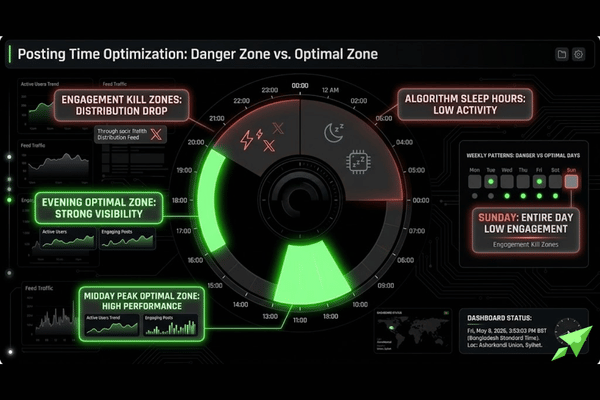
The worst times and days to post on Instagram in 2026 are Saturday afternoon, all of Sunday, and any weekday slot before 6 a.m. or after 10 p.m. These windows produce engagement rates 40 to 60% below the platform average for equivalent content quality [source: Hootsuite Social Trends, 2026].
Saturday afternoon and Sunday represent the lowest-engagement period of the week. Audiences shift to offline activity, and the Instagram algorithm has fewer active users interacting with content, which limits the early engagement signal that new posts need to earn distribution. Content published on Sunday evening risks sitting in a quiet feed until Monday morning, by which point it is already 12 to 18 hours old, significantly reducing its algorithmic freshness score.
Early morning slots before 6 a.m. on any weekday produce similarly poor results. Posting at 3 a.m. or 4 a.m. ET to "get ahead" of the morning rush does not work. The algorithm does not bank early posts for the morning wave. It evaluates engagement in real time, and a 3 a.m. post competes against active morning content published 5 hours later with a fresh timestamp.
How do the best Instagram posting times vary by content format?
Here is how the best Instagram posting times vary by content format in 2026:
Feed posts (static images and graphics): Best between 11 a.m. and 1 p.m. on Tuesday through Thursday. Midday browsing drives discovery of visual brand content as users take lunch breaks or mid-morning pauses.
Instagram Reels: Best between 7 a.m. and 8 a.m. for morning commute exposure, and 7 p.m. to 9 p.m. for prime evening entertainment browsing. Reels perform better in the evening window than any other format because audiences in leisure-scroll mode watch more video [source: Meta Business Insights, 2026].
Instagram Stories: Best between 8 a.m. and 10 a.m. as a daily morning check-in format, and again between 6 p.m. and 8 p.m. to capture end-of-day engagement. Stories are consumed sequentially, so morning and evening check-in habits drive the highest completion rates.
Carousel posts: Best between 11 a.m. and 2 p.m. on Wednesday and Thursday. Carousels require more attention than single images, making midday the optimal window when audiences have time to swipe through multiple frames.
The distinction between static posts and Reels in terms of reach and format performance directly affects which timing window to prioritize in your weekly posting schedule.
The best times to post on Facebook by day of the week in 2026 are listed below
The best times to post on Facebook in 2026 are Monday and Wednesday between 12 p.m. and 3 p.m., with a sustained afternoon-to-early-evening pattern producing reliable reach across Tuesday and Thursday as well [source: Sprout Social, 2026]. Facebook's primary demographic of 35 to 65 year-old users drives an afternoon browsing peak distinct from Instagram's younger audience patterns.
The best times to post on Facebook by day of the week in 2026 are listed below.
Monday (12 p.m. – 3 p.m.)
Top-performing day with strong afternoon reach
Tuesday (11 a.m. – 2 p.m.)
Consistent midweek performer
Wednesday (12 p.m. – 3 p.m.)
Second-strongest day with peak engagement around 1 p.m.
Thursday (11 a.m. – 1 p.m.)
Solid reach before Friday drop-off begins
Friday (10 a.m. – 12 p.m.)
Performance drops sharply after noon
Saturday
Avoid or test based on audience behavior
Low engagement overall with occasional morning spike
Sunday
Avoid publishing
Lowest reach day on Facebook
What are the best times to post on Facebook by day of the week?
The best times to post on Facebook for each day of the week in 2026 are listed below.
Monday: Post between 12 p.m. and 3 p.m. Monday is Facebook's strongest day in 2026 data, driven by the return-to-work scrolling behavior of its core audience segment during lunch breaks and afternoon task transitions.
Tuesday: Post between 11 a.m. and 2 p.m. Tuesday provides consistent afternoon reach with a peak at 12 p.m. that suits product announcements, community posts, and brand updates.
Wednesday: Post between 12 p.m. and 3 p.m., with 1 p.m. as the single best daily slot. Wednesday's midday peak applies across both organic Page posts and Facebook Group content.
Thursday: Post between 11 a.m. and 1 p.m. Thursday delivers reliable reach for video content and link posts, though performance begins to decline toward Friday evening levels by late afternoon.
Friday: Post between 10 a.m. and 12 p.m. only. Friday afternoon engagement drops sharply as audiences shift to weekend activity, making morning the only reliable window for Facebook reach on this day.
Saturday: Test a morning slot between 9 a.m. and 11 a.m. if your audience is consumer-facing. Weekend engagement is inconsistent and audience-dependent on Facebook. Avoid publishing primary content without data confirming your specific audience scrolls on Saturdays.
Sunday: Avoid publishing. Sunday consistently produces the lowest organic reach and engagement rate of any day on Facebook, with feed competition from aggregated weekend content making new posts difficult to surface.
What are the worst times to post on Facebook in 2026?
The worst times to post on Facebook in 2026 are before 7 a.m. on any weekday, after 8 p.m. on weeknights, and all day Sunday. These windows produce the lowest organic reach across all content types on the platform [source: Hootsuite Social Media Trends, 2026].
Sunday represents a structural low-engagement environment on Facebook regardless of content type or audience size. The platform's algorithm accumulates older content throughout the weekend, and new Sunday posts compete against days-old content that already carries significant engagement history. Early morning slots before 7 a.m. face the same challenge on weekdays: the feed is quiet, early interactions do not accumulate fast enough, and the post ages before the primary audience wakes up to scroll.
How do best Facebook posting times differ for Reels versus feed posts?
Best Facebook posting times differ for Reels versus feed posts because the two formats attract audiences in fundamentally different attention modes at different points in the day. Facebook feed posts peak at 12 p.m. to 2 p.m. on weekdays during active-task scrolling windows. Facebook Reels perform strongly in a late-night window, with data from Sprout Social identifying midnight on Saturday as a notable Reels engagement spike driven by passive entertainment-mode browsing [source: Sprout Social Facebook Benchmark, 2026].
Reels content on Facebook targets users in a relaxed, entertainment-consumption mindset, which skews toward evening and late-night hours when the ambient pressure of work or tasks is absent. Feed posts perform during active-decision windows when users check in purposefully between tasks. Matching the format to the time window rather than applying a single posting time to all content types produces measurably stronger results across both formats.
For businesses managing a complete Facebook presence, Facebook management for small businesses covers how to integrate format-specific timing into a weekly publishing cadence alongside community management and engagement tracking.
The best times to post on LinkedIn by day of the week in 2026 are listed below
The best times to post on LinkedIn in 2026 are Wednesday through Friday between 3 p.m. and 8 p.m., marking a significant shift from the traditional morning-only posting window that dominated LinkedIn strategy through 2024 and 2025 [source: Buffer State of Social Media, 2026]. This evening shift reflects behavioral changes in LinkedIn's professional audience driven by remote work, flexible schedules, and commute-hour browsing.
The best times to post on LinkedIn by day of the week in 2026 are listed below.
Wednesday (4 p.m. – 7 p.m.)
Top performer
Thursday (3 p.m. – 6 p.m.)
Strong performance
Friday (3 p.m. – 5 p.m.)
Solid engagement, pre-weekend window
Tuesday (10 a.m. – 12 p.m.)
Mid-tier, morning window still active
Monday (10 a.m. – 12 p.m.)
Mid-tier, traditional posting window
Saturday
Avoid posting
Low professional engagement
Sunday
Avoid posting
Lowest LinkedIn engagement day
What are the best times to post on LinkedIn by day of the week?
The best times to post on LinkedIn for each day of the week in 2026 are listed below.
Wednesday: Post between 4 p.m. and 7 p.m. Wednesday is LinkedIn's strongest single posting day in 2026, with 4 p.m. representing the peak minute-by-minute engagement slot across company page posts and individual professional content [source: Sprout Social LinkedIn Report, 2026].
Thursday: Post between 3 p.m. and 6 p.m. Thursday performs consistently well as professionals enter the end-of-week review mindset and engage more actively with industry insights and thought leadership posts.
Friday: Post between 3 p.m. and 5 p.m. Friday afternoon captures a final-workday browsing window before the weekend disengagement pattern begins. Engagement drops sharply after 5 p.m. on Fridays.
Tuesday: Post between 10 a.m. and 12 p.m. Tuesday morning remains a reliable secondary window, particularly for company announcements and product updates that benefit from early-week professional attention.
Monday: Post between 10 a.m. and 12 p.m. Monday works for content requiring high cognitive engagement, like articles and data-led posts, when professionals are fresh and plan-oriented at the start of the week.
Saturday: Avoid. LinkedIn's professional audience disengages sharply on Saturdays. Page follower activity on Saturdays averages 65% below weekday levels [source: LinkedIn Analytics Benchmarks, 2026].
Sunday: Avoid publishing. Sunday produces the lowest engagement and reach of any day on LinkedIn, with feed activity dominated by scheduled content from larger brands rather than organic small business posts.
What are the worst times to post on LinkedIn in 2026?
The worst times to post on LinkedIn in 2026 are weekends, early mornings before 10 a.m. on weekdays, and late evenings after 8 p.m. [source: Hootsuite LinkedIn Benchmark, 2026]. These windows represent a meaningful change from 2024 patterns, when morning slots from 8 a.m. to 10 a.m. were still considered viable on LinkedIn.
Saturday and Sunday remain the weakest days by a wide margin. Early morning slots before 10 a.m. on weekdays have also declined in effectiveness in 2026 as the platform's peak shifted toward afternoon and evening. Publishing at 8 a.m. now competes against content already accumulating engagement from the previous evening's late-afternoon posting window, putting early-morning posts at a structural disadvantage.
Late evening posts after 8 p.m. produce equally poor results, as professional audience disengagement from LinkedIn correlates with end-of-day routines that favor personal platform use over professional networking content.
How has the LinkedIn best posting window shifted in 2026 compared to 2025?
The LinkedIn best posting window has shifted in 2026 compared to 2025 because professional browsing behavior shifted from traditional work hours to a late-afternoon and evening pattern driven by remote work adoption and flexible scheduling [Source: Buffer State of Social 2026; Sprout Social LinkedIn Benchmark, 2026].
In 2025, peak LinkedIn engagement centered on the 9 a.m. to 12 p.m. morning block, reflecting the commute-to-desk routine of predominantly office-based professionals. The standard advice was to post early and catch the morning check-in wave. That window still functions but no longer dominates.
By 2026, Buffer and Sprout Social data both identify the 3 p.m. to 8 p.m. window on Wednesday through Friday as the new primary engagement peak. Three factors drove this shift. First, remote workers no longer have a predictable morning commute that drove pre-9 a.m. LinkedIn browsing. Second, flexible work schedules push professional development browsing into the afternoon transition period between focus work and personal time. Third, commute-hour browsing on public transit shifted to evening commutes as hybrid workers return to offices in the mid-afternoon rather than early morning.
This recalibration affects B2B content strategies, thought leadership scheduling, and LinkedIn ad campaign timing for every business targeting professional decision-makers. For businesses actively building a LinkedIn presence, LinkedIn management for small businesses and professionals covers how to apply the 2026 timing data within a full content and engagement strategy.
What are the best times to post on TikTok in 2026?
The best times to post on TikTok in 2026 are Tuesday through Thursday from 2 p.m. to 6 p.m. local time. This late-afternoon window works well because users open TikTok when school, work, and daily tasks slow down.
For broader testing, brands can also try Sunday at 9 a.m., Monday at 1 p.m., Friday at 6 p.m., and Saturday at 5 p.m. These times help you test different user habits across weekdays and weekends.
Best TikTok posting times by day:
Monday: 1 p.m.
Tuesday: 2 p.m. to 6 p.m.
Wednesday: 2 p.m. to 6 p.m.
Thursday: 2 p.m. to 6 p.m.
Friday: 6 p.m.
Saturday: 5 p.m.
Sunday: 9 a.m.
Use these times as a starting point, not a fixed rule. TikTok reach changes by audience age, country, niche, video length, and watch time.
Best times by goal:
More views: Tuesday to Thursday, 2 p.m. to 6 p.m.
Weekend reach: Saturday at 5 p.m. or Sunday at 9 a.m.
Product content: Friday at 6 p.m.
Local audience testing: Use the audience’s local time zone.
Example: A skincare brand can post a routine video at 6 p.m. because users browse beauty content after work. A restaurant can test on Friday evening because people plan weekend meals then.
Recommended Video
Recommended Video: Search YouTube for “best time to post on TikTok 2026 analytics tutorial” to watch a visual guide.
How do best posting times vary by industry across platforms?
The best posting times for Instagram, Facebook, and LinkedIn differ by industry because audience type, daily schedule, and content consumption habits vary by sector. A professional services firm targeting CFOs behaves differently online than a home decor brand targeting interior design enthusiasts. Audience type (B2B versus B2C) directly determines when they scroll, how long they browse, and which platforms they prioritize.
Here is how best posting times vary by industry across Instagram, Facebook, and LinkedIn:
e-commerce and retail: Peak on Instagram midday (11 a.m. to 1 p.m.) and evening (7 p.m. to 9 p.m.), reflecting shopping inspiration behavior during breaks and leisure hours.
B2B professional services: Peak on LinkedIn Wednesday to Friday afternoons (3 p.m. to 6 p.m.), aligning with decision-maker browsing during end-of-workday review periods.
Health and wellness: Peak on Instagram Tuesday and Wednesday mornings (7 a.m. to 9 a.m.), capturing the pre-workout and morning routine browsing window.
Food and restaurant: Peak on Facebook and Instagram around 11 a.m. to 1 p.m. Thursday and Friday, aligned with lunch-decision and pre-weekend dining planning behavior.
Technology and SaaS: Peak on LinkedIn Tuesday through Thursday mornings and Wednesday afternoon, reflecting the research and evaluation habits of technical buyers.
What are the best posting times for B2B brands on LinkedIn and Facebook?
The best posting times for B2B brands on LinkedIn and Facebook are Wednesday through Friday from 3 p.m. to 5 p.m. on LinkedIn, and Monday through Wednesday from 12 p.m. to 2 p.m. on Facebook. Both windows align with when professional decision-makers, including SaaS buyers, consultants, and enterprise technology evaluators, actively browse during work-adjacent hours.
LinkedIn Wednesday afternoon at 4 p.m. represents the single strongest slot for B2B content. Decision-makers in mid-week evaluation mode engage more deeply with thought leadership articles, company case studies, and industry insight posts than during Monday task-focus periods. Facebook's B2B window is narrower. Professional service firms, IT providers, and consulting brands see stronger Facebook reach during Monday and Wednesday lunch breaks when business owners check personal and professional feeds simultaneously.
Example: A B2B SaaS company publishing a LinkedIn article about enterprise security compliance at 4 p.m. on Wednesday targets CFOs and IT directors during their afternoon professional browsing window, rather than competing against the full weekday feed during the crowded 9 a.m. to 11 a.m. block.
What are the best posting times for eCommerce and retail brands on Instagram?
The best posting times for eCommerce and retail brands on Instagram are 11 a.m. to 1 p.m. for product discovery content and 7 p.m. to 9 p.m. for shopping inspiration and lifestyle content [source: Later eCommerce Instagram Study, 2026]. These two windows align with distinct purchasing-decision states in the consumer day.
Midday posting targets active product discovery behavior during lunch breaks, when consumers with purchase intent browse Instagram for specific items or compare options they saw earlier in the day. The 11 a.m. to 1 p.m. window produces the highest link-click rate for product posts, making it the optimal slot for direct-to-purchase content including product launches and limited-offer announcements.
The evening window from 7 p.m. to 9 p.m. captures a leisure-scroll audience in purchase inspiration mode. Consumers in this window browse for ideas and save content for later consideration, making it the strongest time for Reels showcasing products in use and carousel posts featuring room styling, outfit combinations, or recipe applications. The save rate from Instagram posts peaks during the 7 p.m. to 9 p.m. window for eCommerce categories, including home decor, fashion, and beauty [source: Sprout Social eCommerce Report, 2026].
What are the best posting times for beauty brands on Instagram and Facebook?
Beauty brands peak on Instagram around 11 a.m. to 1 p.m. and 6 p.m. to 8 p.m., when users look for skincare routines, makeup inspiration, product tutorials, and before-and-after visuals.
On Facebook, midday and early evening work best for beauty brands because audiences are more likely to engage with reviews, promotions, beauty tips, service updates, and community-driven content during those windows.
How should you build a cross-platform posting schedule in 2026?
You should build a cross-platform posting schedule for Instagram, Facebook, and LinkedIn in 2026 by consolidating platform-specific peak windows into a single weekly calendar that avoids publishing conflicts and maintains consistent presence across all three channels. Steps to build a cross-platform posting schedule for Instagram, Facebook, and LinkedIn in 2026 are listed below.
List each platform's top 3 posting days and times. Instagram: Tuesday, Wednesday, Thursday at 11 a.m. to 1 p.m. Facebook: Monday, Wednesday at 12 p.m. to 2 p.m. LinkedIn: Wednesday, Thursday at 3 p.m. to 5 p.m.
Identify overlap days. Wednesday appears in all three platforms' peak windows, making it the single most valuable publishing day across the full cross-platform strategy.
Stagger posting times within the same day. If you publish on all three platforms on Wednesday, space posts by 2 to 3 hours to give each one a full early-engagement window without fragmenting your own management attention.
Assign content formats to their optimal platform and time. Reels go to Instagram at 7 p.m. to 9 p.m. Thought leadership goes to LinkedIn at 4 p.m. Community content goes to Facebook at 1 p.m.
Use a content calendar to map the full week. A structured weekly plan prevents missed posting windows and maintains the consistency that algorithms reward more than perfect timing alone.
Review and adjust monthly. Platform algorithms shift, audience behaviors evolve, and seasonal patterns change what works. A quarterly review of posting times against your own analytics data keeps the schedule accurate.
A social media content calendar structures this weekly plan into a repeatable publishing system that integrates timing, format, and platform into a single workflow rather than three separate decisions made on the day of posting.
How does your audience's time zone affect best posting times?
Your audience's time zone affects the best time to post on Instagram, Facebook, and LinkedIn because all published benchmark times represent local time for the region where the largest audience segment is located. Publishing at 12 p.m. when your audience is in Eastern Time and you are in Pacific Time means posting at 9 a.m. Pacific, which represents 12 p.m. for your followers in New York. The platform's algorithm evaluates engagement based on when your audience receives the post, not when your device sends it.
For USA-targeted accounts, Eastern Time covers approximately 47% of the total US population [source: US Census Bureau, 2025], making ET the correct default reference point for benchmark times. Accounts with national audiences that span all four contiguous time zones face a 3-hour gap between East Coast and West Coast active windows, requiring either a time-zone-split publishing strategy or a midpoint compromise posting time.
Multi-region or global accounts targeting audiences across more than two time zones need platform analytics data to identify where the majority of their engaged audience resides before applying any benchmark timing. The benchmark data in this guide applies to US-based audiences unless otherwise specified.
How do you adjust posting times for a USA-targeted audience on Instagram and Facebook?
Steps to adjust posting times for a USA-targeted audience across Instagram and Facebook are listed below.
Set all benchmark times in Eastern Time (ET). ET covers the largest US audience segment and produces the highest engagement returns when used as the primary reference time zone for scheduling.
Shift 3 hours later for West Coast-primary audiences. If your analytics show 60% or more of your audience located in Pacific Time states (California, Oregon, Washington), post at 2 p.m. to 4 p.m. ET (11 a.m. to 1 p.m. PT) to align with your actual peak audience window.
Check platform analytics for geographic follower data. Instagram Insights and Meta Business Suite both show follower location by city and country. Pull this data before adjusting any posting schedule away from the ET default.
Test a midpoint time for broad national reach. A 2 p.m. ET post reaches East Coast audiences during their early afternoon window while also catching Midwest and Central Time audiences at 1 p.m. local, the strongest single compromise slot for national USA coverage.
Recommended Video
Recommended Video: Search YouTube for "best time to post on Instagram Facebook LinkedIn 2026 scheduling tutorial" to watch a visual walkthrough of scheduling tools, native analytics setup, and cross-platform calendar building.
How does posting consistency compare to posting time?
Posting consistency compares to posting time across Instagram, Facebook, and LinkedIn in that consistency of schedule produces more sustained reach than perfect timing alone. A business that posts at the optimal time once per week earns a single peak-window benefit. A business that posts consistently 4 times per week at good (but not perfect) times earns compounding algorithmic trust that the single-post-per-week account never builds.
All three platforms treat posting regularity as a trust signal. Instagram, Facebook, and LinkedIn algorithms deprioritize accounts that post irregularly, resetting whatever momentum the account built during active periods. An account that posts daily for three weeks and then disappears for two weeks does not retain the distribution priority it earned. The algorithm treats the gap as evidence that the account is unreliable, reducing future distribution until a new pattern of consistency is established.
Timing amplifies content quality. It cannot compensate for irregular publishing. A well-timed post from an inconsistent account still underperforms a slightly less optimally timed post from a consistent account, because the consistent account carries more algorithmic trust entering every publishing window.
Recommended posting frequency for maximum reach on Instagram, Facebook, and LinkedIn in 2026 are listed below
Recommended posting frequency for maximum reach on Instagram, Facebook, and LinkedIn in 2026 are listed below.
Instagram feed posts: 3 to 5 times per week. Posting more than 5 feed posts per week does not increase reach proportionally and risks reducing per-post engagement by dividing audience attention across too many pieces of content.
Instagram Stories: Daily or near-daily. Stories function as a consistent presence signal that keeps your account appearing in follower feeds between feed posts. Aim for 3 to 7 Stories frames per day [source: Sprout Social, 2026].
Instagram Reels: 3 to 5 times per week if production capacity allows. Reels receive algorithm-favored distribution that feed posts do not, making them the highest-ROI format for organic reach growth.
Facebook: 3 to 5 times per week for business Pages. Facebook Group posting can increase to daily without the same per-post engagement dilution that affects Page posts.
LinkedIn: 3 to 5 times per week for most small businesses, with 3 posts as the reliable baseline that maintains algorithm momentum without reducing per-post quality. Posting 2 times per week is acceptable for high-quality long-form content but risks algorithmic deprioritization over time.
For a detailed breakdown of posting frequency by platform and business type, how many times per week your business should post on social media covers the frequency data with platform-specific guidance for small businesses managing limited content production bandwidth.
How do you find your own best posting times?
You find your own best posting times on Instagram, Facebook, and LinkedIn by analyzing the engagement patterns from your own account's historical data rather than applying benchmark data designed for average accounts. Personalized analytics from your own audience produce timing recommendations that benchmark data cannot provide, because your specific followers have their own activity patterns that differ from the platform-wide average [source: Buffer Social Media Report, 2026].
The process takes 4 to 6 weeks of consistent posting before your analytics contain enough data points to reveal reliable patterns. Steps to find your personalized best posting times on Instagram, Facebook, and LinkedIn are listed below.
Post at multiple different times across a 30-day test period. Include morning, midday, afternoon, and evening slots in your testing rotation to give your analytics a full range of times to compare.
Access your platform's native analytics. Instagram Insights, Meta Business Suite, and LinkedIn Analytics each provide audience activity data showing when your specific followers are most active.
Filter engagement data by post time. Sort your posts by engagement rate rather than total likes, and note which time slots produced above-average rates consistently, not just in one-off viral posts.
Identify patterns across at least 4 to 6 weeks. One week of data reflects noise. Six weeks reveals pattern. Avoid adjusting your schedule based on single-week results.
Test your identified peak times for 30 more days. Confirm the pattern holds before permanently restructuring your posting schedule around it.
What native analytics tools show personalized peak posting windows?
Native analytics tools that show personalized peak posting windows on Instagram, Facebook, and LinkedIn are listed below.
Instagram Insights (Audience: Most Active Times): Navigate to your professional account, select Insights, then Audience. The Most Active Times section shows hour-by-hour and day-by-day activity data for your specific followers. Available on mobile app only [source: Meta Help Center, 2026].
Meta Business Suite (Insights: Audience Activity): Access at business.facebook.com. Navigate to Insights > Audience Activity to see combined Facebook and Instagram follower activity data, including peak hours broken down by day of week. Provides a more granular view than Instagram's mobile-only Insights.
LinkedIn Analytics (Follower Analytics and Content Performance): Access on the LinkedIn company page under Analytics > Followers. The follower activity data shows geographic distribution, seniority levels, and industry breakdown. Cross-reference with Content Analytics to identify which post times produced the highest engagement rates from your specific audience.
Should you use scheduling tools to post at peak times?
You should use scheduling tools to post at peak times on Instagram, Facebook, and LinkedIn because they allow you to plan and publish content automatically at optimal windows without requiring real-time availability. Scheduling tools remove the human bottleneck that causes businesses to publish at convenient times rather than peak-audience times, which is one of the most common and preventable causes of underperforming social content [source: Hootsuite Digital Trends, 2026].
For businesses managing multiple platforms simultaneously, scheduling tools consolidate the publishing workflow into a single dashboard. They also apply AI-powered optimal timing recommendations using your account's historical engagement data. Buffer's Optimal Timing feature, Sprout Social's ViralPost technology, and Later's Best Time to Post suggestions all analyze your own account's past performance to generate personalized posting time recommendations. These AI recommendations outperform generic benchmark data for accounts with 12 or more weeks of historical posting data.
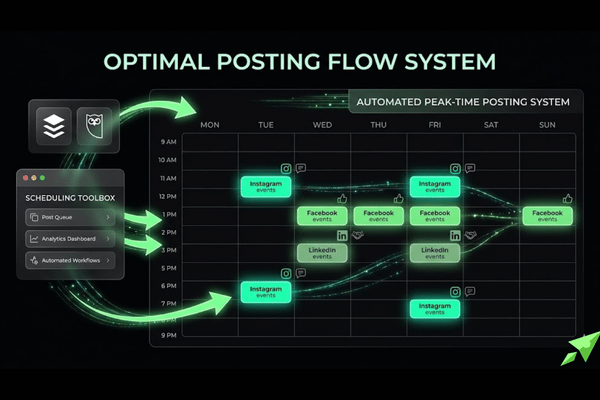
Tools that automate posting at best times across Instagram, Facebook, and LinkedIn are listed below
Tools that automate posting at best times across Instagram, Facebook, and LinkedIn are listed below.
Buffer: Offers an Optimal Timing feature that suggests best posting times based on your account's historical engagement data. Starts at $6 per month. Supports Instagram, Facebook, LinkedIn, TikTok, and Pinterest from a single dashboard.
Sprout Social: ViralPost technology analyzes audience engagement patterns and automatically schedules content during peak windows identified from your specific follower activity. Starts at $249 per month.
Hootsuite: Best Time to Publish feature surfaces recommended posting windows per platform based on your account's engagement history. Starts at $99 per month.
Later: Best Time to Post suggestions displayed directly in the calendar interface for Instagram, Facebook, and LinkedIn. Free plan available with paid plans from $18 per month.
Meta Business Suite (native scheduler): Free scheduling tool for Facebook and Instagram that includes a basic audience activity graph to guide timing decisions. No additional cost beyond the business page.
Buffer
Optimal timing feature: Yes (data-driven suggestions)
Platforms: Instagram, Facebook, LinkedIn, TikTok
Starting cost: $6/month
Sprout Social
Optimal timing feature: Yes (ViralPost AI scheduling)
Platforms: Instagram, Facebook, LinkedIn, Twitter/X
Starting cost: $249/month
Hootsuite
Optimal timing feature: Yes (Best Time to Publish)
Platforms: Instagram, Facebook, LinkedIn, TikTok
Starting cost: $99/month
Later
Optimal timing feature: Yes (Best Time to Post)
Platforms: Instagram, Facebook, LinkedIn, TikTok
Starting cost: $18/month
Meta Business Suite
Optimal timing feature: Basic (audience activity chart)
Platforms: Instagram, Facebook only
Starting cost: Free
The worst times to post on Instagram, Facebook, and LinkedIn in 2026 by platform are listed below
The worst times to post on Instagram, Facebook, and LinkedIn in 2026 are concentrated in early pre-dawn morning hours, late weekend nights, and all day Sunday across all three platforms. Publishing during these windows wastes strong content on near-empty feeds and produces engagement rates too low to trigger meaningful algorithmic distribution.
The worst times to post on Instagram, Facebook, and LinkedIn in 2026 by platform are listed below.
Instagram's worst times: All day Saturday after 11 a.m., all day Sunday, weekday slots before 6 a.m., and weekday slots after 10 p.m. Content published in these windows sits in a low-activity feed and fails to accumulate the early interactions needed for Explore or non-follower distribution.
Facebook's worst times: All day Sunday (the weakest day on the platform regardless of post time), weekday mornings before 7 a.m., and evenings after 8 p.m. on weekdays. Facebook's afternoon-dominant engagement pattern makes off-hours publishing consistently unproductive.
LinkedIn's worst times: Saturday and Sunday entirely, weekday mornings before 10 a.m., given the 2026 evening shift in peak engagement, and evenings after 8 p.m. The shift away from traditional morning posting makes early-slot LinkedIn publishing less effective in 2026 than in any previous year.
The social media posting schedule that avoids these dead zones consistently outperforms one optimized only for best times, because eliminating low-return publishing windows concentrates content output on the hours that actually drive reach. Best times to post on Instagram, Facebook, and LinkedIn matter most when they are applied alongside a consistent weekly publishing plan that the platform algorithm can recognize and reward over time.
Frequently asked questions about the best posting times in 2026
What is the single best time to post on LinkedIn in 2026?
The single best time to post on LinkedIn in 2026 is Tuesday from 11 a.m. to 5 p.m. local time. LinkedIn engagement also stays strong on Wednesday from 11 a.m. to 4 p.m. and Thursday from 1 p.m. to 5 p.m. Use this window for B2B posts, service updates, case studies, and thought leadership content. (Sprout Social)
Does posting time matter more than posting frequency?
No, posting time does not matter more than posting frequency. Posting time helps your content get early views, but posting frequency builds trust, reach, and steady audience contact. A brand that posts useful content 3 to 5 times each week can learn faster than a brand that waits for one perfect time.
What time should I post on Instagram for maximum reach in the USA?
For maximum Instagram reach in the USA, post on weekday afternoons and early evenings in your audience’s main time zone. Sprout Social shows strong Instagram windows on Monday from 2 p.m. to 4 p.m., Tuesday from 1 p.m. to 7 p.m., Wednesday from 12 p.m. to 9 p.m., and Thursday from 12 p.m. to 2 p.m. (Sprout Social)
Example: If most followers live in California, use Pacific Time. If most followers live in New York, use Eastern Time.
What is the best time to post on all platforms on the same day?
The best time to post on all platforms on the same day is Tuesday or Wednesday between 11 a.m. and 6 p.m. local time. This window works across major platforms because many users check social media during lunch, work breaks, and late afternoon slow periods. (Sprout Social)
Example: A small business can post on LinkedIn at 11 a.m., Instagram at 1 p.m., and TikTok at 4 p.m. on the same day.
Does the algorithm favor accounts that post at consistent times?
Yes, social media algorithms favor accounts that post useful content at steady times because steady posting creates repeat engagement. The algorithm measures signals such as watch time, clicks, saves, comments, shares, and early activity. Consistent posting helps your audience know when to expect new content.