
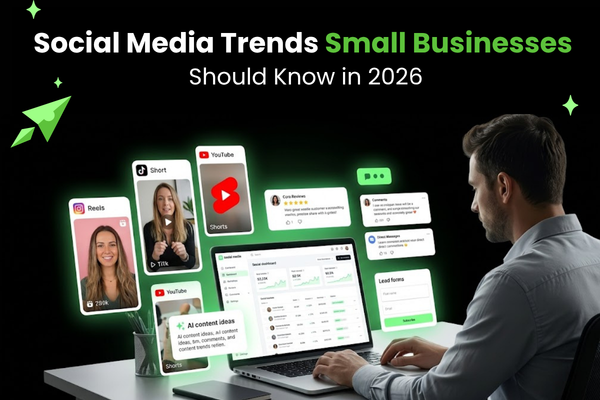
Social Media Trends Small Businesses Should Know in 2026
Social media trends in 2026 are not only about new apps or viral posts. They are about how people find, trust, and choose small businesses online.
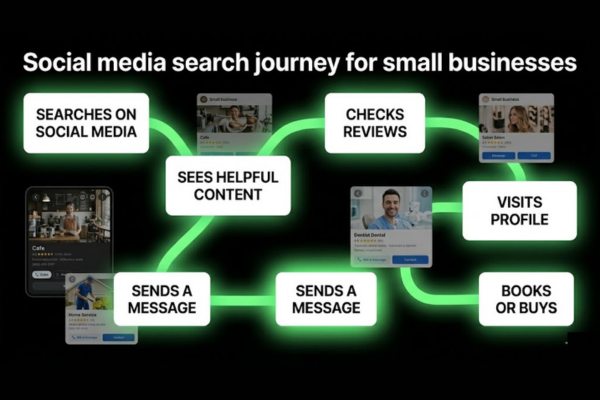
For small businesses, the biggest change is simple: social media is now part of the customer search journey. People search on Instagram, TikTok, YouTube, Facebook, Reddit, and LinkedIn before they call, book, buy, or visit.
That means small businesses need more than random posting. They need clear content, helpful videos, real proof, strong captions, and a simple plan. If a business is starting from zero, it should first build a brand that people can understand and remember.
What social media trends matter most for small businesses in 2026?
The social media trends that matter most for small businesses in 2026 are the trends that improve discovery, trust, engagement, and sales.
Small businesses do not need to chase every new feature. They need to focus on trends that help real customers find them, believe them, and take action.
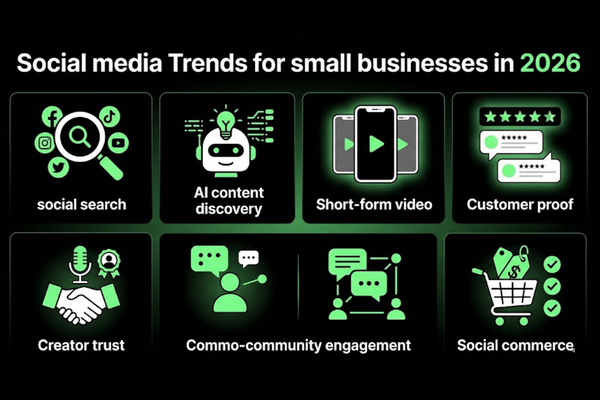
The main social media trends for small businesses in 2026 are:
Social platforms are becoming search engines.
AI is changing content discovery.
Short-form video is driving business discovery.
Real customers and creators are building trust.
Community engagement matters more than follower count.
Social commerce and lead forms are reducing buyer steps.
Paid ads support strong organic content.
These trends work best when they connect to a clear social media strategy. Without a strategy, a business can post often and still get weak results.
Why are social platforms becoming search engines?
Social platforms are becoming search engines because people now use them to research products, services, reviews, ideas, and local businesses.
A customer may search TikTok for “best coffee shop in Austin.” Another may search Instagram for “wedding florist near me.” A homeowner may watch YouTube Shorts before choosing a cleaning company.
This changes how small businesses should post.
A social post should answer real questions. It should use clear captions, simple words, location terms, service names, and helpful visuals. A good post helps both people and platforms understand the topic.
Example: A dental clinic should not only post “Happy Monday.” It can post “How long does teeth whitening last?” That kind of post answers a real search.
This is why social search is now part of small business marketing. People do not always start on Google first. They often check social proof before they trust a business.
How is AI changing content discovery on social media?
AI is changing content discovery by helping platforms decide which posts match each user’s interests.
AI means artificial intelligence. It is software that learns from user actions like watch time, likes, saves, comments, clicks, and shares.
In 2026, social platforms do not show content only because someone follows a page. They show content because the post matches user behavior.
That means better content structure matters.
A small business should make each post clear. The hook should explain the topic fast. The caption should support the video or image. The call to action should tell the viewer what to do next.
Example: A home organizer can post a short video called “3 pantry mistakes that waste space.” The topic is clear. The viewer knows what they will learn. The platform can understand the subject.
AI can help small businesses plan ideas, write draft captions, and repurpose content. But a human still needs to check the message, facts, tone, and offer.
Why is short-form video becoming a business discovery tool?
Short-form video is becoming a business discovery tool because it shows value fast.
Short-form video means quick videos on platforms like Instagram Reels, TikTok, YouTube Shorts, Facebook Reels, and LinkedIn video. These videos often answer one question, show one tip, or prove one result.
Small businesses can use short videos to show:
A product demo.
A service process.
A customer result.
A before and after.
A common mistake.
A quick expert tip.
Example: A med spa can show “What happens during a first skin consultation?” A plumber can show “Why your sink drains slowly.” A bakery can show “How we prepare custom birthday cakes.”
Short videos help people see the business before they contact it. They reduce doubt because the viewer can see the work, the people, and the process.
For many businesses, video will beat plain graphics when the buyer needs proof. This is why comparing static vs video helps small businesses choose better content formats.
How are creators and customers changing brand trust?
Creators and customers are changing brand trust because people believe real people more than polished brand posts.
A creator is a person who makes content for a specific audience. A customer is someone who has bought from the business. Both can create trust because their content feels more real.
Small businesses can build trust with:
Customer reviews.
User-generated content.
Local creator posts.
Owner-led videos.
Team introductions.
Customer story posts.
User-generated content means content made by customers. It can include photos, videos, reviews, tags, or testimonials.
Example: A restaurant can repost a customer’s dinner photo. A fitness coach can share a client progress story. A local salon can post a short client reaction after a haircut.
This kind of proof helps new buyers feel safe. It shows that other people already trust the business.
Why does community engagement matter more than follower count?
Community engagement matters more than follower count because engaged people are closer to taking action.
A large follower count does not always mean more sales. A smaller audience with comments, saves, shares, DMs, and repeat views can produce better business results.
Engagement shows interest.
A save shows that the post was useful. A share shows that the content was worth passing on. A DM shows that the person may need help. A comment can show a real question or concern.
Example: A local cleaning business with 1,500 followers may get more booked jobs than a page with 20,000 weak followers if its audience sends quote requests.
Small businesses should focus on real actions, not vanity numbers. A strong social media consistency plan helps a business stay visible without posting random content.
How can social media trends improve small business visibility?
Social media trends improve small business visibility when they help people discover, remember, trust, and contact the business.
Visibility means people can find the business when they need it. Social media improves visibility through search-friendly posts, videos, reviews, hashtags, captions, local mentions, and active community replies.
A small business should use social content to answer buyer questions.
Example: A personal trainer can post “What should beginners do in their first gym session?” A local accountant can post “What receipts should small business owners keep?” These posts match real customer needs.
Social media visibility also grows when a business uses the same clear message across platforms. The bio, profile photo, content topics, service names, and calls to action should all support the same business goal.
A clear profile helps a new visitor understand the business in seconds.
How does social search help buyers find local businesses?
Social search helps buyers find local businesses by showing helpful posts, videos, reviews, and location-based content.
People use social media to check if a business looks active, trusted, and easy to contact. They may search for local services, product ideas, reviews, or examples before making a choice.
Example: A bride may search Instagram for “wedding makeup artist Dallas.” A parent may search Facebook groups for “best daycare near me.” A homeowner may search TikTok for “garage storage ideas.”
Small businesses should include simple local signals in their content.
These signals include city names, service areas, neighborhood terms, product names, and customer use cases. The goal is not keyword stuffing. The goal is clarity.
A bakery in Phoenix should say Phoenix when the post is about Phoenix customers.
How do keyword captions and on-screen text improve discovery?
Keyword captions and on-screen text improve discovery by helping platforms understand the topic of a post.
A keyword is a word or phrase people use when they search. On-screen text means words shown inside a video or image.
Small businesses should use keywords in:
Captions.
Video titles.
On-screen text.
Spoken words.
Hashtags.
Alt text.
Profile bios.
Example: A dog groomer can use “dog grooming in Tampa” in the caption when the post shows a grooming result. The video can also show on-screen text like “Before and after dog grooming.”
Captions should still sound human. A business should never force the same phrase again and again.
For better captions, use a clear topic, one useful point, and one next step. This guide on caption writing can help with that process.
How can reviews and customer proof improve social trust?
Reviews and customer proof improve social trust by reducing buyer doubt.
People want to know if a business can do what it promises. Customer proof answers that question with real examples.
Small businesses can post:
Review screenshots.
Customer testimonials.
Before and after photos.
Case study posts.
Tagged customer photos.
Short video feedback.
Result-based captions.
Example: A landscaping company can post a before and after yard project. A dentist can share a patient review with permission. A consultant can post a short client result story.
Proof content should be clear and honest. It should not exaggerate the result.
A good proof post explains the problem, the action, and the result. This helps new customers understand what the business can do for them.
How can emerging communities increase brand visibility?
Emerging communities increase brand visibility by helping small businesses join real conversations.
A community can be a Facebook Group, Reddit thread, LinkedIn group, local online group, Threads discussion, or niche forum. These places often have people asking specific questions.
Small businesses should use communities to help, not spam.
Example: A local moving company can answer packing questions in a neighborhood group. A tax professional can explain a basic filing deadline in a small business group. A skincare clinic can answer simple skin care questions on Threads.
The goal is to become useful before asking for a sale.
A business should listen first, answer clearly, and share content only when it fits the question. This builds trust faster than dropping links everywhere.
How can AI help small businesses follow social media trends?
AI helps small businesses follow social media trends by saving time on planning, ideas, drafts, testing, and repurposing.
AI can support the work, but it should not control the whole message. A small business still needs human judgment, real examples, and brand voice.
AI can help with:
Content ideas.
Caption drafts.
Hook options.
Video scripts.
Content calendars.
Topic research.
Post repurposing.
Basic performance reviews.
Example: A restaurant can ask AI for 20 short video ideas based on its menu. The owner can then choose the best ideas and add real stories from the restaurant.
AI works best when the business already knows its audience, offer, and message. Without that, AI content can sound plain and forgettable.
What should small businesses use AI for in social media?
Small businesses should use AI for simple tasks that save time without removing human judgment.
AI is useful for planning and drafting. It is weak when it has no real business details, customer stories, or local context.
Good AI use cases include:
Creating first-draft captions.
Turning blog posts into short posts.
Writing video script ideas.
Creating hook variations.
Planning weekly content themes.
Summarizing customer questions.
Organizing content ideas.
Example: A real estate agent can use AI to turn one market update into a LinkedIn post, Instagram caption, and short video script. The agent should still add local data and personal insight.
AI should not replace real photos, real customer proof, or real business experience.
What should humans review before publishing AI-assisted content?
Humans should review accuracy, tone, claims, offers, visuals, and calls to action before publishing AI-assisted content.
AI can make mistakes. It can also create content that sounds too broad. A business owner or marketer should check every post before it goes live.
Review these items before posting:
Check facts.
Match brand voice.
Remove false claims.
Add real examples.
Check customer privacy.
Confirm the offer.
Fix the call to action.
Example: A clinic should never publish AI-written health advice without expert review. A finance business should check every claim before posting because wrong advice can harm trust.
Human review protects the brand. It also makes the content sound real.
How can small businesses keep AI content authentic?
Small businesses can keep AI content authentic by adding real stories, real photos, customer language, owner opinions, and local details.
Authentic content means the post feels true to the business. It should not sound like it could belong to any company.
Example: Instead of posting “We provide great customer service,” a salon can post, “Maria came in before her job interview and wanted a clean, simple haircut. Here is the final look.”
That post feels real because it includes a person, a reason, and a result.
Small businesses should use AI for structure, then add human detail. Real detail is what makes content worth reading, saving, and sharing.
How can AI speed up content testing and planning?
AI can speed up content testing and planning by creating several content angles from one core idea.
Testing means trying different versions to see what works best. A small business can test hooks, captions, CTAs, video styles, and post formats.
Example: A cleaning company can test three hooks:
“3 signs your office needs deep cleaning.”
“Why your office still feels dusty after cleaning.”
“Before you hire a cleaning company, check this.”
Each hook targets the same service but uses a different angle.
AI can help create these options faster. The business should then track which post gets saves, comments, DMs, calls, or form fills.
A content calendar helps keep these tests organized.
How can video trends create more leads for small businesses?
Video trends create more leads when videos show the problem, proof, offer, and next step quickly.
A lead is a person who shows interest in buying. A lead may call, message, book, fill out a form, or ask for a quote.
Video helps leads because it makes the business easier to understand.
Example: A home repair company can show a 30-second video explaining why a wall crack appears. At the end, the company can say, “Message us for an inspection.”
That video teaches, builds trust, and gives a next step.
Small businesses should use video for problems customers already understand. The best videos answer common questions, remove fear, and show proof.
What short-form video formats should small businesses use?
Small businesses should use short-form video formats that explain, prove, teach, or sell.
The best short videos are simple. They focus on one topic and one action.
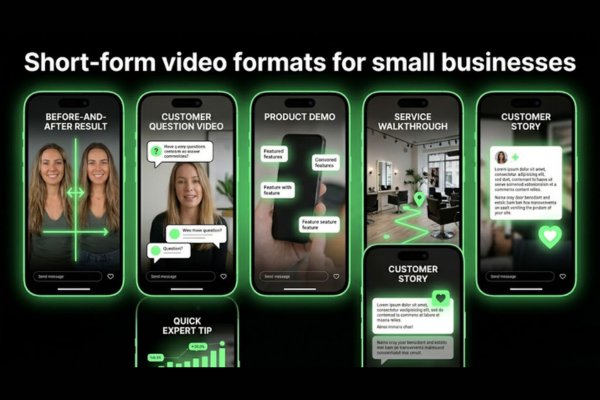
Short-form video formats small businesses should use are:
Show a before and after result.
Answer one customer question.
Explain one common mistake.
Show a product in use.
Walk through a service step.
Share one customer story.
Teach one quick tip.
Example: A local gym can post “3 beginner mistakes on the treadmill.” A dentist can post “What happens during a dental cleaning?” A home organizer can post “One drawer fix for small kitchens.”
Each video should end with a next step. That step can be “save this,” “send a message,” “book a call,” or “visit our profile.”
How should small businesses plan serialized content?
Small businesses should plan serialized content by creating repeatable weekly post ideas.
Serialized content means content that follows the same theme again and again. It helps people know what to expect.
Examples include:
Monday tip.
Weekly customer question.
Before and after Friday.
Mistake of the week.
Owner answers.
Local business spotlight.
Example: A marketing agency can post “Small Business Social Tip” every Tuesday. A cleaning company can post “Room Reset Friday.” A bakery can post “Cake Design of the Week.”
Serialized content supports memory. People are more likely to return when the format is easy to recognize.
It also makes content planning easier because the business does not start from zero every week.
How can live video and interactive content support sales?
Live video and interactive content support sales by letting customers ask questions before buying.
Interactive content means posts that invite action. This includes polls, question stickers, quizzes, countdowns, live comments, and DMs.
A small business can use live video for:
Product demos.
Service walkthroughs.
Live Q&A sessions.
Launch events.
Appointment previews.
Behind-the-scenes tours.
Example: A boutique can go live to show new arrivals. A coach can host a live Q&A about a program. A med spa can explain what happens during a consultation.
Live content works best when the business has a clear topic and clear next step. The next step should be easy, like “DM us,” “book today,” or “join the list.”
How can paid video ads support organic social content?
Paid video ads support organic social content by giving proven posts more reach.
A small business should not boost every post. It should first find which organic posts get strong saves, shares, comments, profile visits, DMs, or clicks.
Then it can promote the best posts.
A simple process is:
Post organic videos.
Track top performers.
Boost the strongest post.
Retarget engaged viewers.
Send traffic to a form, booking page, or offer.
Measure leads and sales.
Example: A local dentist posts a video about teeth whitening. The video gets many saves and DMs. The clinic can turn that video into a paid ad and send people to a whitening consultation page.
Paid ads work better when the content has already shown interest.
How can creator and community trends build small business trust?
Creator and community trends build small business trust by showing real people around the brand.
Trust grows when people see customers, creators, employees, owners, and community members talking about the business. This proof feels more natural than a plain sales post.
Example: A local restaurant can work with a food creator who already has a local audience. A fitness coach can share client clips. A boutique can repost customer outfit photos.
Small businesses should choose trust over reach. A small creator with a local audience can be more useful than a large creator with the wrong audience.
Community content also shows that the business is active, human, and easy to reach.
Which micro-creators should small businesses work with?
Small businesses should work with micro-creators who match their audience, location, niche, and offer.
A micro-creator is a creator with a smaller but engaged audience. A nano-creator has an even smaller audience, often with strong local trust.
Choose creators based on:
Audience fit.
Local relevance.
Engagement quality.
Content style.
Brand safety.
Past proof.
Clear pricing.
Example: A local coffee shop should choose a local food creator, not a national tech creator. The audience must match the buyer.
Small businesses should also agree on the content type before the work starts. The agreement should include the video format, caption points, posting date, usage rights, and payment.
How should small businesses collect user-generated content?
Small businesses should collect user-generated content by asking customers for simple photos, videos, reviews, and tags.
User-generated content gives the business real proof. It also gives the content team more material to post.
A simple process works best:
Ask after a good customer experience.
Give a clear photo or video prompt.
Request permission before reposting.
Save the content in one folder.
Add the content to future posts.
Thank the customer publicly when suitable.
Example: A salon can ask a happy client if it can share the final look. A restaurant can ask guests to tag the business. A fitness coach can ask clients to share a short progress note.
Permission matters. A business should not repost private customer content without approval.
How can employees and owners become trust signals?
Employees and owners become trust signals when they show the human side of the business.
People trust people before they trust logos. Owner-led and team-led content helps buyers understand who they will work with.
Small businesses can post:
Owner advice.
Team introductions.
Service explanations.
Day-in-the-life clips.
Behind-the-scenes videos.
Customer question answers.
Example: A plumber can explain one common pipe issue on camera. A dentist can explain what new patients should expect. A café owner can show how the team prepares morning orders.
This kind of content reduces distance. It makes the business feel more real and easier to contact.
How should small businesses manage comments, DMs, and saves?
Small businesses should manage comments, DMs, and saves as signs of customer interest.
A comment can show a question. A DM can show buyer intent. A save can show the content is useful. These actions should guide future content and follow-up.
A simple workflow is:
Reply to comments daily.
Save common questions.
Turn questions into posts.
Track DMs that ask about price or booking.
Use saved replies for common answers.
Follow up when a buyer asks for help.
Example: If five people ask about pricing, the business can create a post explaining what affects cost.
This turns engagement into content ideas and sales chances.
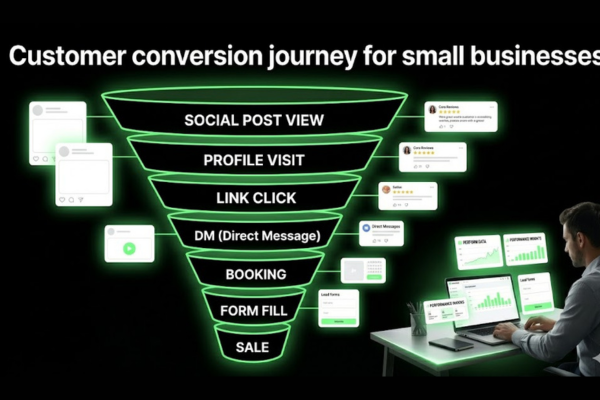
How should small businesses turn social media trends into sales?
Small businesses turn social media trends into sales by connecting content to offers, proof, lead capture, and follow-up.
A trend alone does not create sales. A business needs a clear path from post to action.
That path can be:
Watch the post.
Visit the profile.
Click the link.
Send a DM.
Book a call.
Fill out a form.
Buy or visit.
Example: A med spa can post a video about acne treatment, show a client's result, and invite viewers to book a skin consultation.
Each post should have one job. Some posts build trust. Some posts teach. Some posts ask for action.
To determine whether social content is working, businesses should measure social ROI, not just likes.
How do social commerce and lead forms reduce buyer friction?
Social commerce and lead forms reduce buyer friction by making it easier to act from the post.
Buyer friction means extra steps that slow customers down. Fewer steps can increase action.
Small businesses can reduce friction with:
Product tags.
Booking links.
Quote forms.
Lead forms.
DM buttons.
Pinned comments.
Link-in-bio pages.
Example: A clothing store can tag products in Instagram posts. A service business can send users to a quote form. A consultant can use a booking link for calls.
The best path depends on the offer. A low-cost product may need a checkout link. A high-trust service may need a call or consultation.
Which calls to action work best for small business social content?
The best calls to action for small business social content are clear, short, and matched to the buyer’s next step.
A call to action tells the viewer what to do next. It should fit the content goal.
Effective calls to action include:
Book a call.
Request a quote.
Send a message.
Save this post.
Comment a keyword.
Visit our profile.
Join the email list.
Example: A roofing company can say, “Request a roof quote.” A coach can say, “DM ‘PLAN’ for details.” A restaurant can say, “Reserve your table.”
A post with no next step can still get views, but it may lose ready buyers.
How should paid social support winning organic posts?
Paid social should support winning organic posts by giving more reach to content that already works.
Organic content means unpaid posts. Paid social means ads or boosted posts.
Small businesses should use paid social after they see proof of interest. This lowers risk because the business is not guessing.
A good paid support process is:
Find posts with strong engagement.
Choose one clear business goal.
Boost the best post.
Retarget engaged viewers.
Test one new hook.
Track leads and cost.
Example: A fitness studio posts a video about beginner classes. The video gets saves and DMs. The studio can boost that video to people nearby and send them to a trial class offer.
Paid social should make strong content work harder.
How should social media connect with website, email, and local SEO?
Social media should connect with the website, email, and local SEO by moving people from interest to trust and action.
Social content can introduce the business. The website can explain the offer. Email can follow up. Local SEO can help nearby buyers find the business in search.
Example: A post about “how to choose a wedding florist” can link to a blog or service page. A Google Business Profile post can share the same offer. An email can follow up with more examples.
A business should not treat social media as a separate island. Each channel should support the same message.
This helps customers see the business more than once before they decide.
How should small businesses prioritize social media trends in 2026?
Small businesses should prioritize social media trends by choosing trends that match their audience, budget, time, and sales goal.
The best order is:
Visibility first.
Trust second.
Conversion third.
Scaling last.
Visibility helps people find the business. Trust helps people believe the business. Conversion helps people take action. Scaling helps the business grow what already works.
Example: A new local service business should first fix its profile, post helpful content, share proof, and answer DMs. It should not start with five platforms and daily video if the team cannot keep up.
A simple social media audit can show what to fix before adding new trends.
Which trends fit limited time and budget?
The trends that fit limited time and budget are social search, short-form video templates, customer proof, basic AI planning, and one strong platform.
Small businesses should not try to do everything at once. They should choose the few actions that are easy to repeat.
Start with:
One main platform.
Three content pillars.
One weekly short video.
One proof post.
One helpful tip post.
Daily comment and DM checks.
Example: A small law office can focus on LinkedIn and Facebook. It can post client education, common questions, and attorney insights. It does not need to chase every TikTok trend.
Simple and repeatable beats big and messy.
Which platforms should small businesses choose first?
Small businesses should choose platforms based on audience, content type, business model, and team time.
A business should not pick a platform only because it is popular. It should pick the platform where its buyers already spend time.
Examples:
Instagram works well for visual brands like salons, cafés, boutiques, and med spas.
Facebook works well for local services, community groups, events, and older audiences.
LinkedIn works well for B2B services, consultants, professionals, and agencies.
TikTok works well for discovery, quick tips, product demos, and creator-style videos.
YouTube works well for longer trust-building content and search-based videos.
A business managing more than one channel needs a clear system. This guide on multiple platforms explains how that works.
What should small businesses measure beyond likes?
Small businesses should measure actions that show interest, trust, and sales intent.
Likes are easy to see, but they do not always show business impact. A better report looks at what people did after seeing the content.
Track these metrics:
Saves.
Shares.
Comments.
DMs.
Profile visits.
Link clicks.
Calls.
Form fills.
Bookings.
Sales.
Example: A post with 50 likes and 5 quote requests is more useful than a post with 500 likes and no leads.
Small businesses should connect social media results to real business goals. That makes reporting more useful for owners and managers.
Which social media trends should small businesses avoid chasing?
Small businesses should avoid social media trends that create activity without visibility, trust, leads, or sales.
Not every trend deserves time. A trend is only useful if it fits the audience, brand, offer, and platform.
Avoid these mistakes:
Posting on every platform with no plan.
Copying viral sounds that do not fit the brand.
Using AI with no human review.
Measuring only likes.
Posting random content with no offer.
Ignoring comments and DMs.
Example: A local accountant does not need to copy a dance trend to get clients. A simple video answering tax questions will build more trust.
Good trend use is not about being everywhere. It is about being useful where it matters.
Should small businesses post on every platform?
No, small businesses should not post on every platform unless they have the time, team, and system to do it well.
Posting everywhere can weaken quality. It can also waste time if the audience is not active on those platforms.
A better path is to choose one or two main platforms first. Then the business can repurpose content after it has a working process.
Example: A local bakery may start with Instagram and Facebook. A consultant may start with LinkedIn and YouTube. A home service company may use Facebook, Instagram, and Google Business Profile posts.
Focus helps small businesses stay consistent.
Should small businesses rely fully on AI content?
No, small businesses should not rely fully on AI content.
AI can help with drafts, ideas, and planning. But it cannot replace real customer stories, owner voice, service experience, or local knowledge.
Fully AI-made content often sounds broad. It may not explain what makes the business different.
Example: AI can write a caption about social media tips. But the owner should add a real lesson from a client, a customer question, or a local example.
Small businesses should use AI as an assistant. The final content should still sound like the real business.
Should small businesses chase every viral trend?
No, small businesses should not chase every viral trend.
A viral trend is only worth using if it fits the audience, message, and business goal. If the trend does not connect to the offer, it can confuse people.
Before using a trend, ask:
Does this fit our audience?
Does this match our brand voice?
Can we connect it to our offer?
Will this build trust?
Can this lead to action?
Example: A dentist can use a trending format to answer a dental myth. But copying a random joke with no connection to dental care will not help much.
The best trends support the message. They do not replace it.
How can small businesses create a 2026 social media action plan?
Small businesses can create a 2026 social media action plan by turning trends into weekly actions, content formats, and measurable goals.
An action plan keeps the business focused. It also helps the team know what to post, when to post, and how to measure results.
A simple plan should include:
Target audience.
Main platforms.
Content pillars.
Weekly posting schedule.
Video formats.
Proof content.
Engagement workflow.
Tracking method.
Example: A local spa can choose Instagram as the main platform, post three times per week, share one customer proof post, create one Reel, and track DMs and bookings.
This plan is easier to follow than chasing trends daily.
What should small businesses do in the first 30 days?
Small businesses should use the first 30 days to fix profiles, choose platforms, plan content, and test simple posts.
The first month should build the base. It should not focus on doing everything.
The first 30-day social media actions are:
Audit all active profiles.
Update bios and links.
Choose one or two main platforms.
Define three content pillars.
Build a simple posting schedule.
Collect customer proof.
Post test content.
Track baseline metrics.
Example: A local cleaning company can update its Facebook and Instagram profiles, post before and after photos, answer common questions, and track DMs.
A clear base makes future trends easier to use.
What should small businesses test for 90 days?
Small businesses should test content formats, hooks, CTAs, posting times, proof types, and platform performance for 90 days.
A 90-day test gives enough time to see patterns. It also stops the business from changing direction every week.
Test these items:
Video hooks.
Caption styles.
Posting times.
Short-form video topics.
Customer proof formats.
CTAs.
Paid boosts.
Lead forms.
Example: A fitness studio can test beginner tips, client results, class clips, and trainer advice. After 90 days, it can see which posts bring the most DMs and trial bookings.
The goal is not perfect content. The goal is better decisions.
Which tools and workflows make execution easier?
Tools and workflows make execution easier by helping small businesses plan, create, publish, and measure content.
A workflow is a repeatable way to get work done. It saves time because the team follows the same steps each week.
Helpful tools and workflows include:
A content calendar.
A scheduling tool.
A design template.
A video editing app.
An AI writing assistant.
A review folder.
A simple reporting sheet.
A lead tracking system.
Example: A business can plan posts on Monday, record videos on Tuesday, schedule posts on Wednesday, and review results every Friday.
A simple workflow protects consistency. It also reduces last-minute posting.
Frequently asked questions about social media trends for small businesses
Common questions about social media trends for small businesses focus on the biggest trend, platform value, posting frequency, and paid ads.
Small businesses want simple answers because they have limited time. The goal is not to follow every trend. The goal is to use the right trend for the right business result.
What is the biggest social media trend for small businesses in 2026?
The biggest social media trend for small businesses in 2026 is the move from simple posting to searchable, proof-based, AI-supported content.
People now use social platforms to find businesses, compare options, and check trust. Small businesses should create content that answers real questions, shows proof, and gives clear next steps.
Is Instagram still worth it for small businesses in 2026?
Yes, Instagram is still worth it for many small businesses in 2026.
Instagram works well for visual brands, local businesses, service providers, creators, and community-based businesses. It is useful when the business can post Reels, stories, proof posts, and clear CTAs.
Instagram is not required for every business. The audience should decide the platform.
How often should a small business post on social media in 2026?
A small business should post as often as it can keep quality and consistency.
For many small businesses, 3 to 5 strong posts per week is a practical starting point. Daily engagement is also useful because comments and DMs can turn into leads.
For a deeper schedule, see this guide on weekly post frequency.
Do small businesses need paid social media ads in 2026?
No, small businesses do not always need paid social media ads in 2026.
Paid ads help when the business has a clear offer, strong content, and a tracking system. Ads can boost proven posts, retarget interested viewers, and generate leads faster.
A business should fix its message and content first. Then paid ads can help scale what already works.