
Social Media Management for Franchise Business Owners
Franchise businesses that post consistently on social media see up to 3x more local customer inquiries than inactive locations [site: Rallio, Franchise Social Media Benchmark Report 2025]. That gap comes from structure — not effort. Most franchise owners either post too little or drift too far outside brand rules.
Social media management for franchise business owners covers platform selection, content creation, local page management, brand control, approval workflows, customer replies, paid social, and analytics. It differs from standard social media in that it spans multiple locations, multiple owners, and a single shared brand.
This guide walks through the full process. It covers what franchise social media management means, which platforms work best, how to build a strategy, what content performs, how social turns attention into customers, and how franchisors manage social across locations. It also covers tools, the DIY vs outsource decision, costs, and risks.
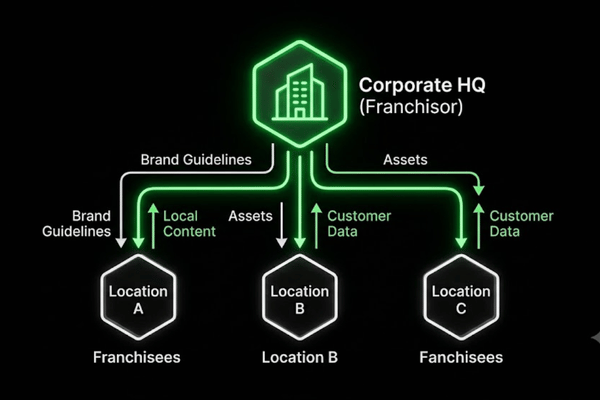
The franchisor sets brand guidelines and builds the content library. The franchisee handles local posts, customer replies, and community content. The corporate marketing team manages asset management, approval workflows, and campaign calendars. Local operators drive store visits, bookings, quote requests, and reviews through location-level posts.
Local franchise marketing and corporate brand control must work together — not against each other. Done well, that balance drives customer retention, franchise sales leads, and long-term franchise development. When done poorly, it creates off-brand posts, confused customers, and compliance risks.
What Is Social Media Management for Franchises?
Social media management for franchises is the process of overseeing platform accounts, content creation, local page management, brand control, customer replies, paid social, and analytics across every location in a franchise network.
It differs from standard social media management because it involves multiple owners, franchisor rules, and location-specific content — all under one brand. A single-business owner controls everything. A franchise network splits that control between the corporate marketing team and each franchisee.
Platform oversight means every location page stays active and on-brand. Content creation includes both national campaign assets and local franchise content. Local page management covers individual Facebook, Instagram, and Google Business Profile pages for each location. Brand control means posts, visuals, offers, and replies all follow franchise brand guidelines. Community replies keep customers engaged at the location level. Paid social drives calls, bookings, and store visits through targeted ads.
Approval workflows are the key difference in franchise social media management. Before a franchisee publishes a post, it often needs review — from a manager, a regional team, or the corporate marketing team. That step protects the brand and keeps offers compliant. Without it, one wrong post can damage the wider brand.
Analytics in a franchise context means reporting at the location level, not just the brand level. A franchisor needs to see which locations perform best, which need support, and where customer inquiries come from.
Multi-location social media adds layers that single-brand managers rarely face. Franchisee freedom to post local content must stay inside fixed brand limits. That balance — local voice inside corporate guardrails — defines franchisee social media at every level.
How Does It Differ for Franchisors and Franchisees?
Social media management differs for franchisors and franchisees because corporate teams protect the brand while local owners build local relationships. Both groups use social media. Their responsibilities, permissions, and goals are different.
Role: Franchisor
Responsibility: Sets brand standards, builds content library, manages national campaigns
Content Rights: Full brand assets, campaign graphics, tone guidelines
Approval Level: Final approval authority
Role: Corporate Marketing Team
Responsibility: Creates templates, manages platforms, tracks reporting
Content Rights: National content, paid social, brand-wide campaigns
Approval Level: Approves local post requests
Role: Area Manager
Responsibility: Reviews local posts, enforces guidelines, supports franchisees
Content Rights: Regional content, local event posts
Approval Level: Mid-level approvals
Role: Franchisee
Responsibility: Posts local content, replies to customers, runs local offers
Content Rights: Approved templates, local photos, community content
Approval Level: Self-publish or submits for approval
Role: Local Staff
Responsibility: Creates on-the-ground content — photos, videos
Content Rights: Raw content only — no direct publishing rights
Approval Level: No approval authority
Franchise agreement rules define what each party can and cannot post. The franchisor owns the brand. The franchisee licenses it. That legal relationship shapes every social media decision. A franchisee who posts incorrect pricing, unapproved health claims, or off-brand visuals creates legal and reputational risk for the whole network.
Why Does Social Media Matter for Franchise Growth?
Social media matters for franchise growth because it builds national brand trust while helping each location reach local customers at the same time. No other channel does both simultaneously.
Key reasons social media supports franchise growth are listed below.
Local discovery — 76% of consumers who search locally on their phone visit a nearby business within 24 hours [site: Google, Think With Google 2024]
Brand awareness — Consistent posting across locations reinforces brand recognition in every market
Store visits — Location-tagged posts and Google Business Profile updates drive direct foot traffic
Bookings and calls — Posts with clear CTAs convert followers into customers faster than passive content
Review generation — Active social pages produce more review requests and responses, improving local reputation
Customer loyalty — Regular content keeps existing customers engaged between purchases
Recruitment — Job posts on local pages fill open roles faster and at lower cost than job boards
Franchise development — Franchisee success stories and brand milestone posts attract new franchise investors
What Goals Should Franchise Social Media Support?
Franchise social media should support brand awareness, local engagement, customer acquisition, reviews, recruitment, franchise sales, and retention. Each goal connects to a specific action a customer or prospect takes.
Brand awareness — Consistent visuals and messaging across all location pages build recognition in every local market
Local engagement — Community posts, local events, and staff stories build neighborhood trust that national campaigns cannot replicate
Customer acquisition — Calls, bookings, quote requests, app orders, and store visit campaigns turn followers into paying customers
Review generation — Post-visit prompts and review request posts increase Google and Facebook ratings at the location level
Recruitment — Job posts with "Apply Now" CTAs fill open roles at each franchise location without recruiter fees
Franchise sales — LinkedIn posts, franchise inquiry forms, and owner success stories move prospective franchisees into the sales pipeline
Retention — Loyalty offers, re-engagement posts, and repeat-visit campaigns keep existing customers coming back
Every goal needs a matching call to action. "Book Now" drives appointments. "Get a Quote" captures leads. "Apply Now" fills jobs. "Learn More" moves franchise prospects forward. Franchise content strategy works best when each post connects to one of these goals — not just to a date on the calendar.
Which Platforms Work Best for Franchise Businesses?
The best platforms for franchise businesses are Facebook, Instagram, LinkedIn, TikTok, YouTube, and Google Business Profile posts. Each serves a different customer intent and location capacity.
The best social media platforms for franchise businesses are compared below.
Platform: Facebook
Primary Use: Community reach, local discovery
Best For: All franchise types
Franchise Application: Location pages, events, offers, reviews
Platform: Instagram
Primary Use: Visual brand content
Best For: Retail, food, fitness, beauty
Franchise Application: Reels, Stories, local photos, campaigns
Platform: LinkedIn
Primary Use: Franchise development, B2B
Best For: Corporate and professional services
Franchise Application: Franchise sales, owner stories, recruitment
Platform: TikTok
Primary Use: Short video discovery
Best For: Food, retail, service brands
Franchise Application: Staff videos, product demos, local moments
Platform: YouTube
Primary Use: Long-form search content
Best For: Home services, education, automotive
Franchise Application: Service explainers, franchisee stories
Platform: Google Business Profile
Primary Use: Local search and reviews
Best For: Every franchise location
Franchise Application: Hours, offers, photos, review responses
Platform selection should match the customer journey. Facebook reaches existing customers and local communities. Instagram builds brand identity through visuals. LinkedIn drives franchise development leads. TikTok delivers organic discovery to new audiences. YouTube builds long-term search traffic. Google Business Profile connects every local search directly to the nearest location.
Not every franchise needs every platform. A food franchise runs best on Instagram, TikTok, and Facebook. A home services franchise runs best on Facebook, Google Business Profile, and YouTube. Location capacity — the staff time available for social media — should guide how many platforms a franchisee actively manages.
How Should Facebook Support Local Franchise Reach?
Facebook supports local franchise reach through location pages, community posts, events, offers, reviews, groups, and paid boosts for each active franchise location.
Every franchise location needs its own Facebook location page — not just a check-in spot under the main brand page. Location pages let customers leave reviews, find store hours, message the local team directly, and see location-specific offers. None of that works on a central brand page.
Tools and features that drive local reach on Facebook:
Facebook Events — Promote grand openings, limited offers, community days, and seasonal campaigns
Offers — Location-specific promotions with clear terms, expiry dates, and redemption rules
Facebook Messenger — Handles customer inquiries, booking requests, and support messages at the location level
Community Groups — Local staff can participate in neighborhood groups to increase brand presence organically
Paid Boosts — Promote high-performing posts to a defined local radius with a small daily budget
Reviews — Ask every satisfied customer to leave a Facebook review, then respond to each one publicly
Example: A cleaning franchise in Austin uses its location page to post weekly before/after photos, respond to every review, and boost a "Free Estimate" offer to a 10-mile radius. That single location generates 40+ inquiries per month from Facebook alone.
How Should Instagram Support Brand and Location Content?
Instagram supports brand and location content through Reels, Stories, carousels, local photos, staff posts, and campaign visuals that work at both the national brand level and the individual franchise location.
National brand assets — campaign graphics, product photography, seasonal visuals — come from the corporate marketing team. Franchisees use these as a base. Local stores add their own content: staff names, neighborhood landmarks, local customers with consent, and location-specific offers.
Behind-the-scenes content performs well for franchise locations. A quick Reel showing morning prep at a fitness studio, a carousel of a new menu item being made, or a Story featuring a team member builds the trust that polished brand graphics cannot.
Location tags on every post help local discovery. When a customer in Dallas searches for a nearby service, tagged posts from the Dallas franchise location appear in local search results. Hashtags — both brand-specific and location-specific — extend reach further.
Story Highlights act as a permanent menu on the profile. Franchisees should keep Highlights updated with offers, team bios, FAQs, and location details. This turns Instagram from a broadcast channel into a local information hub.
Example: A fitness franchise uses a corporate Reel template every Monday for a national campaign. By Thursday, each location posts a local variation featuring their own trainers — same brand, different faces. Engagement on local variations consistently outperforms the corporate post.
How Should LinkedIn Support Franchise Development?
LinkedIn supports franchise development through founder content, brand milestones, franchise owner stories, recruitment posts, and investor-facing updates that build credibility with prospective franchisees.
Franchise sales start with trust. A prospective franchisee researching a brand checks LinkedIn before filling out a contact form. What they find there shapes their first impression. Consistent, professional content builds the trust that drives franchise inquiry form submissions.
Tactical LinkedIn content for franchise development:
Share franchisee success stories with territory growth numbers and specific revenue outcomes
Post brand milestones — new location openings, unit count benchmarks, and industry awards
Publish founder and executive thought leadership on the franchise model and support system
Announce available territories with location-specific market details
Highlight franchisee testimonials with direct quotes and measurable business outcomes
Showcase corporate training programs and franchisee support infrastructure
Share franchise award recognition from the IFA (International Franchise Association) or trade publications
B2B partners, investors, and corporate recruiters also use LinkedIn. Franchise companies that treat it as a development channel — not just a job board — build stronger pipelines for both franchise sales leads and corporate talent at the same time.
How Should TikTok and YouTube Support Franchise Visibility?
TikTok and YouTube support franchise visibility through short videos, local stories, service demos, customer education, franchisee stories, and searchable brand content that reach different audiences in different ways.
TikTok drives discovery. Its algorithm shows content to users who have no prior relationship with the brand. A 30-second staff video, a product reveal, or a quick "day in the life" clip at a franchise location can reach thousands of local viewers with zero ad spend. TikTok's organic reach for new customer discovery leads every major platform [site: Sprout Social, Social Media Index 2025].
YouTube drives search. A customer who types "how to [service your franchise offers]" into YouTube finds your location's explainer video today, tomorrow, and two years from now. YouTube Shorts bring short-form content to a search-driven platform.
Format: Quick clips
Platform: TikTok
Length: 15–30 sec
Best Franchise Use: Discovery, local moments, staff content
Format: Service demos
Platform: Instagram Reels
Length: 30–60 sec
Best Franchise Use: Product or service explainers
Format: YouTube Shorts
Platform: YouTube
Length: 30–60 sec
Best Franchise Use: Quick tips, offers, staff interviews
Format: Explainer videos
Platform: YouTube
Length: 3–10 min
Best Franchise Use: Service walkthroughs, franchisee stories
Format: Owner interviews
Platform: Both
Length: 60–90 sec
Best Franchise Use: Franchise development, recruitment
Example: A home services franchise films a 2-minute "What to Expect on Your First Appointment" video for YouTube. It ranks in local search results for two years and drives 20+ booking inquiries monthly with no ongoing effort.
What Should a Franchise Social Media Strategy Include?
A franchise social media strategy should include brand rules, platform roles, local content plans, approval workflows, paid social, reporting, and customer response standards. Without a documented strategy, each franchisee makes different decisions — and the brand breaks down at the edges.
A clear franchise social media strategy protects the franchisor and supports the franchisee. It sets the rules so local operators can move fast without making expensive mistakes.
Franchisor goals center on brand equity, franchise development, and national reach. Franchisee needs center on local customers, quick posts, and community engagement. A strategy bridges both.
Key elements to include:
[ ] Brand guidelines document with approved logos, colors, tone, and prohibited terms
[ ] Platform roles — which platforms are mandatory and which are optional per location size
[ ] Content pillars — the recurring topic categories each location posts from
[ ] Posting cadence — minimum post frequency per platform per location
[ ] Asset library — a central folder of approved images, videos, and caption templates
[ ] Approval workflow — who reviews what, and within what time window, before publishing
[ ] Local content rules — what franchisees can customize and what stays fixed
[ ] Paid social guidelines — approved ad formats, targeting rules, and offer terms
[ ] Analytics dashboard — location-level reporting standards and review cadence
[ ] Review management — response time targets and escalation rules for complaints
Multi-location social media breaks down when the strategy lives only in the franchisor's head. Document it. Share it. Train every franchisee on it before they open their first location page.
Example: A national sandwich franchise gives every new franchisee a 12-page Social Media Starter Guide on day one. It covers platform setup, posting templates, content calendar, and approval contacts. New locations post faster and stay on-brand longer than those who started without it.
How Do Franchises Balance Brand Control and Local Voice?
Franchises balance brand control and local voice by setting fixed brand rules while allowing approved local customization. The franchisor decides what never changes. The franchisee decides what speaks to their neighborhood.
Fixed — Brand Controls
Logo placement and size
Brand colors and fonts
Campaign language and hashtags
Product names and descriptions
Review response tone guidelines
Prohibited claims — health, legal, pricing
Flexible — Franchisee Can Customize
Local staff photos and names
Community event announcements
Location-specific offers within approved limits
Neighborhood references and local landmarks
Behind-the-scenes content
Local hiring posts and staff milestones
Brand standards exist to protect both parties. A franchisee who posts incorrect pricing, unapproved health claims, or off-brand visuals creates legal and reputational risk across the whole network. Clear rules prevent this.
Local customization builds the community trust that national brands cannot buy. A post featuring the local Little League team the franchise sponsors outperforms a corporate campaign graphic — when the brand standards hold. Franchise brand consistency improves when franchisees understand not just what the rules are, but why they exist.
What Content Pillars Work for Franchise Locations?
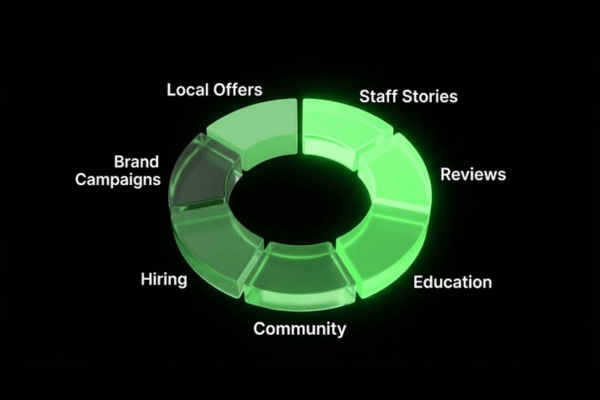
The best content pillars for franchise locations are brand campaigns, local offers, staff stories, customer proof, education, community posts, and hiring content. Each pillar drives a specific business outcome.
Franchise location content pillars are listed below.
Brand campaigns — National promotions and seasonal visuals maintain brand recognition across all locations and tie local pages to the wider brand story
Local offers — Location-specific deals, limited-time discounts, and service bundles drive immediate store visits and calls
Staff stories — Employee spotlights, team anniversaries, and training milestones build trust with local customers who want to know who they're doing business with
Customer proof — Reviews, before/after photos, testimonials, and user-generated content convert new visitors into buyers more reliably than any ad
Education — How-to posts, service explainers, and product guides answer common customer questions before they ever call
Community posts — Local event sponsorships, charity involvement, school partnerships, and neighborhood news build loyalty that competitors cannot replicate
Hiring content — Job posts, "day in the life" videos, and employee benefit highlights attract local talent and signal business growth
A franchise content strategy that rotates through all seven pillars creates consistent variety. Locations that post only offers burn out their audience. Locations that post only brand content miss local connection. The mix drives both reach and trust.
How Should Franchises Build a Content Calendar?
Franchises build a content calendar by combining national campaigns, local events, seasonal offers, review posts, hiring needs, and service updates into one shared planning document.
The corporate marketing team provides the national calendar first: campaign launch dates, product releases, seasonal promotions, and brand-wide events. The franchisee fills in local dates around it.
Map national campaign dates from the corporate marketing team at least 6 weeks in advance
Add local holidays, community events, and area-specific seasonal needs
Schedule seasonal offers 3–4 weeks before the relevant date so approval clears in time
Block product launch dates and grand opening milestones as anchor points
Add recurring post-type review requests every Friday; staff posts every Tuesday to build consistency
Confirm approval lead times: posts needing review require 48–72 hours of buffer
Review the calendar monthly and adjust for local changes or missed opportunities
Example: A tax preparation franchise builds its national calendar around January 1 (filing season opens), April 15 (filing deadline), and October (extension deadline). Each location adds local tax workshop dates, seasonal hiring posts, and community partner promotions around those fixed anchors.
How Often Should Franchise Locations Post?
Franchise locations should post often enough to stay visible locally without creating weak or off-brand content. Volume without quality damages the brand. Silence loses the local algorithm.
Content Type: Feed posts — Facebook or Instagram
Corporate Page: 5–7 per week
Local Location Page: 3–5 per week
Content Type: Stories
Corporate Page: 1–2 per day
Local Location Page: 3–5 per week
Content Type: Reels or Short Videos
Corporate Page: 3–4 per week
Local Location Page: 1–2 per week
Content Type: LinkedIn posts
Corporate Page: 3–5 per week
Local Location Page: 1–2 per week
Content Type: Google Business Profile posts
Corporate Page: 2–3 per week
Local Location Page: 1–2 per week
Posting frequency depends on location size, industry, staff support, approval speed, and offer frequency. A single-owner franchise with no support staff cannot maintain a corporate-level posting schedule. A lower-frequency calendar with consistent quality outperforms a high-volume calendar with weak content every time.
Approval speed directly affects cadence. If every local post requires a 72-hour review, the franchisee cannot react to real-time local moments. Fast-track approval categories — pre-approved templates, evergreen content — keep the calendar moving without compliance gaps.
What Content Works Best for Franchise Social Media?
The best content for franchise social media includes national campaigns, local posts, customer stories, staff content, offers, reviews, short videos, and community updates. Each content type serves a different audience at a different stage.
High-performing franchise content types are compared below.
Content Type: National campaign visuals
Platform: All
Purpose: Brand awareness
Performance Driver: Consistency across every location
Content Type: Local offer posts
Platform: Facebook, Instagram
Purpose: Store visits, calls
Performance Driver: Location-specific CTAs
Content Type: Customer reviews and testimonials
Platform: Facebook, Google
Purpose: Trust, conversion
Performance Driver: Real names, real outcomes
Content Type: Staff spotlights
Platform: Instagram, TikTok
Purpose: Community trust
Performance Driver: Faces behind the brand
Content Type: Short videos — Reels, TikTok
Platform: Instagram, TikTok
Purpose: Discovery, organic reach
Performance Driver: Algorithm-driven distribution
Content Type: Community partnership posts
Platform: Facebook
Purpose: Local loyalty
Performance Driver: Authentic neighborhood connection
Content Type: Hiring posts
Platform: Facebook, LinkedIn
Purpose: Recruitment
Performance Driver: “Apply Now” CTA
Content Type: Educational how-to content
Platform: YouTube, Facebook
Purpose: Customer education
Performance Driver: Evergreen search value
Content that shows real people at real locations outperforms polished stock-photo posts across every platform. Franchisees who post local photos, staff faces, and community moments build audiences that respond — not just follow.
Short video is the best-performing single content type for franchise location growth [site: Meta, Business Insights 2025]. Reels and TikTok clips reach non-followers through the algorithm. Static posts do not.
How Should National Campaigns Become Local Posts?
National campaigns become local posts when franchisees add location details, local photos, staff context, and market-specific CTAs to the corporate campaign template.
A campaign graphic from the corporate marketing team is a starting point — not a finished post. Franchisees who publish campaign graphics with no local context get lower engagement than those who adapt the message for their market.
The localization process:
Receive campaign templates and caption examples from the corporate asset library
Replace generic product images with photos taken at the local store
Add the local store's address, phone number, or booking link to the caption
Adjust the CTA to match local availability — "Book at our Austin location" beats "Book now"
Include local staff names or a local customer quote when available
Check offer terms against approved local limits before submitting
Submit for approval with a 48-hour lead time built in
Example: A national pizza franchise launches a "Summer Slice Deal" campaign. The corporate team creates the graphic and caption. Each franchisee adds their store photo, local delivery zone, and the manager's name — "Ask for Carlos." Engagement increases 40% compared to unlocalized campaign posts.
How Does Local Content Drive Community Trust?
Local content drives community trust by showing real staff, local customers, nearby events, partnerships, and neighborhood involvement that customers in that area already recognize.
Community trust builds fastest when followers see things they know: the local school the franchise sponsors, the charity run the staff joined, the customer they recognize from the neighborhood.
Post about local partnerships with schools, charities, and sports teams by name
Share service-area proof — before/after content from actual jobs in the local area
Feature customer photos and quotes with signed consent
Tag local organizations and partners directly in every mention
Participate in local Facebook Groups as the franchise page — to contribute, not to sell
Post about local events the franchise supports or attends with photos and staff names
Celebrate local staff milestones: work anniversaries, promotions, and team achievements
Example: A pest control franchise in Phoenix posts monthly photos at the local food bank where its staff volunteers. In six months, community engagement on its Facebook page doubles — and it receives zero complaints about being "too promotional."
How Do Reviews and Testimonials Support Franchise Credibility?
Reviews and testimonials support franchise credibility by showing location-specific proof while reinforcing the larger brand promise customers already associate with the franchise name.
A four-star average on Google with 200+ reviews tells a prospective customer more than any advertisement. Reviews are the most trusted form of social proof for local service and retail businesses [site: BrightLocal, Local Consumer Review Survey 2025]. A franchisee who actively collects and responds to reviews builds a compounding credibility asset that compounds over time.
Trust signals to include in social content:
Screenshot Google and Facebook reviews and post as branded graphics using templates from the asset library
Share customer quotes with specific outcome details — not just "great service"
Post before/after service results from real local jobs
Respond to every review — positive and negative — within 24 hours
Use review responses to add context, thank customers, and show accountability publicly
Collect short video testimonials from loyal customers and post as Reels or Stories
Location-specific proof matters because national brand claims feel distant to local buyers. "Best pest control in Phoenix" from a real Phoenix customer converts better than any brand tagline. Service recovery posts — showing how the franchise resolved a real problem — also build trust by demonstrating accountability.
How Do Short Videos Increase Location-Level Engagement?
Short videos increase location-level engagement by showing faces, services, products, procesprocesses,s, offers, and local moments quickly in a format the platform algorithm actively pushes to non-followers.
A 15-to-60-second video on Instagram Reels or TikTok reaches people who have never heard of the franchise. Static posts do not have that reach advantage. That gap makes short video the highest-priority content format for franchise locations trying to grow local audiences from scratch.
Video Type: Staff introduction
Length: 15–30 sec
Platform: TikTok, Reels
Use Case: Build local brand recognition
Video Type: Product or service demo
Length: 30–60 sec
Platform: Reels, TikTok, Shorts
Use Case: Drive purchase intent
Video Type: Customer FAQ
Length: 30–45 sec
Platform: Reels, YouTube Shorts
Use Case: Handle objections before they arise
Video Type: Behind-the-scenes
Length: 15–45 sec
Platform: TikTok, Stories
Use Case: Show authenticity
Video Type: Local event recap
Length: 30–60 sec
Platform: All platforms
Use Case: Community connection
Video Type: Franchisee story
Length: 60–90 sec
Platform: YouTube, LinkedIn
Use Case: Franchise development
Franchise locations do not need expensive equipment. A smartphone, good natural light, and a clear message produce content that outperforms polished studio videos. Authenticity outperforms production value for local franchise social media content at every location size [site: HubSpot, State of Video Marketing 2025].
Recommended Video: Search YouTube for "how to film franchise location Reels on a phone" to watch a step-by-step visual guide on short-form video for local franchise pages.
How Does Social Media Turn Franchise Attention Into Customers?
Social media turns franchise attention into customers when posts give local users a clear next step and route every inquiry to the right location. Reach without conversion is noise.
The gap between a viewed post and a booked customer is almost always one weak CTA. A post can reach 10,000 people and drive zero bookings if the next step is unclear or broken. Every piece of franchise social media content needs to point somewhere specific: a call, a booking link, a quote form, or a map pin.
The conversion process works in five steps. The customer sees a location-level post. The post includes a local CTA. The CTA routes to the correct location page, phone number, or booking system. The inquiry gets tagged in the CRM. The franchisee follows up within the agreed response window.
Comments, DMs, profile clicks, and review responses are all conversion touchpoints. A customer who messages a franchise location page and gets no reply for 48 hours does not become a customer. A customer who gets a response in under an hour — with a booking link — does. Speed and clarity at the local level is what makes social media turn into revenue.
Paid social adds a second layer. Location-level Facebook and Instagram ads reach people searching for the exact service the franchise offers, in the exact area the franchise serves. Combined with organic content, paid social creates a full funnel — from first impression to booked appointment.
How Should Comments and DMs Become Local Inquiries?
Comments and DMs should become local inquiries through location routing, saved replies, response rules, booking links, and CRM tags that move every conversation toward a conversion.
Set up saved replies for the five most common questions at each location — hours, pricing, bookings, directions, and services
Route DMs to the right franchisee — not the corporate team — within a 1-hour window during business hours
Include a booking link or direct phone number in every reply involving a service request
Tag each inquiry in the CRM with source, location, and service type
Set after-hours auto-replies with the location's next available time and a direct booking link
Escalate complaints or negative feedback to the regional manager if the franchisee cannot resolve in one exchange
Track response time per location and target under 60 minutes during business hours
Example: A hair salon franchise uses Meta Business Suite to manage all DMs across 14 locations from one inbox. Each message routes to the right location team within 15 minutes. Booking conversions from DMs increase 55% in the first 90 days after the system is set up.
What CTAs Work for Franchise Locations?
CTAs work for franchise locations when they match the customer's intent, location, and next step. A generic "Learn More" CTA does not drive the same result as "Book Your Free Estimate in Dallas."
Customer Intent: Ready to buy or book
Best CTA: “Book Now” / “Schedule Today”
Platform Use: Facebook, Instagram, Google
Customer Intent: Wants information first
Best CTA: “Get a Free Quote” / “Request Details”
Platform Use: Facebook, LinkedIn
Customer Intent: Needs directions
Best CTA: “Get Directions” / “Find Your Nearest Location”
Platform Use: Facebook, Google Business Profile
Customer Intent: Wants a deal
Best CTA: “Claim This Offer” / “Use Code [X]”
Platform Use: Instagram, Facebook
Customer Intent: Looking for a job
Best CTA: “Apply Now” / “Join Our Team”
Platform Use: Facebook, LinkedIn
Customer Intent: Considering franchising
Best CTA: “Request Franchise Info” / “Download Our Guide”
Platform Use: LinkedIn, Facebook
Customer Intent: Needs to call
Best CTA: “Call [Location Phone]”
Platform Use: All platforms
Location-specific CTAs outperform generic ones. "Book Your Denver Location" converts better than "Book Now" because it confirms availability and removes uncertainty. Franchise locations should never use CTAs that link to the national website homepage — route to the specific location page or direct booking tool every time.
How Should Franchise Owners Measure Lead Quality?
Franchise owners should measure lead quality by tracking source, location, intent, response speed, conversion rate, cost per lead, and revenue value — not just follower count or post reach.
Source — Which platform and post type generated the lead — Instagram Reel, Facebook ad, Google post
Location — Which franchise location the lead contacted
Intent — What the lead asked for — booking, quote, directions, or job application
Response speed — How quickly the franchisee responded to the inquiry
Conversion rate — Percentage of social inquiries that became paying customers
Cost per lead — Total paid social spend divided by leads generated at that location
Revenue value — Average order or job value attributed to social-sourced customers
UTM links on every CTA track which post drove which click. Call tracking numbers per location separate social calls from other sources. CRM tagging by source gives the franchisor a clear picture of which locations convert social traffic most effectively — and which need coaching.
How Should Franchisors Manage Social Media Across Locations?
Franchisors should manage social media across locations with brand guidelines, content libraries, approval workflows, page access rules, and location-level reporting — a management layer that connects every franchisee to the same brand standard.
This is the bridge from customer growth to franchise operations. A franchisor cannot be in every franchise location every day. The social media management system becomes the guardrail that keeps 10, 50, or 500 locations aligned without constant intervention from the corporate team.
Corporate teams control the national content strategy, campaign calendars, and brand asset management. Franchisees access pre-approved content from a shared library and submit custom posts for review. Regional managers handle mid-level approvals and flag compliance issues. The reporting dashboard shows the franchisor which locations are active, which are off-brand, and which are driving results.
Page access rules determine who can publish, who can only draft, and who can edit account settings. These permissions must be set up in Meta Business Manager and equivalent tools at every location before a single post goes live.
The foundation of multi-location workflow management is documentation. Brand guidelines, approval processes, response standards, and reporting expectations must exist in writing — not just in verbal onboarding sessions. Without documentation, every new franchisee reinvents the system.
Multi-location social media management is not a one-time setup. It requires monthly audits, quarterly strategy reviews, and ongoing training for new franchisees and local staff. Franchise social media management at scale demands the same operational discipline as any other part of running a franchise system.
How Can Franchises Keep Brand Voice Consistent?
Franchises keep brand voice consistent by using tone rules, caption templates, visual standards, offer guidelines, and review response examples that every franchisee follows without needing to interpret.
Define the brand voice in 3 words — write examples of on-brand and off-brand captions for each one
Build a caption template library with 10–15 reusable frameworks per content pillar
Set visual standards: approved image filters, logo placement rules, text overlay limits, and prohibited font choices
List prohibited phrases — competitor comparisons, unverified claims, and informal language not approved for the brand
Provide three example review responses: one for a positive review, one for neutral, one for a negative review
Build a brand training module for every new franchisee and every new local staff member who posts
Run quarterly brand audits — review 10 random posts per location against the brand standard and score them
Franchise brand voice fails when guidelines exist but training does not. A document no one reads changes nothing. Live onboarding, short video training modules, and quarterly check-ins keep brand standards active across the network.
What Approval Workflow Protects Brand and Compliance?
An approval workflow protects brand and compliance by reviewing local posts, offers, claims, images, replies, and paid ads before publishing — creating a checkpoint between franchisee intent and public brand output.
Franchisee drafts the post in the scheduling tool with caption, visual, CTA, and target publish date
Draft routes to the area manager or marketing coordinator for first review
Legal review triggers for posts with price claims, health statements, or regulated language
Reviewer approves, edits, or rejects with a written reason and correction note
Approved posts publish on schedule; rejected posts return to the franchisee with specific corrections required
All approvals and rejections log to an audit trail for compliance records
Emergency posts — crisis response, service alerts — follow a fast-track path with a 2-hour turnaround target
Regulated industries — healthcare franchises, financial services, food safety claims — need stricter review at every stage. An audit trail protects both the franchisor and franchisee if a complaint or legal challenge arises from a published post.
How Can Franchisees Repurpose Corporate Content Locally?
Franchisees repurpose corporate content locally by adding store details, staff context, community references, and location-specific CTAs to content the corporate marketing team already created.
Corporate Content: Campaign graphic
Local Repurposing Method: Add local store exterior photo as background; keep brand logo untouched
Corporate Content: Blog post or article
Local Repurposing Method: Pull one key fact, write a local caption, link to the full article
Corporate Content: Seasonal offer graphic
Local Repurposing Method: Add local store hours, local delivery zone, and the manager's name
Corporate Content: Product launch video
Local Repurposing Method: Film the local team reacting to it; post as a paired clip
Corporate Content: Brand award announcement
Local Repurposing Method: Add “Our [City] location is proud to be part of this…” as the caption
Corporate Content: Hiring campaign graphic
Local Repurposing Method: Replace the generic role with the specific local opening and pay range
Repurposing saves franchisees time and keeps brand standards intact. A franchisee who starts from a corporate template makes fewer brand mistakes than one who creates from scratch. The corporate marketing team should build every campaign asset with local customization in mind — editable text, swappable images, and flexible caption formats built in from the start.
What Tools Support Franchise Social Media Management?
Tools that support franchise social media management include scheduling, digital asset management, approval workflows, analytics, review management, AI, and CRM tools built to handle multi-location complexity.
Tool: SOCi
Category: All-in-one
Best For: Multi-location brands
Franchise Feature: Location pages, reviews, ads, reporting
Tool: Rallio
Category: Franchise-specific
Best For: Franchisee adoption
Franchise Feature: Corporate + local content, compliance tools
Tool: Sprout Social
Category: Scheduling + analytics
Best For: Mid-to-large franchise groups
Franchise Feature: Approval workflows, location reporting
Tool: Hootsuite
Category: Scheduling
Best For: Teams managing multiple accounts
Franchise Feature: Multi-user access, scheduling, analytics
Tool: Canva
Category: Design + asset management
Best For: Content creation at scale
Franchise Feature: Brand kits, locked franchise template libraries
Tool: Meta Business Suite
Category: Page management
Best For: Facebook and Instagram
Franchise Feature: Location page management, ad center
Tool: Google Business Profile
Category: Local search
Best For: Every franchise location
Franchise Feature: Posts, reviews, hours, photos
Tool: Birdeye / Podium
Category: Review management
Best For: High-review-volume franchises
Franchise Feature: Multi-location review aggregation
Tool selection should match the size and structure of the franchise network. A 5-location franchise manages well with Hootsuite and Canva. A 200-location franchise needs a purpose-built platform like SOCi or Rallio with built-in approval workflows and location-level dashboards. The tool that fits the team's actual capacity outperforms the most feature-rich tool that no one uses.

Which Scheduling and Asset Tools Help Franchise Teams?
Scheduling and asset tools help franchise teams publish faster while keeping local posts inside brand rules by centralizing approved content and removing the friction of building posts from scratch.
Tool: SOCi
Primary Function: Scheduling + local pages + reviews
Franchise Fit: Large multi-location brands
Starting Cost: Custom pricing
Tool: Hootsuite
Primary Function: Scheduling + basic analytics
Franchise Fit: Small-to-mid franchise groups
Starting Cost: ~$99/month
Tool: Sprout Social
Primary Function: Scheduling + team workflows + reports
Franchise Fit: Mid-to-large teams with approval needs
Starting Cost: ~$249/month
Tool: Rallio
Primary Function: Franchise-specific scheduling + compliance
Franchise Fit: Franchise systems with strict brand rules
Starting Cost: Custom pricing
Tool: Canva
Primary Function: Design + template library + brand kit
Franchise Fit: Content creation for every location
Starting Cost: Free / ~$120/year pro
Tool: Meta Business Suite
Primary Function: Facebook + Instagram management
Franchise Fit: All franchise levels
Starting Cost: Free
A digital asset management tool — a central library where all brand images, videos, and templates live — is the backbone of any multi-location content system. Google Drive, Dropbox, or a built-in DAM within SOCi or Rallio all serve this function. Every franchisee needs access. Every asset needs clear naming and version control so the right file gets used every time.
How Can AI Support Franchise Content Creation?
AI supports franchise content creation by drafting local captions, adapting campaign messages, generating post ideas, and summarizing reports faster than any manual process.
AI tools reduce the time a franchisee spends staring at a blank caption field. A prompt library — a set of pre-written instructions franchisees paste into an AI tool — produces on-brand caption drafts in seconds. The franchisee reviews, adjusts for local context, and submits for approval.
AI use cases for franchise social media:
Draft 5 caption variations for a local offer post in under 60 seconds
Adapt a national campaign message to sound natural in a specific city or region
Generate a full month of post ideas based on content pillars and the calendar
Summarize weekly review sentiment across multiple locations into one short report
Human review is mandatory before any AI-generated content goes live. AI tools do not know local offer terms, franchise agreement rules, prohibited claims, or current stock levels. Brand guardrails must exist in every prompt. A prompt library reviewed and approved by the corporate marketing team prevents AI-generated brand mistakes. Franchisees should never publish AI content without checking it against brand standards first.
What Tools Connect Social Media With Local Reporting?
Social media and local reporting tools connect posts to calls, bookings, forms, reviews, sales, and location performance through a tracking chain that makes social media measurable — not just visible.
UTM links — Add unique tracking parameters to every CTA link so Google Analytics shows which post drove which click at which location
Call tracking numbers — Assign a unique phone number to each location's social profiles and track which calls come from social media specifically
CRM tags — Tag every social inquiry in the CRM with source, location, and conversion outcome
Google Analytics 4 — Connect UTM traffic from social posts to bookings, form fills, and on-site conversions
Review tool dashboards — Birdeye, Podium, and SOCi track review volume, rating trends, and response rate per location in one view
Location benchmarks — Compare posting frequency, engagement rate, lead volume, and conversion rate across all franchise locations side by side
The franchisor reporting dashboard should show every location at a glance. Which locations post consistently? Which have unanswered DMs? Which drive the most booking inquiries? That data makes franchise support conversations specific and productive — not guesswork.
Should Franchise Owners DIY or Outsource Social Media?
Franchise owners should choose DIY or outsourced social media based on brand rules, location count, staff time, approval needs, content volume, and growth goals — not budget alone.
Model: Franchisee-led DIY
Who Manages Content: Local owner or staff
Best For: Small locations, involved owner
Main Risk: Off-brand content, inconsistent posting
Model: Corporate-led
Who Manages Content: Central marketing team
Best For: Newer franchise systems, brand-critical industries
Main Risk: No local voice, slow response times
Model: Agency-led
Who Manages Content: Third-party agency
Best For: Multi-location growth, paid social management
Main Risk: Cost, briefing time, local knowledge gaps
Model: Hybrid
Who Manages Content: Corporate + franchisee + tools
Best For: Most established franchise systems
Main Risk: Coordination complexity
Model: Software-supported DIY
Who Manages Content: Franchisee using approved tools
Best For: Systems with strong asset libraries
Main Risk: Low tool adoption rate
No model works for every franchise. A food franchise with 3 locations and an involved owner thrives on DIY with good templates. A home services franchise with 50 locations and no in-house marketing team needs agency or software support. The right model reduces brand risk while keeping local content authentic.
Cost matters but should not be the only deciding factor. A $500/month agency that keeps a franchise on-brand and posting consistently generates more revenue than a free DIY approach that produces off-brand or irregular content.
When Does DIY Social Media Work for Franchisees?
DIY social media works for franchisees when the brand provides clear templates, simple rules, and enough local staff time to post consistently without specialist help.
DIY social works well when:
[ ] The franchise has 1–3 locations with an owner who is active in the day-to-day business
[ ] The corporate team provides pre-approved templates, captions, and a content calendar
[ ] The franchisee has 3–5 hours per week available to dedicate to social media
[ ] Brand guidelines are simple enough to follow without a marketing background
[ ] Offers and promotions are straightforward — no complex legal or pricing terms
[ ] Content volume is low: 3–5 posts per week across 1–2 platforms
The risk in DIY is not effort — it is knowledge. A franchisee who posts authentically without checking brand rules creates brand inconsistency risk for the wider network. Strong brand guidelines, a good template library, and a fast approval process keep DIY inside safe limits.
Example: A single-location tutoring franchise owner posts 4 times per week using Canva templates and corporate-approved captions. She spends 90 minutes per week on social media and generates 15–20 local inquiries monthly with no agency budget.
When Should Franchises Hire Social Media Help?
Franchises should hire social media help when location count, approval delays, inconsistent branding, paid ads, reporting, or review management becomes hard to control with internal resources.
Multiple locations — Managing 5+ franchise locations with separate local pages exceeds one person's realistic capacity
Inconsistent branding — Regular off-brand posts, unapproved offers, or wrong visuals signal the DIY model has broken down
Paid social — Running Facebook and Instagram ads across multiple locations requires specialist knowledge of targeting, budgets, and creative testing
Review management — High review volume across many locations needs a dedicated tool or outsourced response team
Reporting — Location-level reporting, benchmarking, and performance analysis require more than a spreadsheet can handle
Content production — Reels, short videos, and regular photography at every location need either dedicated staff or an agency with local coverage
Managed franchise marketing services range from a single freelancer for one location to a full franchise marketing vendor managing the entire network. The decision point is usually when the current approach starts producing visible brand damage — missed inquiries, off-brand posts, or locations that have not posted in weeks.
How Much Does Franchise Social Media Management Cost?
Franchise social media management cost depends on location count, platforms, content volume, approval needs, tool costs, paid ads, and reporting depth.
Model: DIY — owner-managed
Monthly Cost Range: $0–$100
What It Includes: Canva, basic scheduling tool, owner time
Model: Software-supported
Monthly Cost Range: $100–$500 per location
What It Includes: SOCi, Rallio, or Hootsuite plus templates
Model: Freelancer
Monthly Cost Range: $300–$1,500 per location
What It Includes: Content creation, posting, basic reporting
Model: Local agency
Monthly Cost Range: $1,000–$3,500 per location
What It Includes: Full content, paid social, review management
Model: Franchise marketing vendor
Monthly Cost Range: $500–$1,500 per location
What It Includes: Multi-location strategy, approvals, reporting
Model: National campaign support
Monthly Cost Range: $5,000–$50,000+ per campaign
What It Includes: Corporate-level creative, paid media, analytics
Ad spend is separate from management fees. A local franchise location should budget $300–$1,000/month in paid social ad spend to support bookings and lead generation, in addition to management costs [site: WordStream, PPC Benchmarks 2025].
The lowest cost option is not always the right one. Off-brand content, missed inquiries, and poor review management cost more in lost revenue than any money saved by cutting the social media budget.
What Risks Affect Franchise Social Media Management?
Risks that affect franchise social media management include brand inconsistency, wrong offers, account access issues, poor reviews, off-brand replies, legal claims, and crisis spread — each one capable of damaging individual locations or the entire network simultaneously.
A single off-brand post does limited damage. A pattern of off-brand posts across multiple locations erodes the brand equity the franchisor spent years building. A viral complaint handled poorly on social media can reach national media before the corporate team even knows it happened.
Franchise agreement rules define the franchisee's social media obligations. Violating those rules — posting unapproved offers, using competitor comparisons, making health claims — creates legal exposure for both parties. Regulated industries like healthcare, finance, and food safety face the highest compliance risk.
Common risks and their business impact:
Brand inconsistency — Erodes customer trust and weakens the national brand over time
Wrong offers or pricing — Creates legal liability, customer complaints, and franchisee disputes
Account access loss — A former employee or agency retaining admin access can delete pages or post harmful content
Poor review management — Unanswered negative reviews drive customers directly to competitors
Off-brand replies — One wrong response to a customer complaint can trigger a PR crisis across all locations
Legal claims in posts — Unapproved health, pricing, or competitor claims create regulatory risk at the brand level
Crisis spread — A local incident goes viral across all location pages before corporate can issue a response
Social media risk management is not a separate topic. It is built into every part of the franchise social media strategy — the approval workflow, the brand guidelines, the page access rules, and the review response process.
How Can Franchises Prevent Brand Inconsistency?
Franchises prevent brand inconsistency by setting rules for logos, colors, captions, offers, visuals, hashtags, replies, and local edits before any franchisee publishes a single post.
Do This: Use approved logo files from the asset library
Do Not Allow This: Recreate or resize logos in personal editing tools
Do This: Follow color hex codes from the brand book
Do Not Allow This: Use custom colors in franchise-branded content
Do This: Write captions using approved templates
Do Not Allow This: Write offers, health claims, or price comparisons from scratch
Do This: Use approved hashtags in every post
Do Not Allow This: Create location-specific hashtags not in the brand guidelines
Do This: Respond to reviews using approved response templates
Do Not Allow This: Post personal opinions or emotional replies to complaints
Do This: Source all images from the content library
Do Not Allow This: Pull images from personal stock photo sites
Quarterly content audits — reviewing 10 posts per location against brand standards — catch inconsistency early. A simple scoring system: on-brand, off-brand, needs correction. Audit reports shared with regional managers create accountability without constant policing.
Design templates in Canva with locked elements — where the logo, colors, and approved fonts cannot be moved or changed — are the most effective prevention tool for visual brand inconsistency across the network.
How Should Franchises Handle Reviews and Crises?
Franchises handle reviews and crises with fast routing, calm replies, location ownership, corporate escalation, and documented follow-up — in that order, every time.
Situation: Positive review
Who Handles It: Local franchisee
Response Time: Within 24 hours
Next Step: Thank and reinforce the brand promise
Situation: Neutral review — 3 stars
Who Handles It: Local franchisee
Response Time: 24–48 hours
Next Step: Acknowledge and offer to connect offline
Situation: Negative review — 1–2 stars
Who Handles It: Franchisee + area manager
Response Time: 2–4 hours
Next Step: Apologize, take offline, resolve
Situation: Viral complaint post
Who Handles It: Corporate marketing + area manager
Response Time: Under 1 hour
Next Step: Issue statement, document facts, escalate
Situation: Media inquiry via social
Who Handles It: Corporate PR team
Response Time: Immediately
Next Step: Do not respond publicly until PR clears
Never delete a negative comment unless it violates the platform's terms of service. Deleting complaints signals defensiveness and makes the situation worse publicly. Calm, factual, empathetic replies — even to unreasonable complaints — demonstrate professionalism to every other customer watching the exchange.
A crisis response plan — documented before a crisis happens — prevents reactive mistakes. Every franchise system should have a one-page escalation guide: what qualifies as a crisis, who contacts who, and what the approved public response framework looks like.
How Should Franchise Teams Manage Page Access?
Franchise teams manage page access by assigning roles, removing former employees, protecting passwords, and documenting ownership for every location page in the network.
[ ] Set up every location page under the corporate Meta Business Manager account — not personal profiles
[ ] Assign page roles in writing: Admin for the corporate team, Editor for the franchisee, Moderator for local staff
[ ] Enable two-factor authentication on every admin account without exception
[ ] Remove access for agency partners, former staff, or departing franchisees within 24 hours of departure
[ ] Document the legal owner of each page in a central access registry
[ ] Audit all page admin lists every 90 days
[ ] Set up account recovery contacts for every location in case of lockout
Account access disputes are one of the most damaging and time-consuming problems in franchise social media. A departing franchisee who retains admin access to a location page can post harmful content, change passwords, or delete the page entirely. Prevention is far cheaper than recovery.
Meta Business Manager is the correct tool for managing Facebook and Instagram access across all franchise locations from one corporate account. No location page should exist outside this structure.
Franchise Social Media Management FAQs
Franchise social media management FAQs answer the short questions franchise owners ask before creating pages, hiring help, or scaling content.
What Should Franchise Owners Post on Social Media?
Franchise owners should post local offers, staff stories, customer proof, community updates, service education, reviews, events, and brand campaign content. Rotate through these types weekly to keep the audience engaged without repeating the same message.
Example: A cleaning franchise posts a before/after photo on Monday, a staff spotlight on Wednesday, and a limited-time offer with a "Book Now" link on Friday. That three-post week covers trust, community, and conversion in under 30 minutes of total effort.
Should Each Franchise Location Have Its Own Social Page?
Each franchise location should have its own social page when local search, reviews, offers, events, and customer messages need location-specific handling. A central brand page supports awareness but cannot handle location-level inquiries, reviews, or community posts.
Separate local pages are better when the franchise has physical locations in different cities, customers ask location-specific questions, or offers vary by area. A single central page works for a franchise with one geographic market or a fully centralized operation.
Which Platform Is Best for Franchise Marketing?
The best platform for franchise marketing depends on the business model, customer journey, and local market. Facebook works for most franchise types due to its location page features and local ad targeting. Instagram drives visual brand content and discovery through Reels. LinkedIn is the top platform for franchise development and B2B connections. TikTok reaches new local audiences fast through organic short video. Google Business Profile is mandatory for every single location.
Is Social Media Management Worth It for Franchises?
Yes, social media management is worth it for franchises when it improves brand consistency, local visibility, customer inquiries, reviews, recruitment, and reporting. Results depend on clear roles, steady posting, local content, and conversion tracking. A franchise that posts consistently, responds to every inquiry, and measures social-attributed revenue builds a real customer acquisition channel — not just a content calendar.