
Social Media Management for Coaches and Consultants
73% of B2B buyers say thought leadership content directly influences who they hire [site: Edelman-LinkedIn B2B Thought Leadership Impact Report, 2023]. That number changes the entire question. Social media is not optional for coaches and consultants. It is the trust infrastructure buyers check before they ever send a message.
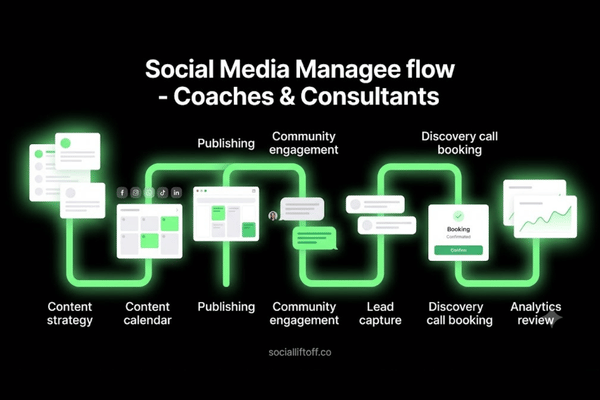
Social media management for coaches and consultants covers platform management, content planning, publishing, community replies, authority building, lead capture, analytics, and offer support — built around a personal brand that sells expertise, not services.
This guide covers strategy, platform selection, authority content, content calendars, lead funnels, discovery calls, analytics, tools, outsourcing, and ethics. It applies to life coaches, business coaches, career coaches, executive coaches, consultants, advisors, fractional executives, mentors, and consulting firms.
What is social media management for coaches and consultants?
Social media management for coaches and consultants is the ongoing process of planning, publishing, engaging, and reviewing content across platforms to build authority, attract clients, and drive sales conversations.
It includes platform management, content scheduling, community replies, lead capture systems, analytics reviews, and offer support. Done right, it connects every post back to a business outcome — a discovery call, a consultation request, or a retainer inquiry.
General social media management focuses on brand awareness. Expert social media management goes further. It builds personal trust, communicates client transformation, and moves buyers toward a sales conversation. A coach is not selling a product. They are selling belief in an outcome. Content must earn that belief before a buyer ever reaches out.
This applies to life coaches, business coaches, career coaches, and executive coaches, as well as solo consultants, advisors, fractional executives, and full consulting firms. Each type sells expertise differently — but all of them depend on trust before a buyer books a call.
How does it differ for coaches, consultants, and firms?
Social media management differs for coaches, consultants, and firms because each business type sells a different form of expertise. A solo coach sells personal transformation. A consultant sells results. A firm sells a team's methodology.
Solo coach
Content Voice: Personal, first-person
Lead Ownership: Owner
Approval Speed: Immediate
Offer Type: 1:1 or group program
Independent consultant
Content Voice: Professional, insight-led
Lead Ownership: Owner
Approval Speed: Immediate
Offer Type: Project or retainer
Fractional executive
Content Voice: Authority-driven, niche
Lead Ownership: Owner + firm
Approval Speed: Fast
Offer Type: Part-time executive role
Group coaching brand
Content Voice: Founder + team voice
Lead Ownership: Shared
Approval Speed: Review required
Offer Type: Cohorts, memberships
Consulting firm
Content Voice: Brand voice + expert POVs
Lead Ownership: Team
Approval Speed: Full approval flow
Offer Type: Retainer, engagement
Solo coaches and independent consultants move fast. They write, post, and respond without waiting for approval. Firms carry more risk — one wrong claim can affect a client relationship or a contract. Buyer cycle, proof type, and voice ownership shift with every business model.
Why does social media matter for expert authority?
Social media matters for expert authority because buyers judge trust before booking a call or requesting advice. A buyer who finds your profile, reads your posts, and sees client proof is already half-sold before the first conversation.
Key reasons social media builds expert authority are listed below.
Credibility signals — Published opinions and frameworks show buyers you have a real point of view, not just a service menu.
Repeated visibility — Showing up consistently tells buyers you are active and current.
Content depth — Long-form posts, carousels, and videos prove you understand the problem at a level buyers respect.
Buyer education — Posts that explain the problem help buyers self-qualify before they reach out.
Proof — Client wins and case studies show outcomes, not promises.
Referrals — Buyers share authority content with peers. One post can introduce you to a room you never entered.
Pre-sold conversations — A buyer who reads 20 of your posts arrives on a discovery call already trusting your thinking.
What goals should coach and consultant social media support?
Coach and consultant social media should support authority building, audience growth, lead generation, discovery calls, referrals, email list growth, and client retention. Each goal connects to a real business outcome. Content is not visibility alone — it is a system that moves buyers from stranger to signed client.
Discovery call bookings — Posts with direct CTAs that invite readers to book a 30-minute conversation
Consultation requests — Thought leadership that triggers inbound messages from qualified buyers
Lead magnet downloads — Free guides, checklists, or audits that capture email addresses
Webinar signups — Event-based content that moves buyers into a deeper education experience
Paid program inquiries — Offer posts and proof content that attract buyers ready to invest
Proposal requests — Consulting-focused content that signals high-ticket readiness
Retainer conversations — Authority posts that attract long-term clients who want ongoing access
Community nurture — Regular publishing that keeps past clients and warm contacts engaged
Each goal needs its own content type and CTA. Mixing them without a system means posts generate views but not revenue.
Which platforms work best for coaches and consultants?
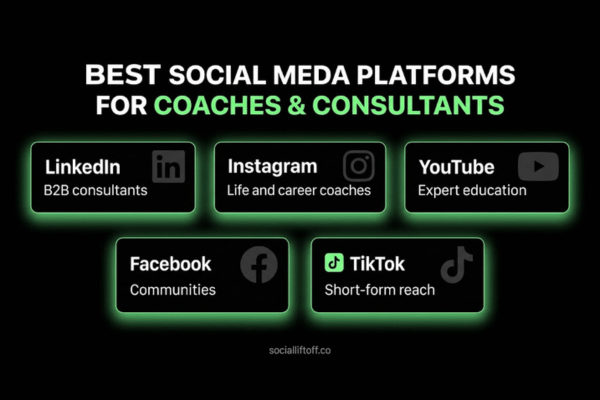
The best platforms for coaches and consultants are LinkedIn, Instagram, YouTube, Facebook, and TikTok. Platform choice depends on offer type, audience, trust stage, sales cycle, and content format.
The best social media platforms for coaches and consultants are compared below.
Best For: Consultants, B2B coaches
Content Format: Text posts, articles, carousels
Sales Cycle: Long, usually weeks to months
Trust Level: High
Instagram
Best For: Life, mindset, and career coaches
Content Format: Reels, Stories, carousels
Sales Cycle: Medium, usually days to weeks
Trust Level: Medium-high
YouTube
Best For: All expert types
Content Format: Long-form video, tutorials
Sales Cycle: Long
Trust Level: Very high
Facebook
Best For: Group coaches and communities
Content Format: Group posts, live sessions
Sales Cycle: Medium
Trust Level: Medium
TikTok
Best For: Younger audiences and broad reach
Content Format: Short video
Sales Cycle: Short to medium
Trust Level: Low-medium
No single platform fits every expert. A B2B consultant closing $20,000 retainers needs LinkedIn. A life coach selling a $500 group program needs Instagram. Match the platform to the buyer, not to personal preference.
How should LinkedIn support consulting leads?
LinkedIn should support consulting leads through thought leadership posts, authority articles, a clear profile headline, strategic comments, direct messages, and referral relationships.
LinkedIn's user base includes over 1 billion professionals [site: LinkedIn, 2024]. Founders, executives, HR leaders, SaaS teams, and agency owners make buying decisions there every day. B2B consultants and coaches who post consistently are the ones who appear when those buyers start looking.
Optimize the profile headline — State exactly who you help and what outcome you produce.
Post thought leadership 3–5 times per week — Share frameworks, diagnoses, and industry opinions.
Comment on target accounts — Add real insight to posts from ideal clients.
Use DMs for warm outreach — Respond to post engagement with a genuine follow-up message.
Publish long-form articles — Show depth on topics your buyers care about most.
Build referral relationships — Connect with complementary experts who serve the same buyer.
Tag clients and partners carefully — Social proof through association builds credibility fast.
How should Instagram support coaching trust?
Instagram should support coaching trust through personal brand content, Reels, Stories, carousels, client wins, and behind-the-scenes posts that show who the coach is — not just what they sell.
Instagram works well for life coaches, fitness coaches, mindset coaches, career coaches, and business coaches selling transformation-based programs. The platform rewards personality and consistency over polished production.
Example: A career coach posts a 30-second Reel sharing "3 signs you're undervalued at work." It reaches 12,000 people. Three DM her about her coaching program. One books a discovery call and signs up that week.
Reels reach cold audiences. Stories build daily connection with warm followers. Carousels teach and get saved for later. Client win posts show proof without selling. Each format does a different job in the trust-building process. The best Instagram accounts for coaching use all four consistently, not randomly.
How should YouTube support expert education?
YouTube should support expert education through long-form teaching videos, search-led content, webinar recordings, case studies, and tutorials that prepare buyers before a sales call.
YouTube is the world's second-largest search engine, with over 2.7 billion logged-in monthly users [site: Google/YouTube, 2024]. Consultants and coaches who publish there get found by buyers actively searching for answers — not scrolling passively.
Example: A business consultant records a 12-minute video titled "How to fix a broken sales process in 30 days." A founder searches that exact phrase, watches the video, and books a strategy call the same day.
Video SEO matters here. Use the client's exact question as the video title. Add timestamps. Include a lead magnet link in the first line of the description. A buyer who watches 10 minutes of your teaching is pre-sold on your thinking before they ever message you.
How should Facebook communities support warm leads?
Facebook communities should support warm leads by giving coaches and consultants a space to teach, answer questions, and build trust with people already interested in their topic.
Facebook Groups work best for group coaching programs, memberships, and challenge-based offers. Every member opted in, which makes this a warmer room than any cold social feed.
Community nurture tactics that work:
Weekly live teaching sessions — 20–30 minute video lessons inside the group
Pinned welcome post — A clear statement of group purpose and rules for new members
Weekly question prompts — Invite members to share problems you can publicly address
Soft offer mentions — Reference paid programs only after delivering consistent free value
Member spotlights — Celebrate client wins to build social proof inside the group
Challenge content — 5 or 7-day challenges that drive daily engagement and soft conversions
A well-run Facebook Group becomes a warm lead pool. Members trust you before they ever book a call.
What should a coach's or consultant's social media strategy include?
A coach's or consultant's social media strategy should include audience definition, offer positioning, platform selection, content pillars, a content calendar, a lead path, analytics reviews, and an ethics check.
Strategy is not a posting schedule. It is a connected system where every piece of content serves a business outcome. Without strategy, coaches and consultants post inconsistently, attract the wrong audience, and wonder why social media does not convert into consulting leads.
A complete strategy covers: niche and ideal client, authority message, service offers, lead magnets, posting cadence, CTAs, discovery call flow, testimonial use, and confidentiality rules. It also requires an honest audit of what the expert can realistically publish — quality beats frequency every time.
Strategy checklist:
[ ] Ideal client profile defined
[ ] Offer and outcome clearly stated
[ ] Primary platform selected
[ ] Content pillars chosen (3–5 topics)
[ ] Weekly publishing plan confirmed
[ ] Lead magnet or free offer ready
[ ] CTA on every post
[ ] Booking link active
[ ] Analytics review scheduled monthly
[ ] Client privacy rules documented
How do you define "audience" and "offer position"?
Coaches and consultants define audience and offer position by choosing who they help, what problem they solve, and what outcome they sell.
Vague positioning kills conversions. "I help people grow" is not a position. "I help SaaS founders close their first $1M in ARR through outbound sales coaching" is a position. Buyers self-qualify instantly when they read something that specific.
Ideal client
Question to Answer: Who do I serve best?
Example: Mid-level HR managers at tech companies
Niche
Question to Answer: What specific problem do I solve?
Example: Reducing employee turnover
Offer promise
Question to Answer: What outcome do I produce?
Example: 30% retention improvement in 90 days
Buyer readiness
Question to Answer: Are they aware of the problem?
Example: Yes — they actively search for solutions
Price level
Question to Answer: What can they invest?
Example: $5,000–$15,000 retainer
Service model
Question to Answer: How do I deliver?
Example: Monthly retainer + async support
Get the ICP (ideal client profile — the exact type of person most likely to buy) right first. Platform, content, and CTA all follow from that decision.
What content pillars work for expert businesses?
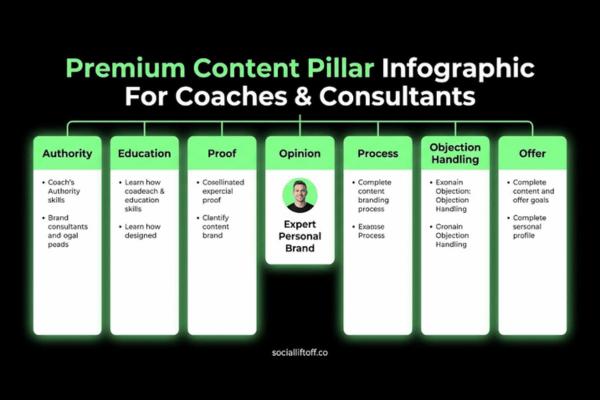
The best content pillars for expert businesses are authority, education, proof, opinion, process, objection handling, and offer content.
Each pillar targets a different buyer stage. A cold follower needs education. A warm follower needs proof. A ready buyer needs a clear offer. Rotating all seven pillars ensures the content library serves buyers at every point in the decision.
Coach and consultant content pillars are listed below.
Authority — Share frameworks, diagnoses, and original thinking to signal expertise to new audiences
Education — Teach one actionable concept per post to help buyers understand their problem better
Proof — Post client wins, case studies, and testimonials to show real outcomes from your work
Opinion — Take a clear stance on an industry belief to attract buyers who share your worldview
Process — Walk through how you work to reduce uncertainty and pre-answer "what does working with you look like?"
Objection handling — Address the top reasons buyers hesitate — price, timing, fit, and skepticism
Offer — State clearly what you sell, who it is for, and how to get started
How should coaches and consultants plan a content calendar?
Coaches and consultants should plan a content calendar by mapping weekly posts to authority, education, proof, objections, and offers — with launch dates and discovery call targets anchoring the entire schedule.
A content calendar is not a list of post ideas. It is a publishing plan tied to business outcomes.
Start with business dates — Mark launch dates, webinar dates, and coaching lead targets before writing a single post
Assign weekly pillars — Monday: authority. Wednesday: education. Friday: proof or offer
Add lead magnet promotion — Schedule at least 2 posts per month driving to a free resource
Plan case study posts — One detailed client story per month builds proof consistently
Build in repurposing slots — One long-form piece should feed 3–5 shorter posts
Review and adjust monthly — Track what drove DMs, bookings, and saves — repeat those formats
How often should coaches and consultants post?
Coaches and consultants should post often enough to stay visible without weakening content quality or expert positioning.
More posts do not mean more clients. A consultant posting twice a week with strong opinions outperforms one posting daily with surface-level tips. Content quality signals expertise. Frequency alone signals effort.
Recommended Cadence: 3–5x per week
Format Notes: Text posts + 1 carousel per week
Instagram Feed
Recommended Cadence: 4–5x per week
Format Notes: Mix of Reels, carousels, and single images
Instagram Stories
Recommended Cadence: 5–7x per week
Format Notes: Daily connection, polls, and behind-the-scenes
YouTube
Recommended Cadence: 1–2x per week
Format Notes: Long-form videos, usually 8–15 minutes
Facebook Group
Recommended Cadence: 3–5x per week
Format Notes: Questions, live sessions, and announcements
TikTok / Shorts
Recommended Cadence: 3–5x per week
Format Notes: 30–90 second clips
High-ticket consultants with long sales cycles can post less often. Three posts per week on LinkedIn with real depth beats seven posts with noise. Adjust cadence based on offer price, team size, and content quality available.
What content works best for coaches and consultants?
The best content for coaches and consultants includes thought leadership posts, educational content, case studies, testimonials, personal stories, objection posts, and direct offer content.
Each type targets a different stage of buyer awareness. Cold audiences need education. Warm audiences need proof. Ready buyers need a clear offer with a simple next step.
High-performing content types for coaches and consultants are compared below.
Thought leadership
Buyer Stage: Cold and warm
Primary Goal: Build credibility
Best Platform: LinkedIn, X
Educational post
Buyer Stage: Cold
Primary Goal: Teach and attract
Best Platform: All platforms
Case study
Buyer Stage: Warm
Primary Goal: Show outcomes
Best Platform: LinkedIn, Instagram, YouTube
Testimonial
Buyer Stage: Warm + hot
Primary Goal: Remove doubt
Best Platform: Instagram, LinkedIn
Personal story
Buyer Stage: Cold + warm
Primary Goal: Build connection
Best Platform: Instagram, Facebook
Objection post
Buyer Stage: Warm + hot
Primary Goal: Reduce hesitation
Best Platform: LinkedIn, Instagram
Offer content
Buyer Stage: Hot
Primary Goal: Drive action
Best Platform: All platforms
The mix matters. A feed of only offer posts trains followers to scroll past. A feed of only education never converts. Rotate the pillars. Track what drives DMs and bookings. Double down on what works.
How does thought leadership build demand?
Thought leadership builds demand by showing how the expert thinks, diagnoses problems, and challenges common beliefs — before a buyer ever asks for help.
Buyers hire experts whose thinking they already trust. A post that reframes a problem — "Your sales process isn't broken. Your qualification is." — does more selling than any promotional caption. It shows diagnostic ability. That is what high-ticket buyers are paying for.
Example: A leadership consultant posts, "Most companies fix their managers. The ones who grow fastest fix the culture managers operate in." That post attracts 47 comments from founders. Three send DMs asking about her advisory work.
Point of view, industry insight, and contrarian takes attract executive buyers who respect confidence. POV content is the rarest and most valuable asset a coach or consultant can share publicly. Post it regularly.
How do case studies and testimonials build trust?
Case studies and testimonials build trust by showing real problems, real processes, real outcomes, and real client experiences — with permission from the people involved.
A case study without a measurable result is just a story. Before-after context, a direct client quote, and a specific number turn a story into proof. Example: "Helped a founder go from 3 to 11 clients in 60 days through weekly 1:1 coaching and a revised outreach script."
Trust signals to include in every case study or testimonial:
The client's starting problem (anonymized if needed)
The process used
A measurable outcome (revenue, time saved, percentage change)
A direct client quote with written consent
A note if the result is atypical
FTC guidelines require that testimonials reflect typical results — or clearly disclose when they do not [site: FTC Endorsement Guides, 2023]. Never publish client details without consent.
How do educational posts answer buyer objections?
Educational posts answer buyer objections by explaining risks, costs, process, fit, timing, and expected outcomes before a buyer reaches out — making the sales conversation shorter and more direct.
A buyer who already understands how you work, what it costs, and what results to expect does not need to be sold. Pre-education through content removes friction from the discovery call.
FAQ posts — Answer the top 5 questions buyers ask before hiring you
Myth-busting posts — Challenge false beliefs that prevent buyers from taking action
Mistake posts — Show common errors your ideal clients make and how to fix them
Framework posts — Introduce a simple model that explains your entire approach
Checklist posts — Give buyers a way to self-assess readiness or diagnose their own problem
Pricing context posts — Explain what affects cost without requiring exact numbers
Readiness signs — Tell buyers exactly who is and is not a good fit for your offer
How do short videos make expertise easier to trust?
Short videos make expertise easier to trust by showing voice, clarity, confidence, and teaching style in 60 seconds or less.
Text posts show thinking. Videos show the person behind the thinking. A buyer who has watched 10 of your Reels has already formed an opinion about your credibility, energy, and style. That is a trust gap text alone rarely closes.
Recommended Video: Search YouTube for "how to create short expert videos for coaches and consultants" to watch a visual guide.
Talking-head tip
Length: 30–60 sec
Platform: Reels, Shorts, TikTok
Purpose: Quick authority signal
Mini-lesson
Length: 60–90 sec
Platform: Reels, TikTok
Purpose: Teach one concept
Whiteboard breakdown
Length: 2–4 min
Platform: YouTube, LinkedIn
Purpose: Explain a framework
Case study walkthrough
Length: 5–10 min
Platform: YouTube
Purpose: Show proof with depth
Q&A clip
Length: 30–60 sec
Platform: Stories, TikTok
Purpose: Answer common objections
Start with talking-head videos. A phone and good light are all the equipment needed. Add captions — 85% of social media videos are watched without sound [site: Verizon Media, 2023].
How does social media turn expert trust into clients?
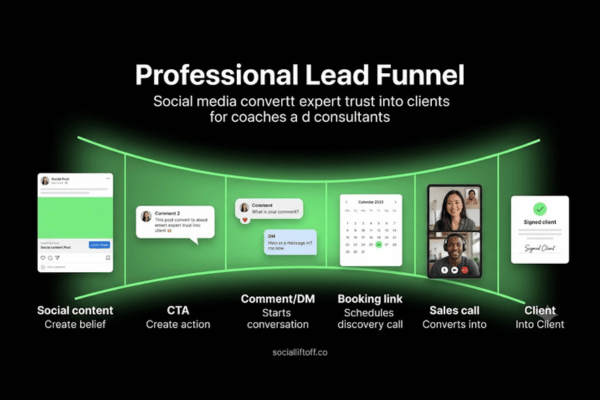
Social media turns expert trust into clients when content creates belief, invites action, and routes every inquiry into a follow-up system.
Trust without a system produces compliments, not clients. A post with 200 likes and zero booked calls is a visibility win, not a business win. The gap between trust and revenue is almost always a missing lead path — no CTA, no booking link, no DM follow-up process.
The flow looks like this: content creates belief → CTA creates action → comment or DM opens a conversation → booking link routes the buyer to a call → call converts to a client. Every stage must be intentional. Lead magnets, comments, DMs, booking pages, calendar links, email nurture, sales calls, proposals, and onboarding tools each play a role. Remove one and the funnel leaks.
How should comments and DMs become discovery calls?
Comments and DMs should become discovery calls through saved replies, qualification questions, calendar links, CRM tags, and follow-up tasks — built into a repeatable workflow.
Without a system, hot leads go cold in 24 hours. A DM response that takes 3 days loses the buyer. Speed and clarity win the conversion.
Post with a comment prompt — "Comment 'audit' and I'll send you the link"
Reply to every comment — Short replies keep conversations open
Move to DM — "Sent you a DM with the details" signals personal attention
Send one qualifying question — "What's your biggest challenge with X right now?"
Assess fit — If the answer matches your offer, send the booking link directly
Confirm the call — Include the calendar link and a one-line expectation setter
Follow up once — If they do not book within 48 hours, one more message with no pressure
What CTAs work for coaches and consultants?
CTAs work for coaches and consultants when they match the buyer's awareness level and offer type.
A cold follower who just found your profile needs a low-friction ask — download a guide, follow for tips. A warm follower who has read 20 posts is ready for a booking link. Mismatched CTAs kill conversions. Asking a cold reader to book a $5,000 strategy session on the first post is the most common mistake in coach marketing.
Cold
Best CTA: Lead magnet download
Example: "Get the free checklist — link in bio"
Warming
Best CTA: Webinar or free training
Example: "Join the free masterclass — link below"
Warm
Best CTA: Audit or strategy session
Example: "Book a free 20-min audit — DM me 'audit'"
Hot
Best CTA: Discovery call
Example: "Apply for a discovery call — link in bio"
Existing audience
Best CTA: Referral or retainer conversation
Example: "Know someone who needs this? Tag them below"
CTA rule
Use one CTA per post
Two CTAs create confusion
Every post must end with one clear next step
How should experts measure lead quality?
Experts should measure lead quality by tracking source, fit, intent, booking rate, show rate, sales call quality, and client value — not follower count or post likes.
Vanity metrics do not pay invoices. A post with 500 likes and zero DMs produced nothing. A post with 12 likes and 3 booked calls produced revenue. Track what actually moves the business.
Source tracking — Which platform and post type drove the inquiry?
Fit score — Does the lead match your ideal client profile?
Intent signal — Did they reach out or did you outreach first?
Booking rate — What percentage of DM conversations become booked calls?
Show rate — What percentage of booked calls actually show up?
Proposal rate — What percentage of calls lead to a sent proposal?
Close rate — What percentage of proposals convert to paid clients?
Client value — What is the average revenue per client by source?
Review these monthly. If booking rate drops, the CTA is broken. If show rate drops, the pre-call nurture is broken.
How should teams manage coach and consultant social media?
Teams should manage coach and consultant social media with shared voice rules, content systems, approval workflows, proof libraries, and clear lead ownership rules. This is the bridge from personal expert strategy to an operational content system.
Solo experts move on instinct. Teams need documented rules. A ghostwriter who does not know the founder's approved opinions publishes content that weakens the brand. A virtual assistant who responds to DMs without a script loses warm leads or creates compliance risk.
Coaching brands, consulting firms, group programs, and scaling advisors all face this challenge. Content teams, assistants, ghostwriters, and approval reviewers each need defined roles — and none of them should publish content involving client proof, income claims, or sensitive opinions without a review layer.
How can expert brands keep voice consistent?
Expert brands keep voice consistent by using documented message rules, tone examples, approved opinions, offer language, and a founder review process before any post is published.
A brand voice guide is the most underbuilt asset in most expert businesses. Without it, every ghostwriter defaults to their own voice — which is rarely the expert's.
Write a phrase bank — 20–30 phrases the expert uses naturally in real conversation
Document approved opinions — A list of POVs the brand holds publicly
List banned phrases — Words, tones, or positions the brand never uses
Create tone examples — One strong post and one weak post side by side with notes
Add offer language templates — Exact wording for every offer, CTA, and DM script
Build a POV bank — 10–15 strong opinions the expert can post without further review
Set a review cadence — The expert reviews a batch of posts weekly before scheduling
What approval workflow protects claims and client privacy?
An approval workflow protects claims and client privacy by reviewing testimonials, case studies, income claims, client details, and offer promises before they are published publicly.
Publishing without review creates legal and reputational risk. One unverified income claim or one identifiable client detail can damage a consulting career built over years.
Collect written consent for all testimonials and client stories before writing them
Anonymize by default — remove names, company names, and revenue figures unless explicitly permitted
Keep screenshots as evidence on file — proof stays internal, not just in the post
Add result disclaimers where outcomes are exceptional or not typical
Check confidentiality clauses in all active client contracts before mentioning any project
Apply FTC review to all sponsored content, affiliate mentions, and paid partnerships
Run an ICF-style ethics check for life coaching content referencing mental health or sensitive life events [site: ICF Code of Ethics, 2023]
How can one idea become content across platforms?
One idea can become content across platforms by changing the format, hook, length, and CTA for each channel — without rewriting the core message from scratch.
Repurposing is not copy-pasting. A LinkedIn post and an Instagram Reel on the same idea should feel native to each platform — different audience, format, and energy.
Webinar recording
Platform Adaptation: YouTube
Format: Full video
CTA Change: Subscribe + free resource link
Webinar clip
Platform Adaptation: LinkedIn
Format: 2-minute native video
CTA Change: Book a call / connect
Key insight from webinar
Platform Adaptation: Instagram Reel
Format: 45-sec talking head
CTA Change: Follow + DM for more
Framework from webinar
Platform Adaptation: Instagram Carousel
Format: 6-slide visual
CTA Change: Save this + link in bio
Insight summary
Platform Adaptation: LinkedIn text post
Format: 150–200 words
CTA Change: Comment for more
Email newsletter
Platform Adaptation: Facebook Group
Format: Short post + question
CTA Change: Comment your answer
Podcast soundbite
Platform Adaptation: TikTok / Shorts
Format: 30–45 sec clip
CTA Change: Follow for more
One hour of webinar content can produce 8–12 pieces of platform-native content. That is the most time-efficient content system available to expert businesses.
What tools support social media management for experts?
Tools that support social media management for experts include scheduling, design, analytics, CRM, booking, AI writing, email, and project management platforms.
No single tool does everything. Experts need a lean stack — one tool per job. Too many tools create more admin than content.
Scheduling
Top Options: Buffer, Later, Hootsuite, Meta Business Suite
Best For: Batching and publishing post
Design
Top Options: Canva, Adobe Express
Best For: Graphics, carousels, and cover images
Analytics
Top Options: Native insights, Google Analytics, Sprout Social
Best For: Tracking reach, clicks, and leads
CRM
Top Options: HubSpot free tier, Notion, Airtable
Best For: Managing leads and follow-ups
Booking
Top Options: Calendly, TidyCal, Acuity
Best For: Discovery call and consultation links
Email
Top Options: ConvertKit, Mailchimp, ActiveCampaign
Best For: Lead magnet delivery and nurture
AI writing
Top Options: Claude, ChatGPT
Best For: Drafting, repurposing, and captions
Project management
Top Options: Notion, Trello, Asana
Best For: Content calendar and team workflows
Start with scheduling + design + booking. Those three cover 80% of the operational work. Add CRM and email when lead volume justifies the investment.
Which scheduling and design tools help solo experts?
Scheduling and design tools help solo experts plan posts in advance, maintain visual consistency, and reduce the daily pressure of creating content without a team.
Canva is the most widely used design tool among solo coaches and consultants. It offers branded templates for carousels, quote graphics, and Reel covers that match brand colors and fonts in minutes. Buffer and Later both offer free tiers that schedule across LinkedIn, Instagram, and Facebook without a paid subscription.
Canva
Free Tier: Yes, generous
Best Feature: Branded templates
Best For: All visual content
Buffer
Free Tier: Yes, 3 channels
Best Feature: Simple queue scheduling
Best For: LinkedIn + Instagram
Later
Free Tier: Yes, 1 profile/platform
Best Feature: Visual grid planner
Best For: Instagram planning
Hootsuite
Free Tier: No, trial only
Best Feature: Full analytics + team features
Best For: Teams and firms
Meta Business Suite
Free Tier: Yes, Meta only
Best Feature: Native Reels + Stories scheduling
Best For: Facebook + Instagram
Notion
Free Tier: Yes
Best Feature: Content calendar + CRM lite
Best For: Planning + organization
Solo experts working alone should start with Canva + Buffer or Later. It costs nothing and handles the core workflow until revenue justifies upgrading.
How can AI support expert content creation?
AI can support expert content creation by drafting hooks, organizing ideas, repurposing long-form content, and simplifying complex expertise into clear, readable posts.
AI does not replace the expert's thinking. It speeds up the execution of ideas the expert already has. The risk is publishing AI-drafted content without checking it for voice accuracy, false claims, client confidentiality, and professional tone.
AI use cases for coaches and consultants:
Hook drafting — Generate 10 opening line options for a single post idea
Repurposing — Turn a webinar transcript into 5 LinkedIn post drafts
Caption variations — Rewrite the same message in 3 tones for split testing
FAQ generation — Produce buyer objection lists from a brief description of your offer
Email sequences — Draft lead magnet delivery and nurture email flows
Always review AI output for accuracy before publishing. Remove any claim that cannot be verified. Check that no client detail, contract detail, or confidential business information appears in a prompt before sending it to any AI tool.
What tools connect social media with sales calls?
Social media and sales call tools connect content engagement to booked calls, pre-call reminders, email nurture sequences, proposals, and client onboarding — making the entire path from post to signed client visible and trackable.
Calendly or TidyCal — Booking link placed in bio, DMs, and post CTAs; auto-sends confirmations and reminders
HubSpot free CRM — Tags every lead by source platform, tracks conversation history, flags follow-up tasks
ConvertKit or Mailchimp — Delivers lead magnets and runs email sequences after a social opt-in
Typeform or Google Forms — Pre-call questionnaire that qualifies the lead before the call happens
PandaDoc or Proposify — Sends proposals with e-signature directly after the discovery call
Zoom or Google Meet — Call platform with recording for review and content repurposing (with client permission)
Should coaches and consultants DIY or outsource?
Coaches and consultants should choose DIY or outsourced social media based on time, skill, offer price, sales goals, content volume, and brand risk.
There is no universal answer. A new coach with a $500 offer and no team should DIY everything. A consultant billing $20,000 per month who cannot find time to post loses money every week social media goes quiet. The decision is financial, not just operational.
Owner-led DIY
Best For: Early stage, low budget
Risk: Time drain
Monthly Cost Range: Tool costs only
VA-assisted
Best For: Growing brand, consistent posting
Risk: Voice drift
Monthly Cost Range: $500–$1,500
Ghostwriter
Best For: High-ticket expert with ideas, no time
Risk: Voice inconsistency
Monthly Cost Range: $1,000–$4,000
Freelancer
Best For: Specific tasks, such as design or editing
Risk: Inconsistency
Monthly Cost Range: $500–$2,000
Agency
Best For: Full management and firm-level brands
Risk: Cost and brand control
Monthly Cost Range: $3,000–$8,000
Managed service
Best For: End-to-end expert social management
Risk: Dependence
Monthly Cost Range: $1,500–$5,000
Match the model to the current revenue stage. Outsourcing before revenue is established creates cost without a return.
When does DIY social media work?
DIY social media works when the expert has clear ideas, limited budget, a simple offer, and enough time to publish at least 3–4 times per week without breaking content quality.
New coaches and solo consultants benefit most from doing it themselves early on. Direct audience feedback is the most valuable asset at the start. When the expert writes and posts personally, they learn which messages resonate, which CTAs drive DMs, and which audiences respond. No agency can learn that faster.
DIY works when:
[ ] Budget is below $2,000/month for marketing
[ ] The offer is simple enough to explain in one post
[ ] The expert can commit 5–10 hours per week to content creation
[ ] Audience size is under 5,000 followers
[ ] The expert has not yet identified which content consistently drives consulting leads
When should experts hire social media help?
Experts should hire social media help when consistency, content quality, sales support, repurposing, analytics, or brand voice management becomes too difficult to maintain alongside client work.
Hiring too early wastes money. Hiring too late costs revenue. The right moment is when the expert has proof that social media drives leads — and simply cannot keep up with the content volume needed to sustain that.
Content volume exceeds one person's capacity — 5+ platforms, daily posting, video editing, plus active client work
High-ticket offers require a polished brand — $10,000+ programs need professional-looking content consistently
Launches and webinars need content surges — 2–4 weeks of intensive publishing that exceeds daily capacity
Repurposing never happens — Long-form content sits unused because no one has time to break it into shorter posts
Analytics are not being reviewed — Without data, no one knows what is actually generating coaching leads
How much does expert social media management cost?
Expert social media management cost depends on platforms, posting volume, ghostwriting depth, video editing, strategy involvement, community management, and reporting requirements.
DIY costs $50–$300 per month in tool subscriptions alone (Canva, Buffer, Calendly). Hiring a freelancer for captions and scheduling adds $500–$2,000 per month. A ghostwriter who writes in the expert's voice costs $1,000–$4,000 per month. A full-service agency managing strategy, content, and community runs $3,000–$8,000 per month [site: Clutch.co industry surveys, 2024].
DIY (tools only)
Who Provides It: Owner
Monthly Cost Range: $50–$300
VA (scheduling + posting)
Who Provides It: Virtual assistant
Monthly Cost Range: $500–$1,500
Freelancer (content + design)
Who Provides It: Freelancer
Monthly Cost Range: $500–$2,000
Ghostwriter (writing in voice)
Who Provides It: Specialist writer
Monthly Cost Range: $1,000–$4,000
Agency (strategy + execution)
Who Provides It: Marketing agency
Monthly Cost Range: $3,000–$8,000
Managed service (end-to-end)
Who Provides It: Expert-focused service
Monthly Cost Range: $1,500–$5,000
Paid ad budget sits on top of these costs. LinkedIn ads for B2B consultants average $5–$15 per click [site: WordStream, 2024]. Facebook ads for coaching offers average $1–$5 per click.
What ethics and compliance risks affect expert content?
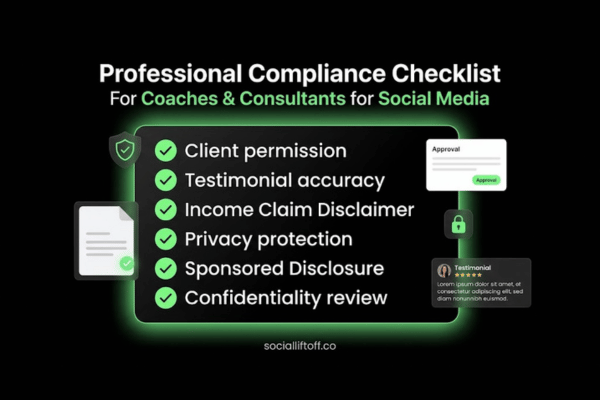
Ethics and compliance risks that affect expert content include client confidentiality, unverified testimonials, income claims, result claims, conflicts of interest, and undisclosed paid promotions.
These risks are not theoretical. The FTC has acted against influencers and coaches for undisclosed income claims. The ICF enforces ethics policies that govern how certified coaches use client information in public content. One post can end a client contract, trigger a regulatory review, or permanently damage the trust an expert spent years building.
Common risk areas for coach and consultant content:
Client confidentiality (sharing details without written permission)
Testimonial accuracy (publishing exceptional results without a disclaimer)
Income claims (posting screenshots without typical result disclosures)
Conflict of interest (recommending tools you earn affiliate income from without disclosure)
Paid promotions (endorsing sponsors without a clear #ad or #sponsored label)
ICF ethics violations (life coaching content that touches mental health without appropriate professional boundaries) [site: ICF Code of Ethics, 2023]
How should coaches protect client confidentiality?
Coaches should protect client confidentiality by getting clear written permission before sharing any client name, story, screenshot, outcome, or personal detail in any public content.
ICF ethics standards require coaches to maintain strict confidentiality — including in marketing content [site: ICF Code of Ethics, 2023]. Coaching agreements should include a specific clause about content use. Without it, using a client's story in a post — even a positive one — creates a legal and ethical exposure.
Sharing a client result
Do This: Anonymize name, company, and revenue number
Not This: Post full name, company, and exact revenue
Using a client quote
Do This: Get written consent and let them review the draft
Not This: Screenshot a DM and post it without asking
Sharing a transformation story
Do This: Use a composite story with details changed
Not This: Share a real story with identifying details intact
Referencing a group program win
Do This: Use "one of my clients" with no specifics
Not This: Tag the client without asking first
Posting a screenshot testimonial
Do This: Blur identifying info if not explicitly permitted
Not This: Post the original screenshot publicly
When in doubt, ask. Most clients are happy to share — they just need to be asked first.
How do FTC rules affect testimonials and income claims?
FTC rules affect testimonials and income claims by requiring honest results, clear disclosures, and evidence for any advertised outcome — including coaching results and consulting case study metrics.
The FTC updated its endorsement guidelines in 2023. Any testimonial showing an atypical result must include a clear disclosure such as "Results not typical" or "Individual results will vary." This applies to income screenshots, revenue growth claims, and any before-after metric used in paid or organic content [site: FTC Endorsement Guides, 2023].
Compliance checklist:
[ ] All sponsored posts labeled #ad or #sponsored
[ ] Affiliate links disclosed in the post — not buried in comments
[ ] Income screenshots include a "results not typical" disclaimer
[ ] Coaching outcome claims reference the conditions that produced the result
[ ] All endorsements reflect genuine experience — not manufactured reviews
[ ] Paid partnerships disclosed at the start of the content — not the end
How should consultants use client proof safely?
Consultants should use client proof safely by checking permission first, removing private business data, and explaining results accurately — without overstating what their work alone produced.
NDAs (non-disclosure agreements — legally binding contracts that restrict sharing client information) are common in consulting engagements. Before using any case study, revenue number, company name, or outcome metric in public content, the consultant must confirm the NDA does not prohibit it [site: American Bar Association, business contract guidance].
Decision flow for publishing any client case study:
Does an active NDA or confidentiality clause cover this client? → If yes, seek written permission or fully anonymize.
Does the case study include revenue, headcount, or proprietary IP data? → Remove or replace with ranges.
Has the client reviewed and approved the draft? → Do not publish until they have confirmed approval.
Does the result directly reflect the consultant's contribution? → If other factors were involved, say so clearly.
Is the client logo being used? → Confirm logo rights — most brand guidelines prohibit use without explicit approval.
Coach and Consultant Social Media FAQs
Coach and consultant social media FAQs answer the short questions experts ask before they start posting or consider hiring help. Each answer below is direct, self-contained, and actionable.
What should coaches and consultants post?
Coaches and consultants should post educational tips, thought leadership opinions, client proof, personal stories, objection-handling content, offer posts, and behind-the-scenes content.
Rotate across all seven content pillars to serve buyers at every awareness stage. Example: A business coach posts Monday: a framework for fixing pricing. Wednesday: a client case study. Friday: a direct CTA to book a discovery call. That three-post week covers education, proof, and offer in one clean rotation.
Which platform is best for expert leads?
The best platform for expert leads depends on the audience, offer price, content format, and sales cycle. LinkedIn produces the highest-quality B2B leads for consultants, executive coaches, and advisors. Instagram works best for life coaches, mindset coaches, and transformation-based programs with visual audiences. YouTube builds the deepest trust for complex, high-consideration offers. Choose based on where your buyer already spends time — not where you feel most comfortable.
Is social media worth it for consultants?
Yes, social media is worth it for consultants when it builds authority, starts sales conversations, supports referrals, and produces qualified discovery calls consistently. The return depends on niche clarity, content consistency, and a working lead funnel — not just posting volume. A consultant with a clear offer, a defined audience, and a CTA on every post can generate retainer inquiries from social media within 60–90 days of consistent publishing.
How long does social media management take to work?
Social media management can show early engagement within 2–4 weeks, but trusted authority and qualified calls need consistent publishing for 60–90 days minimum. The 90-day mark is the first honest benchmark — at that point, enough content exists to see what resonates, what drives DMs, and which posts generate coaching lead bookings. Review results at 30, 60, and 90 days. Adjust platform, pillar mix, and CTA before changing the offer or the niche.